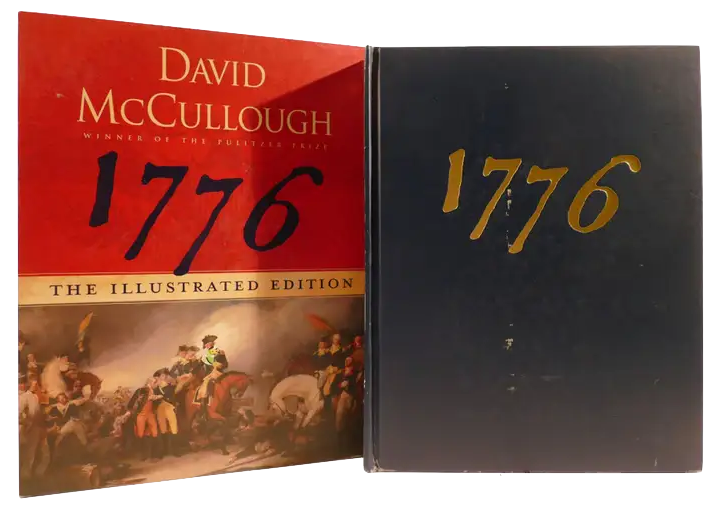
1776 Reading Guide and Discussion Questions
As part of the Utah Reads effort, this page contains a reading guide and discussion questions for the Declaration
of Independence and for McCullough's 1776 for use in book clubs, classrooms, or public reading activities, which can be adapted
by parents for use at home.
Discussion Questions for the Declaration of Independence
McCullough’s 1776 does not focus much on the Declaration of Independence, whose 250th anniversary we
are celebrating on July 4, 2026. However, the battles of 1776—which the book does focus on—brought Americans together, solidifying their determination to be a free
and self-governed people.
- What does the Declaration of Independence mean to you personally, and why do you think
it is still important today?
- In what ways has the nation lived up to—or fallen short of—the ideals of the Declaration?
- How has the interpretation and practical application of the Declaration's principles
evolved through significant periods of American history, such as the abolitionist
movement, the Civil Rights Movement, or the women's suffrage movement?
- How can we honor the 250th anniversary in a way that brings people together?
- If you could convey one message to future generations about the enduring importance
of the Declaration of Independence, what would that message be?
Discussion Questions for McCullough's 1776
- What was the most surprising fact you learned about the American soldiers in 1776
from this book?
- How did George Washington's leadership style change throughout 1776, and what challenges
shaped him? What does his leadership during the retreats and defeats reveal about
effective crisis management? If you were in his position, what do you imagine would
have been the most difficult decision to make?
- What role did ordinary citizens play in the Revolutionary War beyond just being soldiers?
- What do you think was the most important quality that helped the Americans survive
the year 1776? Why were the victories at Trenton and Princeton so important for American
morale?
- How did the British underestimate the American colonists, and what were the consequences?
- Why do you think McCullough chose to focus on 1776 specifically rather than the entire
war?
- What does the book reveal about the personal costs of war for both sides? How does
understanding the hardships and sacrifices of 1776 make you feel about the history
of our country? What moments in the book made you feel most proud or most worried
about the American cause?
- What does it mean to fight for freedom? Is that fight won only on the battlefield?
1776 Chapter-by-Chapter Reading Guide
This guide contains significant passages and their significance, related & shorter
“micro quotes,” & discussion prompts
Ch 1: “Sovereign Duty”(pp. 3–19) — Washington’s frank assessment & the precarious start
- Why read it: McCullough opens by putting Washington’s private anxiety on display — it’s a sober,
almost intimate passage that undoes heroic myth and shows how thin the margin for
survival is. (4–6 minutes to read aloud)
- Micro-quote/hook (p 1, epigraph line): “Few people know the predicament we are in.”
- Discussion prompt: How does hearing Washington’s private worry change your view of leadership under
pressure?
Ch 1: King George III (pp. 4–6)
- Why read it: Shows a sincerely duty-bound king, not cartoon villain.
- Micro-quote (p. 6): “America must be made to obey.” (Could read whole paragraph.)
- Discussion prompt: How does seeing the other side’s logic change our judgment?
Ch 2: “Rabble in Arms”(pp. 41–69) —Army’s condition (desertions, enlistments, supply woes)
- Why read it: This multi-page portrait is powerful: mud, illness, men leaving, officers who don’t
know what to do — it makes visceral the army’s unpreparedness and explains why the
cause looked close to failure. (5–8 minutes to read aloud)
- Discussion prompt: What practical differences separate a ragtag force from a professional army? Which
matters most, training or leadership?
Ch 2: Henry Knox / “Noble Train of Artillery”(pp. 58–70) —set-up & character sketch leading to the Ticonderoga to Boston expedition
- Why read it: McCullough’s portrait of Knox — a bookseller who becomes an artillery mastermind
— is character drama + logistics, showing how small, imaginative acts of grit produced
strategic leverage. (4–6 minutes to read aloud)
- Discussion prompt: Who are modern “Knoxes” in civic life—logistical problem-solvers who quietly change
outcomes?
Ch 3: Dorchester Heights: The night occupation & the British evacuation (pp. 97–112)—turning moment at Boston, the decisive night operation & the flight
- Why read it: Cinematic, suspenseful, and decisive: the Americans transform an impossible situation
into a strategic victory. The Siege of Boston ends with the Americans fortifying Dorchester
Heights. This marks the first major victory for the Continental Army and a pivotal
turning point in the American Revolution, the first time British troops are forced
from a major city. Readers will feel the shift from desperation to stunned relief.
( ~6–9 minutes to read aloud)
- Micro-quote (p. 105): “In no time small boys came running . . . to deliver the news that the ‘lobster
backs’ were gone at last.”
- Discussion prompt: How did deception, logistics, and timing combine to create a victory without a pitched
battle? When does caution become a risk? / The victory came with lessons in humility
and increased community pride from Washington. What lessons are given in leadership?
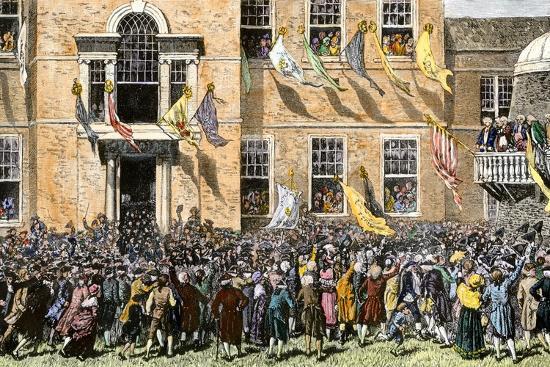
Ch 5: The Declaration of Independence read to the troops in New York(pp. 135–140) —(the July 9 reading & its effect)
- Micro-quote (p. 137): “At a stroke the Continental Congress had made the Glorious Cause of America
more glorious still, for all the world to know, and also to give every citizen soldier
at this critical juncture something still larger and more compelling for which to
fight.”
- Why read it: Washington orders the Declaration of Independence read to the troops. This civic-ritual
moment reframes soldiers’ purpose. ( ~3–5 minutes to read aloud)
- Discussion prompt: How do public rituals and readings turn private belief into collective action? What
words in the Declaration of Independence would have given you “something still larger
and more compelling for which to fight”?
Ch 5: Landing at Long Island and the collapse in the field(pp. 171–182) — August assault & rout
- Why read it: This is full combat drama — professional British troops overwhelm the Americans.
It’s essential for readers to understand how much Washington was out-manned and how
close the cause came to being crushed. (6–8 minutes to read aloud)
- Discussion prompt: When an army is outclassed, what options does a commander realistically have?
Ch 5: The midnight evacuation from Brooklyn(pp. 182–197) — the “vanish in the night” escape
- Why read it: Reads like a suspense/thriller: desperate, quiet, cold — yet brilliantly executed.
It’s a perfect moment to show competence and luck rescuing a bad situation. (6 minutes
to read aloud)
- Micro-quote: “That the rebel army had silently vanished in the night under their very noses was
almost inconceivable” (p. 191).
- Discussion prompt: Is an orderly withdrawal or skillful retreat a defeat or a form of strategic success?
courage? Why did Washington make the choices he did? What modern leaders have “won”
by withdrawing?
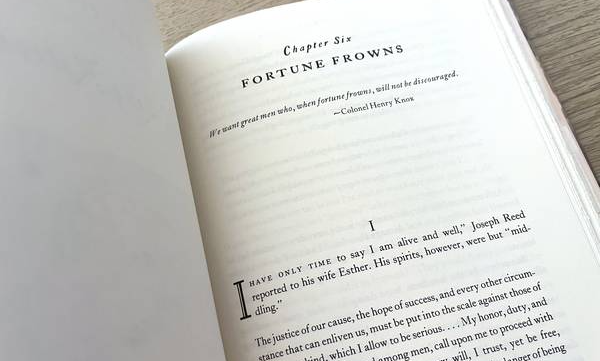
Ch 6: Fortune Frowns(pp. 207–216) — the Kips Bay panic & Washington’s furious reaction
- Why read it: Unvarnished depiction of fear and collapse under naval bombardment — McCullough doesn’t
spare the ugliness. It shows morale crack and a commander pushed to the edge.( 5–7 minutes to read aloud)
- Discussion prompt: How should commanders respond when troops break — discipline vs. compassion? How
do teams and their leaders deal with morale, training, and accountability?
Ch 6: Fall of Fort Washington & the near-collapse of the campaign(Section III, pp. 234–246) — The Fort Washington disaster and its consequences
- Why read it: One of the severe blows of 1776—thousands captured, morale shattered, Congress terrified.
A sober passage that dramatizes how close the Revolution came to unraveling. (5–8
minutes to read aloud)
- Micro-quote: “Washington is said to have wept as he watched the tragedy unfold from across the
river. . .” (p. 244).
- Discussion prompt: What do catastrophic defeats do to political will at home? Can victory be recovered
after such losses?
Ch 7: “Darkest Hour” → Paine’s The American Crisis, the Delaware crossing, & Trenton(pp. 247–294) — despair, the effect of Thomas Paine’s The American Crisis, & Trenton crossing & attack
- Why read it: This long, dramatic sequence contains the low point (desertion, sickness, near collapse),
Paine’s galvanizing words, the secretive crossing, and the Christmas-morning strike
that re-made Washington’s reputation. It’s the emotional apex for showing how tiny
actions can change a nation’s trajectory. (For a full dramatic arc, read the entire
chapter. If you need a 5–8 minute read, consider pp. 247–260 [despair] then pp. 272–284
[crossing and Trenton attack].)
- Micro-quotes: “These are the times that try men’s souls” (p. 251). / Washington’s password for
the Trenton attack: “Victory or death” (p. 273).
- Discussion prompt: How do words (Paine’s pamphlet) and action (crossing the Delaware) combine to restore
public courage?