Spreading & Celebrating the Declaration of Independence: Newspapers, Broadsides, & Public Readings
What was it like for Americans to be introduced to the Declaration of Independence?
Who heard and read it first and where?
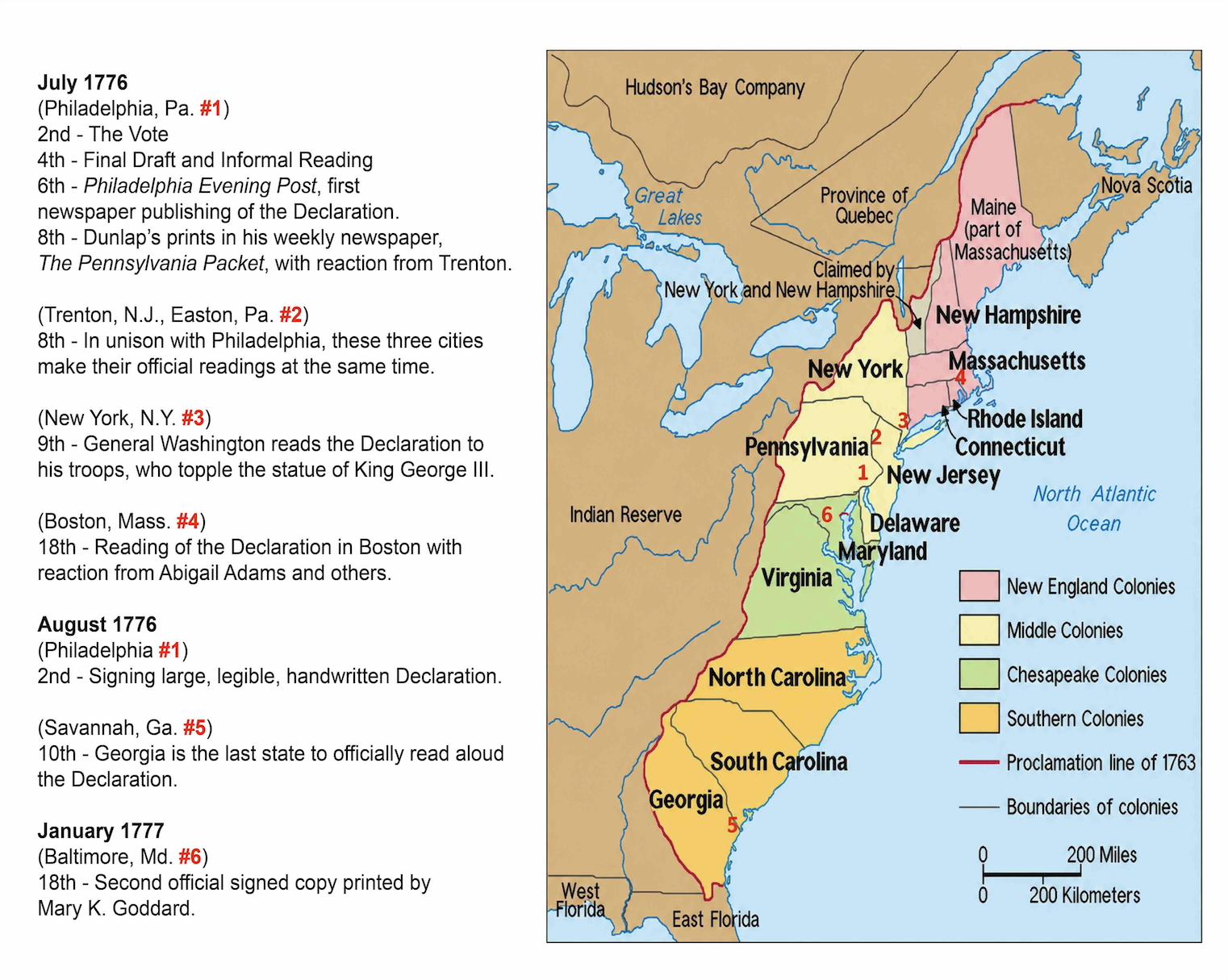
Check out this timeline of events:
Thursday, July 4 (Philadelphia)
Two days after the July 2 decision to formally break with Great Britain, the final draft of the Declaration of Independence was approved by the Second Continental Congress. (The vote on July 2 was the formal declaration of independence, while the document approved on July 4 explained why they were taking this step.)
After final changes, a clean printer’s copy was penned, likely by the Continental Congress Secretary Charles Thomson or his senior clerk, an established penman, Timothy Matlack. It was then signed by John Hancock, president of the Congress, and Charles Thomson, Congress secretary.
In keeping with its intention as a spoken declaration, Thomas Jefferson added diacritical marks to the copy as suggestions for speechmaking. (We know this because, although the printer’s copy has been lost, the first printing included some of the markings as if quotation marks. Jefferson later told the printer to remove them.)
Jefferson "was a diligent student of rhythm, accent, timing, and cadence in discourse. . . . There can be little doubt that . . . he consciously composed for the ear as well as for the eye—a trait that is nowhere better illustrated than in the eloquent cadences of the preamble in the Declaration of Independence."
However eloquent a writer, Jefferson was a poor orator and would not be the first to make a public reading of the document. With the printer’s copy in hand, the Declaration was carried from the State House building (now Independence Hall), likely by Matlack, a skillful orator with a stentorian voice. Many believe that it was he who read the Declaration to a small crowd of laborers and artisans gathered in the State House Yard (now Independence Square).
Described by Deborah Norris (14 at the time) as “not the most sober or reflecting” lot, this was likely the first public (though informal) reading, made on the way to the printing shop of John Dunlap, the publisher of The Pennsylvania Packet. If Norris is correct, the crowd followed the speaker to the Court House where he read the Declaration a second time.
Matlack, a merchant and brewer turned revolutionary, was a committed political and social radical. He kept regular company with people from the "poorer sorts” and reveled in the popular culture of the colony. If Matlack indeed gave these informal readings to a less “sober or reflecting” lot, he probably enjoyed himself!
Friday, July 5 (Philadelphia)
On the night of July 4–5, printer John Dunlap quickly ran off about 200 copies of the Declaration, in broadside form. Broadsides—large pieces of paper printed to be posted in public spaces—were a common way for spreading news.
The directive from Congress specified that copies were to be sent to "the several Assemblies, Conventions & Committees or Councils of Safety and to the several Commanding Officers of the Continental troops that it be proclaimed in each of the United States & at the head of the army." It should be shared "in such a mode, as that the people may be universally informed of it."
This was how many Philadelphians learned on July 5 of Congress’s declaration of independence: by reading what we now call the “Dunlap Broadsides.”
Saturday, July 6 (Philadelphia)
On July 6, the Pennsylvania Evening Post became the first newspaper to print the document. Published by Benjamin Towne, the paper was "issued every Tuesday, Thursday and Saturday evenings," and could be bought for the reasonable price of "only two coppers."
Monday, July 8 (Philadelphia and Easton, Pa.; Trenton, N.J.; and New York, N.Y.)
On July 8, Dunlap printed the full text of the Declaration again, this time in his own weekly newspaper, the Pennsylvania Packet.
Founded in 1771, the Packet “is considered a cornerstone of American journalism, reflecting the spirit of the times and contributing to the formation of public opinion in the young nation.”
From Philadelphia outward, news of the Declaration traveled at the speed of horse-borne riders to other cities, where it was soon reprinted in newspapers and local broadside editions. The relatively close cities of Philadelphia, Trenton, N.J., and Easton, Pa., decided to make their first official public readings—the country’s first official public readings—at 12 noon, simultaneously.
For Philadelphia and Easton, at least, July 8 was also Election Day. The formal public proclamation of the Declaration was read by Colonel John Nixon to a group of wealthy merchants and lawyers in Philadelphia at the State House Yard (now Independence Square).
Thereafter and continuing long into the night, the bells of the city rang in celebration. Parades and volleys of musket fire occupied the American celebrants, and the King's arms were removed from the State House.
In Trenton, N.J., a participant’s observations were later printed in Dunlap’s Pennsylvania Packet: The declaration of Independence was this day proclaimed here . . . [and was] received with load [sic] acclamations. The people are now convinced of what we ought long since to have known, that our enemies have left us no middle way between perfect freedom and abject slavery. In the Field we hope, as well as in Council, the inhabitants of New Jersey will be found ever ready to support the Freedom and Independence of America.
And in Easton, PA, the Pennsylvania Evening Post, recorded this:
This day the DECLARATION of INDEPENDANCY was received here, and proclaimed in the following order: The Colonel and all other field officers of the first battalion repaired to the courthouse, the light infantry company marching there with drums beating, fifes playing, and the standard (the device for which is the thirteen United Colonies) which was ordered to be displayed, and after that the Declaration was read aloud to a great number of spectators, who gave their hearty assent with three loud huzzas, and cried out MAY GOD LONG PRESERVE and UNITE the FREE and INDEPENDANT STATES of AMERICA.
Such public proclamations were instructed to be disseminated by the Continental Congress. States were to have the Declaration read publicly to the citizens, as soon as possible after the copies arrived.
The historian Pauline Maier observed, "Public proclamation . . . was demanded both by the significance of the Declaration and by custom governing legal pronouncements."
Finally, on July 8, General George Washington received a letter from John Hancock, President of the Continental Congress, as well as the full text of the Declaration.
Hancock wrote: That our affairs take a more favorable turn, the Congress have judged it necessary a to dissolve the connection between Great Britain and the American colonies, and to declare them free and independence sates; as you will perceive by the enclosed Declaration, which I am directed to transmit to you, and to request you will have it proclaimed at the head of the army in the way you shall think most proper.
This momentous event would happen the very next day.
Tuesday, July 9 (New York, N.Y., and Baltimore, Md.)
In New York City, at six in the evening and on Washington’s orders, several brigades were marched to the Commons and other parade grounds where they heard the Declaration read aloud. The pronouncements were “every where received with loud huzzas, and the upmost demonstrations of joy.”
As David McCullough writes in 1776:
[F]rom this point on, the citizen-soldiers of Washington’s army were no longer to be fighting only for the defense of their country, or for their rightful liberties as freeborn Englishmen. . . . It was now a proudly proclaimed, all-out war for an independent America, a new America, and thus a new day of freedom and equality. . . . At a stroke the Continental Congress had made the Glorious Cause of America more glorious still, for all the world to know, and also to give every citizen soldier at this critical juncture something still larger and more compelling for which to fight. Washington saw it as a “fresh incentive,” and to his mind it had come not a moment too soon.
Shortly thereafter an energized crowd charged Bowling Green’s recently erected equestrian statue of King George III “which tory pride and folly raised.” Grabbing ropes and then pulling, the statue “was by the sons of freedom, laid prostrate in the dirt; the just desert of an ingrateful tyrant. The lead where with this monument was made, is to be run into bullets” (Newcastle Weekly Courant, July 11, 1776).
This toppling became a popular subject to mid-19th century, pre-Civil War artists. Elsewhere on July 9, the Declaration was printed in Baltimore and by a German paper in Philadelphia, the Pennsylvanischer Staatsbote.
Thursday, July 11–August 31 (New York, N.Y.; Annapolis, Md.; New London, Hartford, Norwich, and New Haven, Conn.; Exeter, N.H.; Salem and Worchester, Mass.; Savannah, Ga.; and others)
Despite the excitement of a public reading, the printed word continued to be the way many Americans first experienced the Declaration of Independence. They include newspapers in New York and Annapolis, Md. (July 11); New London, Hartford, and Norwich, Conn. (July 12 and 15); Exeter, N.H., and Salem, Mass. (July 16); and New Haven, Conn., and Worcester, Mass. (July 17).
It took longer, of course, for the Declaration to reach the colonies farther away. When it finally reached Savannah, Ga., for instance, and was read publicly on August 10, those gathered parodied the Church of England’s “Service for the Burial of the Dead” “for King George and the tyranny they thought he represented.”
By the end of August 1776, the Declaration had been reprinted in 29 newspapers and 14 broadsides (18 of those newspapers are quoted here).
Thursday, July 18 (Boston)
Massachusetts had been a hotbed of revolutionary fervor. Boston's Continental Journal printed the Declaration of Independence on July 18, also the day of its public reading there.
In a letter written by a notary and clerk Henry Alline, Jr., we read that “Yesterday the Declaration for Independency was Published [out] of the Balcony of the Town House” to the ringing of bells, firing of cannon, and hearty cheers of the town's population. He continues: “[I]n the Afternoon was tore down the Lion & the Unico[r]n [symbols of England and Scotland, respectively] upon the East End of the Court Town House & the Kings Arms taken down from the Council Chamber, Court House & other places & towards Evening all were Committed to the flames to the Satisfaction of every body but Tories. . . .”
Despite all this excitement, Alline puts these comments halfway down the second page of his letter. He had something more pressing to focus on: recovery from a smallpox inoculation.
Abigail Adams and her four children, who were also in Boston on the 18th, were recovering from the same thing. She had already apologized in an earlier letter for having “so much cares upon my Hands and Mind, with a bad inflammation in my Eyes [a symptom of small pox] that I have not been able to write.”
She opens her letter on July 21 with more references to how the family is healing from the inoculation. Also, halfway through the letter, she at last turns to the Declaration:
Last Thursday after hearing a very Good Sermon I went with the Multitude into Kings Street to hear the proclamation for independence read and proclaimed. Some Field peices with the Train were brought there, the troops appeard under Arms and all the inhabitants assembled there (the small pox prevented many thousand from the Country). When Col. Crafts read from the Belcona [balcony] of the State House the Proclamation, great attention was given to every word. As soon as he ended, the cry from the Belcona, was God Save our American States and then 3 cheers which rended the air, the Bells rang, the privateers fired, the forts and Batteries, the cannon were discharge, the platoons followed and every face appeard joyfull. After dinner the kings arms were taken down from the State House and every vestage of him from every place in which it appeard and burnt in Kings Street. Thus ends royall Authority in this State, and all the people shall say Amen.
Friday, July 19 (Philadelphia)
On July 19, the Continental Congress ordered that a more official, formal version of the Declaration of Independence be produced. This would be “fairly engrossed on parchment”—meaning it was to be painstakingly and ornately handwritten on animal skin—and signed by each delegate. The task was to be completed by Timothy Matlack, once again.
Friday, August 2 (Philadelphia)
Matlack completed the task of engrossing the Declaration by August 2. John Hancock, as President of the Congress, signed first—and big.
Other delegates signed, below the text and arranged by geographic location of the states they represented. New Hampshire, as the northernmost state, began the list, and Georgia ended it.
Eventually 56 delegates signed the document. However, they were never all in the same room at the same time as is depicted in John Trumbull's 1819 painting, Declaration of Independence. The painting does not represent a real ceremony but shows the five-man drafting committee of the Declaration presenting their work to the Second Continental Congress.
Saturday, August 10 (Savannah, Ga.)
The last state to have an official reading of the Declaration was Georgia on August 10, whose distance meant it had only arrived a few days earlier.
January 1777 (Baltimore, Md.)
On January 18, 1777, the Journals of the Continental Congress record the order: "That an authenticated copy of the Declaration of Independency, with the names of the members of Congress subscribing the same, be sent to each of the United States, and that they be desired to have the same put upon record."
The printer for this second authenticated printing of the Declaration was Mary Katharine Goddard, who completed the order within two weeks. At the time, Goddard was serving as Baltimore’s postmaster—first postmaster in Baltimore, first female postmaster in the colonies, and shortly thereafter the first female postmaster in the United States of America. She was also the editor of the Maryland Journal, Baltimore’s first newspaper, which had been started by her brother William a few years before.
When William's priorities shifted, Mary continued to print the paper under the androgynous name of “M.K. Goddard.” In the course of her work, she had editorialized against British brutality. She had also reprinted Thomas Paine’s Common Sense and had printed the Declaration of Independence on July 10, 1776.
On Christmas Day 1776, emboldened by Washington’s crossing of the Delaware and the victories at Trenton and Princeton, Congress decided to print the Declaration again. This time, the signers’ names were included in the document. This new version was specifically intended for preservation in each state’s archives.
At the bottom of the broadside, there is one more name, also committed to the cause. “Baltimore, in Maryland: Printed by Mary Katharine Goddard.” Not M.K. Goddard, but her full and female name.
Map Representing the Timeline of Public Readings of the Declaration
Suite 305, UVU Fulton Library
800 West University Parkway
Orem, UT 84058
(801) 863-5470

