

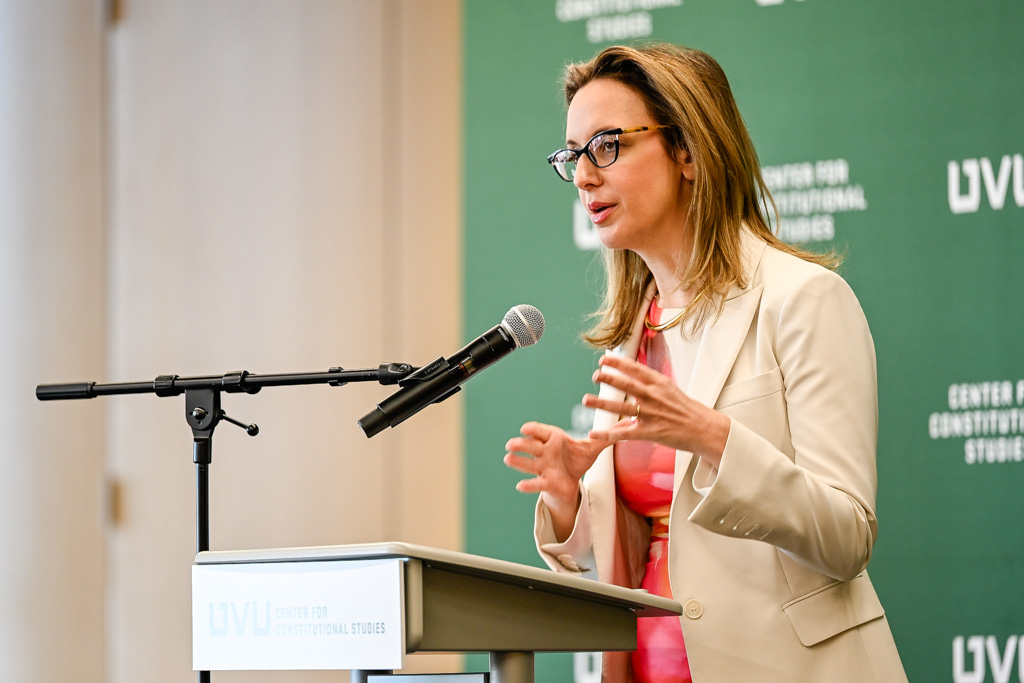
First Amendment Conference
See photos of the event.
Watch the sessions on YouTube.
Read Deseret News coverage of the conference.
The Center for Constitutional Studies hosted its annual First Amendment Conference March 25, 2026.
The theme of the conference was The Pen and the Sword: Free Press at the Founding.
Keynote speaker for the conference was Sarah Isgur, senior editor at The Dispatch and co-host of the Advisory Opinions podcast.
Conference Schedule
March 25, 2026
- 9:30 a.m. | CB 511 | Session 1 | Matthew Brogdon | Introduction: The Declaration and a Free Press
- 10 a.m. | CB 511 | Session 2 | Greg Jackson | "That rascal Freneau!": The Partisan Press and Free Speech in the Early Republic
- 11 a.m. | CB 511 | Session 3 | Sarah Isgur | The Place of a Free Press in America
- 12 noon | Lunch Break
- 2 p.m. | CB 511 | Session 4 | Carson Holloway and RonNell Andersen Jones | Libel and the New York Times v. Sullivan Decision | Moderated by Robert Gehrke
- 3 p.m. | CB 511 | Session 5 | Journalism Panel with Clay Calvert, Bill Grueskin, and Carson Holloway | Press Access, National Security, and the Federal Government | Moderated by Doug Wilks
Presenters and Panelists
- Sarah Isgur | Sarah Isgur is a senior editor at The Dispatch, contributor at SCOTUSblog, and co-host of Advisory Opinions, a podcast with David French. She has experience on three presidential campaigns and the three branches of the federal government and brings a unique perspective on the news of the day and an unparalleled knowledge of how decisions in Washington really get made. Ms. Isgur most recently served in the Department of Justice as director of the Office of Public Affairs and senior counsel to the Deputy Attorney General during the Russia investigation. She was backstage for more than a half dozen presidential debates as deputy campaign manager for Carly Fiorina’s presidential campaign. She is a graduate of Harvard Law School and Northwestern University and clerked for Judge Edith H. Jones of the United States Court of Appeals for the Fifth Circuit.
- Matthew Brogdon | Matthew Brogdon (Ph.D., political science, Baylor University) is the Larry H. & Gail Miller Chair and Director of the Center for Constitutional Studies at Utah Valley University. Dr. Brogdon teaches and writes on the ideas and practices that support constitutional government, ordered liberty, and the rule of law. His published scholarship deals with the creation and development of the federal courts, judicial federalism, the development of religious liberty in America, the politics of nullification and secession, and the critical importance of voluntary associations for the exercise of civil and religious liberty. Through the Center’s partnership with Oxford’s Quill Project, Dr. Brogdon works to make the tradition of constitutional statesmanship on display in American constitutional conventions accessible to jurists, scholars, teachers, and students. He serves on the Academic Council of the Jack Miller Center for the Teaching America’s Founding Principles & History.
- Greg Jackson | Professor Greg Jackson is best known as the creator, host, and head writer of the U.S. history podcast, History That Doesn't Suck. He's a regular on History Channel documentaries and makes appearances on other major history podcasts and radio. He also tours nationally with his live-stage show, The Unlikely Union. He is an associate professor at Utah Valley University, where he's a senior fellow in National Security Studies and a fellow in Integrated Studies. He earned his Ph.D. in History from the University of Utah as a Burton Scholar. He earned his M.A. in French Studies and B.A. in History from Brigham Young University.
- Carson Holloway | A visiting fellow at Utah Valley University and a Washington Fellow at The Claremont Institute’s Center for the American Way of Life. His research focuses on American constitutionalism and the liberal nationalism of the American Founding. He is the Ralph Wardle Diamond Professor of Arts and Sciences and Professor of Political Science at University of Nebraska, Omaha. He is co-editor, with Bradford P. Wilson, of the two-volume work The Political Writings of Alexander Hamilton (Cambridge University Press, 2017). He is also the author of Hamilton versus Jefferson in the Washington Administration: Completing the Founding or Betraying the Founding? (Cambridge University Press, 2015). His scholarly articles have appeared in the Review of Politics, Interpretation: A Journal of Political Philosophy, and Perspectives on Political Science, and he has written for The Wall Street Journal, First Things, The New Criterion, National Affairs, Law & Liberty, Public Discourse, The Federalist, and National Review.
- Clay Calvert | A nonresident senior Fellow at the American Enterprise Institute and professor emeritus at the University of Florida in Gainesville, where he held a joint appointment as professor of law at the Levin College of Law and as Brechner Eminent Scholar in Mass Communication in the College of Journalism and Communications. He has authored or co-authored more than 150 law-journal articles on freedom of expression-related topics and has published more than 130 columns for the American Enterprise Institute on First Amendment and media-law issues involving communications technologies. Calvert is lead author of the undergraduate textbook, Mass Media Law, 2026 Release (McGraw Hill 2026), and is the author of Voyeur Nation: Media, Privacy, and Peering in Modern Culture (Westview Press 2000).
-
Bill Grueskin | A professor of professional practice at Columbia University Graduate School of Journalism, he began his journalism career as a reporter and editor at the Daily American in Rome. He worked as a reporter and editor in Baltimore and Tampa before moving to The Miami Herald where he eventually became city editor. On his first day in that post, Hurricane Andrew hit Dade County, and the Herald’s coverage of the storm won the Pulitzer Gold Medal for public service. Grueskin joined The Wall Street Journal in 1995, editing Page One features and projects. In June 2001, he became managing editor of WSJ.com and oversaw the staff during and after the Sept. 11 attacks on the World Trade Center, next to WSJ’s offices. He came to Columbia in 2008 as academic dean. At the Columbia Journalism School, he oversaw a dramatic transformation of the curriculum, designed to give students more flexibility to focus on skills ranging from video to data visualization to long-form digital journalism.
- Robert Gehrke | Spending nearly 30 years as a reporter and columnist writing about Utah and the surrounding region, Robert Gehrke is a graduate from the University of Utah, he began working for The Associated Press in 1996 and moved to The AP’s Washington, D.C., bureau in 2001. He joined The Salt Lake Tribune in 2004 in D.C. before moving back to Utah in 2007. He has primarily covered government and politics in the West, including investigating the 2007 collapse of the Crandall Canyon Coal mine and corruption in the Utah Attorney General’s office from 2012–14. He spent six years as an opinion columnist before returning to the news side of the publication. He has two kids and two dogs and spends his free time outdoors and rooting for the Detroit Lions, Cleveland Guardians, Utah Jazz, and underdogs everywhere.
- Doug Wilks | The executive editor of the Deseret News, Doug Wilks' four-decade news career as reporter and editor included stints with the Scripps League Newspaper Group, Gannett in Marin County, California, and the New York Times Regional Media Group as an editor in various capacities in Santa Rosa, California. He joined the Deseret News in 2012 as managing editor of the combined newsroom with KSL and was named the Deseret News's top editor in November 2016, helping increase its influence from beyond the Intermountain West to across the nation.