

We Hold These Truths: UVU Wind Symphony Concert
See photos from the concert.
Watch video from the concert.
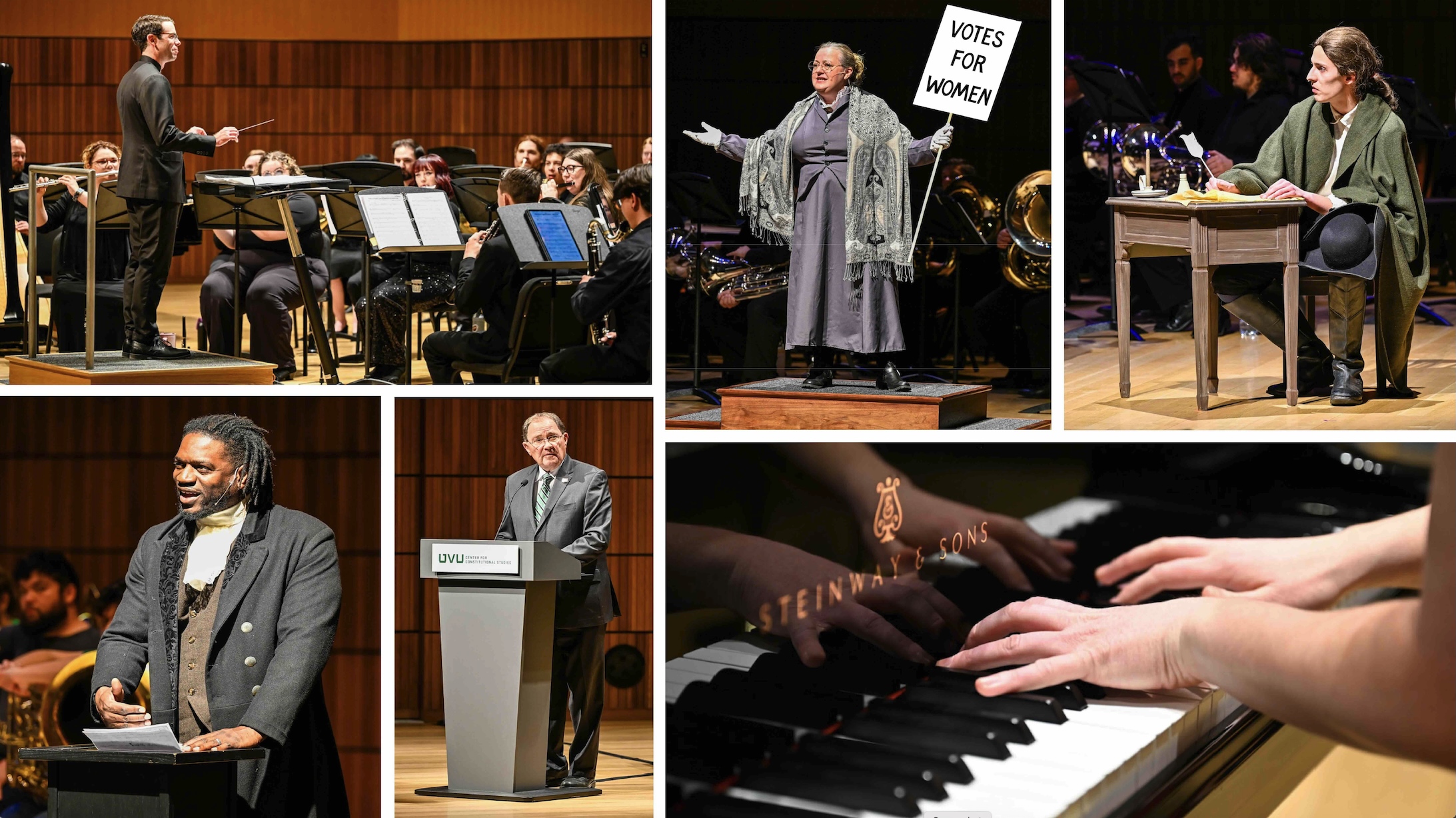
In partnership with the Center for Constitutional Studies and America250 Utah, UVU’s School of the Arts presented We Hold These Truths: Celebrating 250 Years of American Independence, a concert performed by UVU’s wind symphony April 20, 2026, in the Noorda Center for the Performing Arts on UVU Campus.
In partnership with the Center for Constitutional Studies (CCS) and America250 Utah, UVU’s School of the Arts presented We Hold These Truths: Celebrating 250 Years of American Independence, a concert performed by UVU’s wind symphony April 20, 2026, in the Noorda Center for the Performing Arts on UVU Campus.
The event celebrated the 250th anniversary of American independence. A performance of patriotic musical works and portrayals of historical vignettes guided attendees to reflect on the nation’s founding principles of liberty, equality, and self-government and to consider their meaning today.
The concert was many months in the making. In the summer of 2025, Chris Ramos, director of the symphony, mentioned in a casual conversation to CCS senior director Matthew Brogdon that he planned to have his students focus on musical compositions recognizing the 250th anniversary of the Declaration of Independence.
“I wanted to connect my current students with that history and at the same time create a program that reflected serious civic thought through rigorous artistic expression,” said Ramos.
Brogdon saw immediately how the symphony and CCS could collaborate in a way that would advance the mission of both organizations. He suggested to Ramos that they narrow the focus to the ideals written in the Declaration of Independence, since “it is something everyone can gather around, regardless of political affiliations or policy,” said Ramos.
“Art and music play a vital role in civic life,” he said. “Music moves the heart in ways that no other human craft can. It has power to evoke joy, fear, anxiety, and reverence. And if the words and principles of the Declaration are to maintain their vitality in our communities, our celebration of them must show up in our civic art.”
When Brogdon took these ideas to the CCS staff, Eleesha Tucker, a constitutional-literacy fellow at the Center, offered to write the script.
“Years ago, while working at the Society of the Cincinnati in Washington, DC, I was often drawn to a bookshelf in the special-collections library that held materials from the U.S. Bicentennial,” said Tucker. “I wished I had lived during that time to take part in those celebrations. This project was a chance to create something similar.”
Brogdon suggested incorporating historical vignettes into the program to help tell the story of the Declaration. Ramos liked the idea and they continued talking through the fall, winter, and early spring.
Preparations for the concert included refining the script, hiring actors to portray figures from American history, and going through the musical selections with the students in the symphony.
“I pushed our students hard,” said Ramos of the rehearsals. “We met twice a week as a full ensemble for more than 90 minutes, and then students also had one-hour sectionals outside of that each week. We also spent a lot of time talking about why we were playing the music we were and why this concert was so different from what we usually do.”
“It was pretty serious rehearsal work” recalled Michael Rodeback, a French-horn player in the symphony, who is also a Wood research assistant at CCS, working on the Quill Project. “We were expected to take the music home and be ready to play. Each prep session involved breaking down each piece into chunks and then stringing them together.”
Program selections included music from William Schuman (New England Triptych), Aaron Copland (Lincoln Portrait), Samuel Augustus Ward (America the Beautiful), John Philip Sousa (Stars and Stripes Forever), and a 2024 composition from James Stephenson (Declaration).
Brogdon served as master of ceremonies, and local performers portrayed George Washington (Charles Mosher), Susan B. Anthony (Melonie Cannon), and Frederick Douglass (Yahosh Bonner). Former Utah Governor Gary Herbert narrated Copland's Lincoln Portrait.
In crafting the script, Tucker looked to highlight how “reformers drew on the Declaration’s logic to argue for expanded rights, including the abolition of slavery, citizenship protections for people of color, and women’s suffrage,” she said.
The program concluded by emphasizing the responsibilities we bear today as citizens to carry forward the legacy we have inherited.
“My goal was to remind all attendees of the urgency to preserve our freedoms for ourselves and our posterity,” said Tucker.
During the rendition of Sousa’s “Stars and Stripes Forever,” members of the audience applauded and cheered the four musicians playing piccolo—Jenifer Swanson, Cami Bartholomew, Liesel Scott, and Ashley Toomey—and gave all the performers a standing ovation at the conclusion of the concert.
“This was the largest audience I have seen at a wind-symphony concert, and it was my first time collaborating with an entity outside of the School of the Arts,” said Ramos. “Getting to work with all the amazing scholars and experts at CCS brought more depth and rigor than anything I could have done on my own.”
“CCS not only provided artistic support, scholarship, and collaborative guidance for the concert, but it also contributed significant funds to make this happen,” he added. “It was a tremendous experience for me and for our students.”
Rodeback had a big complement of professors and co-workers in the audience, something he was not used to. “I had to work extra hard to focus properly, and it was fun to show them wind symphony can do,” he said.
“I had a lot of fun with the music,” he continued. “These were classic American tunes and some from the Revolutionary era. It was right at the intersection of my work with the Center, my study of American history, and my interest in music.”
“It was an incredible program to offer to the public and made a difference in the understanding of where we’ve come from as a country,” said Paige Larsen, senior administrative assistant for CCS, who handled many of the logistics for the concert, to include scheduling rehearsals and locating props and costumes. “I loved seeing the impact of the roles on the actors themselves. It was all very moving.”
“It was a great honor to help, by words, to frame the music and guide the audience in an understanding of its connection to our shared history,” said Brogdon. “Universities are among the rare institutions today that devote themselves to the pursuit of truth, beauty, and goodness. Our charge is to preserve the knowledge, wisdom, and art of our legacy and pass it on to the next generation, which extends to our constitutional inheritance.”