On April 14th, 2026, students from the United Nations Sustainable Development Goals
(SDGs) course at Utah Valley University (UVU) presented reflections on their participation
in, and the outcomes of the 70th Commission on the Status of Women (CSW70) of the
United Nations to the faculty and students at UVU. The students advocated at the CSW70
by hosting a parallel event, titled “Raising Justice Awareness for Mountain Women
and Girls" as club members of the Utah International Mountain Forum (UIMF), a coalition
of student clubs at UVU. UIMF advocates sustainable mountain development (SMD) in
the State of Utah and at the United Nations. It also advocates for the inclusion “mountain
women” in the final document of the CSW. This has never happened before yet and each
year, since 2018, members of the UIMF have participated at every CSW session and raised
their voices to call for this to change.
The event was attended by UVU dignitaries, including the Interim President, Dr. Wayne
Vaught, Dean of the College of Humanities and Social Sciences (CHSS), Dr. Steven Clark,
and Mrs. Amy Barnett, the Program Director, UVU Office for Global Engagement. At the
beginning of the event the group photo was taken with all participants, including
dignitaries signing the poster for memorabilia.
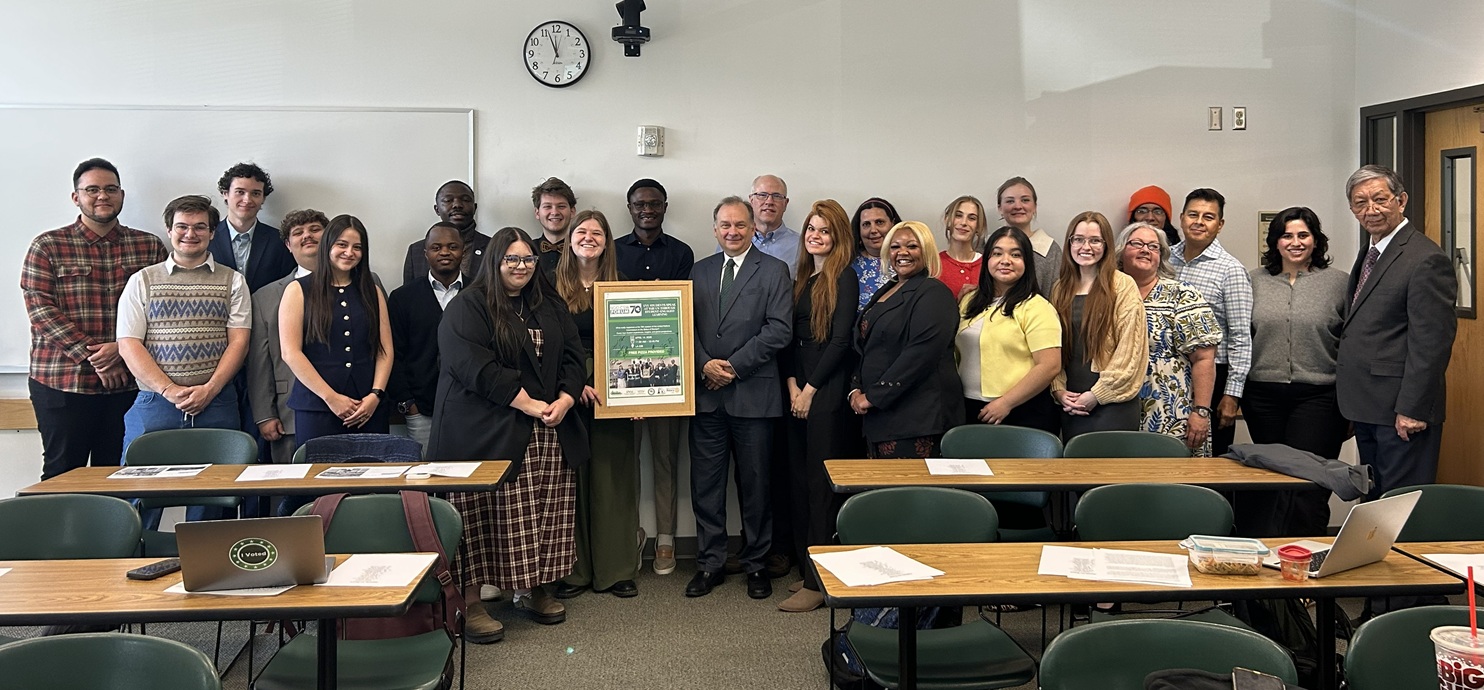
Group photo with Students and Dignitaries
Dr. Baktybek Abdrisaev, who teaches the class and mentors UIMF members, opened the
event by explaining to the audience that he is also an official representative of
the United Nations Mountain Partnership at UVU. 2026 commemorates the 20th anniversary of UVU’s membership in this UN body, which coordinates SMD through its
607 members globally. He mentioned that the MP was glad that through the support of
the UVU History and Political Science Department and College of Humanities and Social
Sciences, UIMF members have been able to promote State of Utah as one of the best
models for SMD at the UN, and both UVU and UIMF were highlighted for their efforts
to advocate for SMD and women in mountain communities 7 times in the United Nations
Secretary General’s (UNSG) reports on SMD. UNSG summarizes best practices and activities
in SMD implementations globally for three years term. The last UNSG report on SMD
was adopted on July 24, 2025 and highlights such achievements and contributions made
by interested MP members from 2023-2025. UVU was featured in this document again and
it will be important for the UVU to recognize students who advocated and lobbied at
the UN. He mentioned Janessa-Micelle Purcell, Ana Caballero and Louyoko Nianza, three
students in the audience, who contributed their skills, experiences and energy to achieve such a result by advocating for mountain women and girls during CSW sessions.
Dr. B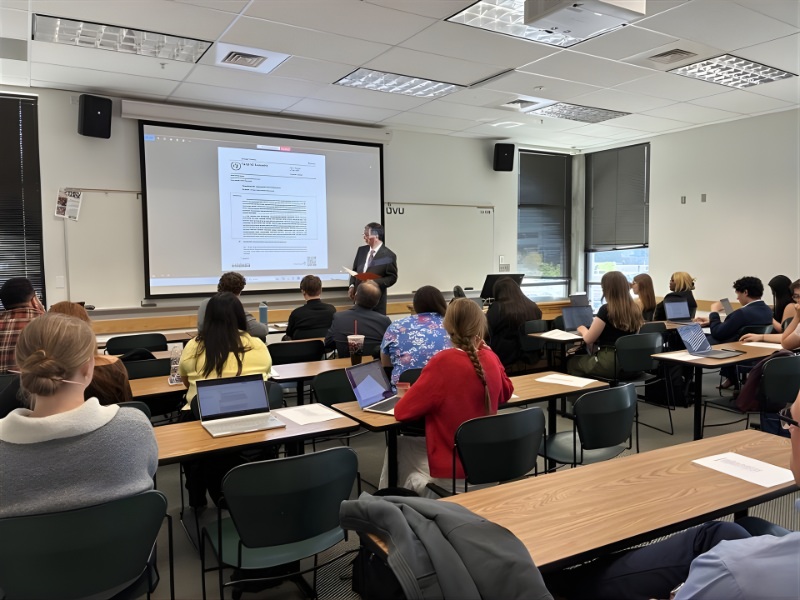
Dr. Baktybek Abdrisaev Speaks at the Event
In their presentations, students shared their experience with preparing for and participating
in the CSW, as well as their findings from their individual research. Students performed
case studies on mountainous regions in countries around the world, including China,
Japan, Georgia, Armenia, Norway, the Democratic Republic of Congo, and more. They
highlighted common issues the women in these communities’ face, including inequalities
in education, the workplace, and the law, discrimination towards indigenous communities,
and a lack of representation and consideration in public policy. Though Utah and UVU
are seen as strong models of SMD, research was even done on challenges faced in Utah,
including environmental concerns around air pollution and the ecological decline of
the Great Salt Lake.
An important aspect of the students research was the use of the Student Engaged Learning
(SEL) model where instead of merely assessing students performance through tests,
students are given hands on opportunities to show the things they’ve learned in class,
and in the case of the SDG course and UIMF, this has meant being able to advocate
and create change. Which includes traditional and non-traditional students working
together in clubs and classes locally and abroad to have real world impact. This has
been part of UIMF from the beginning, as its first president, Alitha Thompson, was
a non-traditional student and mother who advocated for women in Gunnison, Utah.
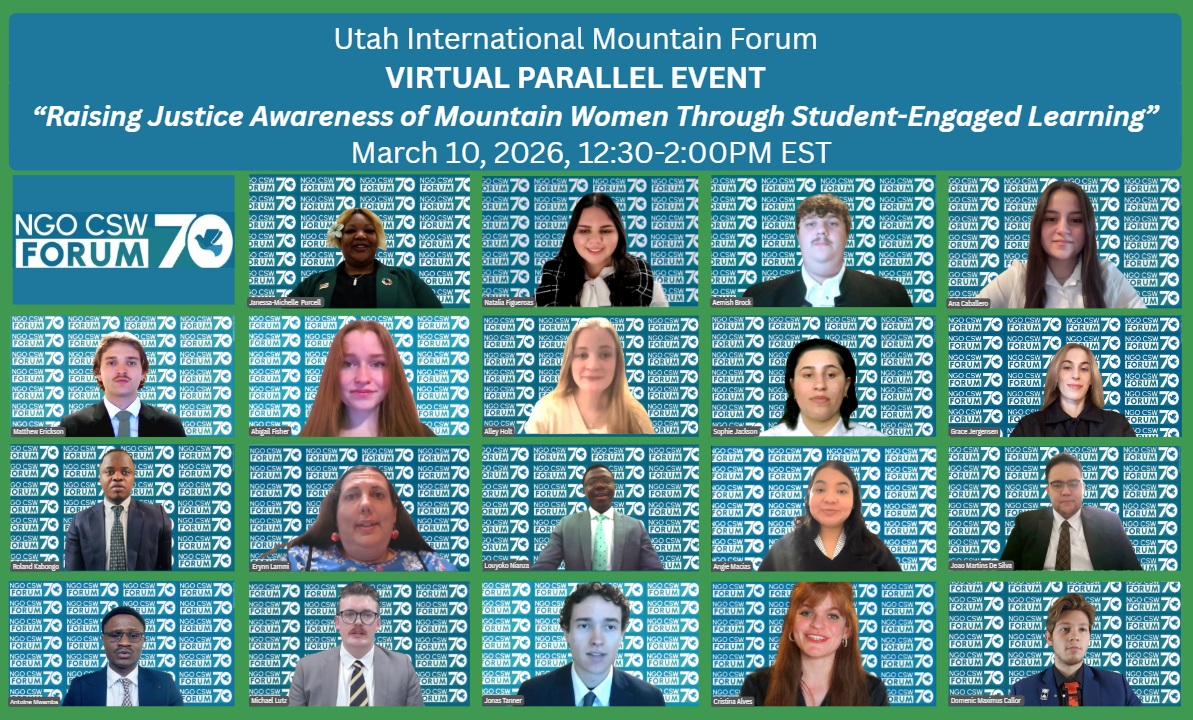
Group photo of the CSW70
In the end, the reflection on the SDG class and UIMF’s participation in the 70th CSW
was an opportunity for the students to show the attending dignitaries of UVU the impact
that can be made when they are given the chance to participate in large scale events
like the CSW, advocating for the issues that matter to them. It demonstrates that
the efforts of the students should be recognized beyond internships, in the advocacy
they are able to perform. The opportunity to participate in the United Nations is
a major achievement for these students and should not go understated. An outcome from
the CSW 70 and real world impact can be seen in the story of the president of the
foreign affairs club Natalia Figueroa, whose post advocating for Mapuche women’s participation
in government in Chile received recognition from Gloria Della Fuente, the former undersecretary
of Chile. Another outcome was when Antoine Mwamba advocated for Sexual violence within
weak legal systems and explained how in 2025 the Muzenze prison in the DRC 150 women
were reportedly raped and killed. His speech was part of the new CSW goal for “Justice
for incarcerated women”. The work done at these events prepares the students for their
future opportunities to advocate at the World Health Organization and World Trade
Organization in Geneva, Switzerland this July.
Guardian Post about CSW new agenda Natalia’s Linkedin post liked by Dignitary
The participation of the SDG class and UIMF at the 70th CSW matters to women and girls
not just in Utah, but globally. Their persistent efforts demonstrate that when voices
are continually lifted to speak out about those in need, real recognition, impact,
and change are possible.
Below you can find a summary of each student's presentation from UVU’s Presentation.
Natalia Figueroa: Natalia highlighted how Indigenous Mapuche women in Chile are affected by anti-terrorism
and “usurpation” laws used in land disputes, especially the Anti-Terrorism Law (Law
No. 18.314) and related property laws. These laws can criminalize land occupation
or defense even when the land is claimed as ancestral Mapuche territory, and critics
argue they are often applied in ways that favor forestry and other companies. This
has led to increased police presence, arrests, and legal pressure in Indigenous communities,
where women are often the primary defenders of land and water. Cases like Nicolasa
Quintreman are cited as examples of how environmental conflict and weak protections
can leave Indigenous women vulnerable to violence and lack of justice. With the new
president of Chile, Kast, experts warn these policies could further threaten Mapuche
women’s rights and safety despite UN intervention.
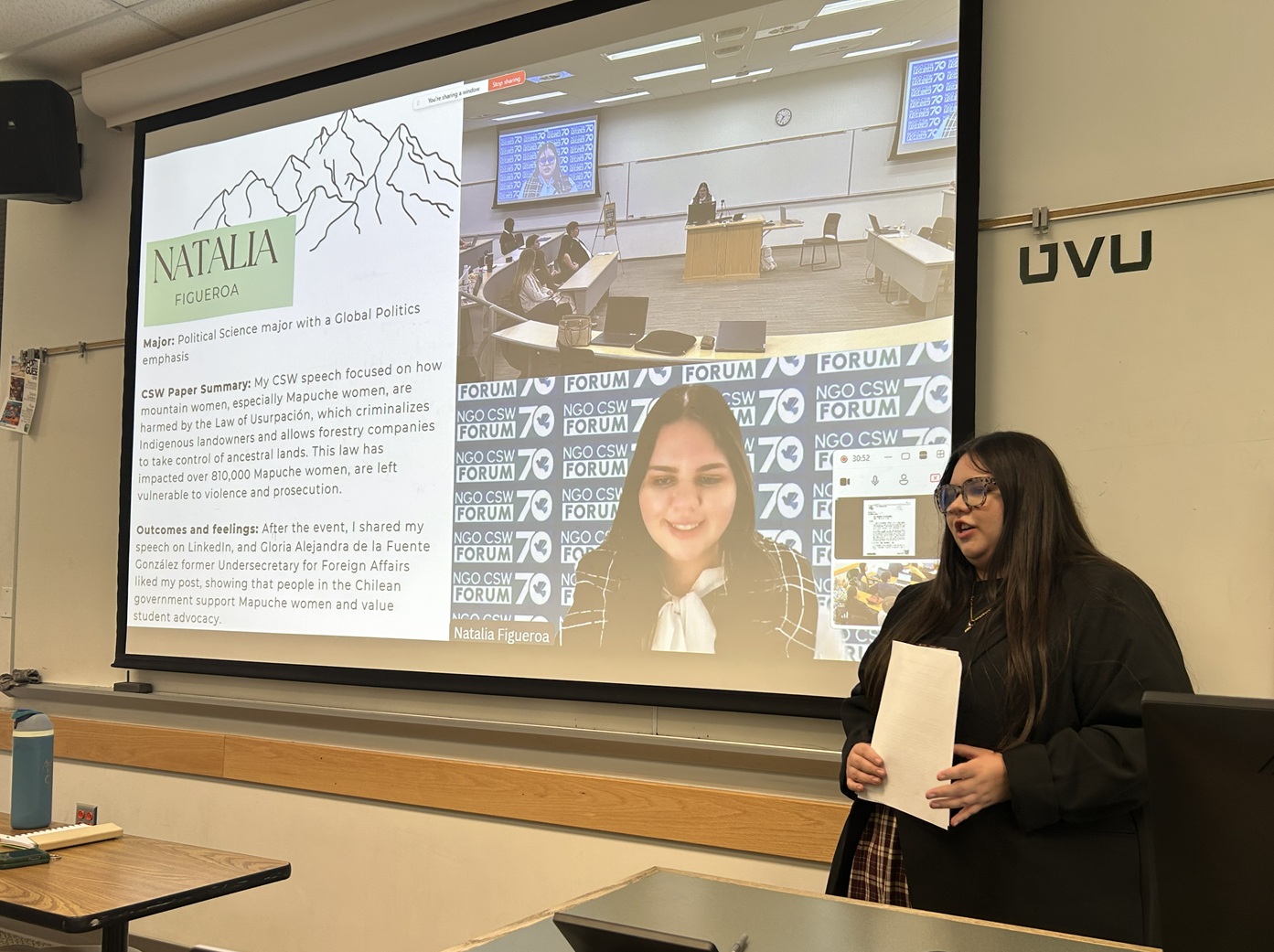
Natalia Figueroa presenting to dignitaries
Aemish Brock: Aemish highlighted how mountain communities are too often treated as peripheral in
policy decision-making, even though they are central to mountain living. In many mountain
regions, women carry disproportionate burdens related to household energy, caregiving,
food security, and climate adaptation, while still facing barriers to decision-making,
education, economic opportunity, and equal justice. When UN policy is made, the needs
of mountain women specifically must be accounted for. As well as Austria's free trade
as an example to help mountain women.
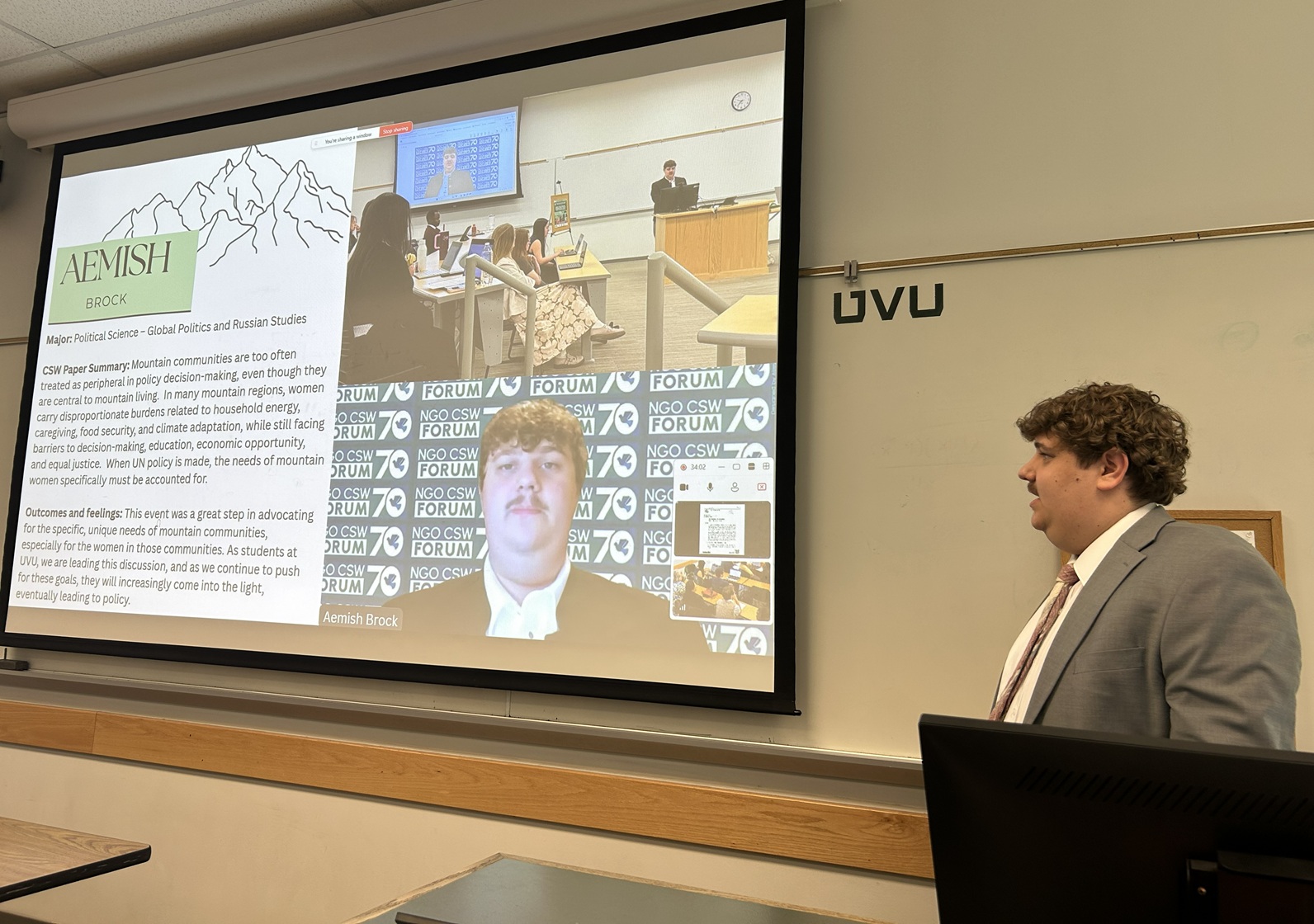
Aemish Brock presenting to dignitaries
Janessa-Michelle Purcell: Janessa highlighted that her research was a continuation of a project with her research
colleague McKay Jones and began in the Fall of 2024. Our research project focused
on the Air Pollution problem here in Utah particularly in West Salt Lake. Through
this process we have identified that many air pollutants are consolidated on the West
side of the I15, which also hosts the largest population of minorities. With about
52% of their 140,000 residents identifying as part of a minority group. She urged
the United Nations to recognize and acknowledge the injustice many women and girls
are facing, not just on the west side of Utah but across the world as climate change
continues to impact us all.
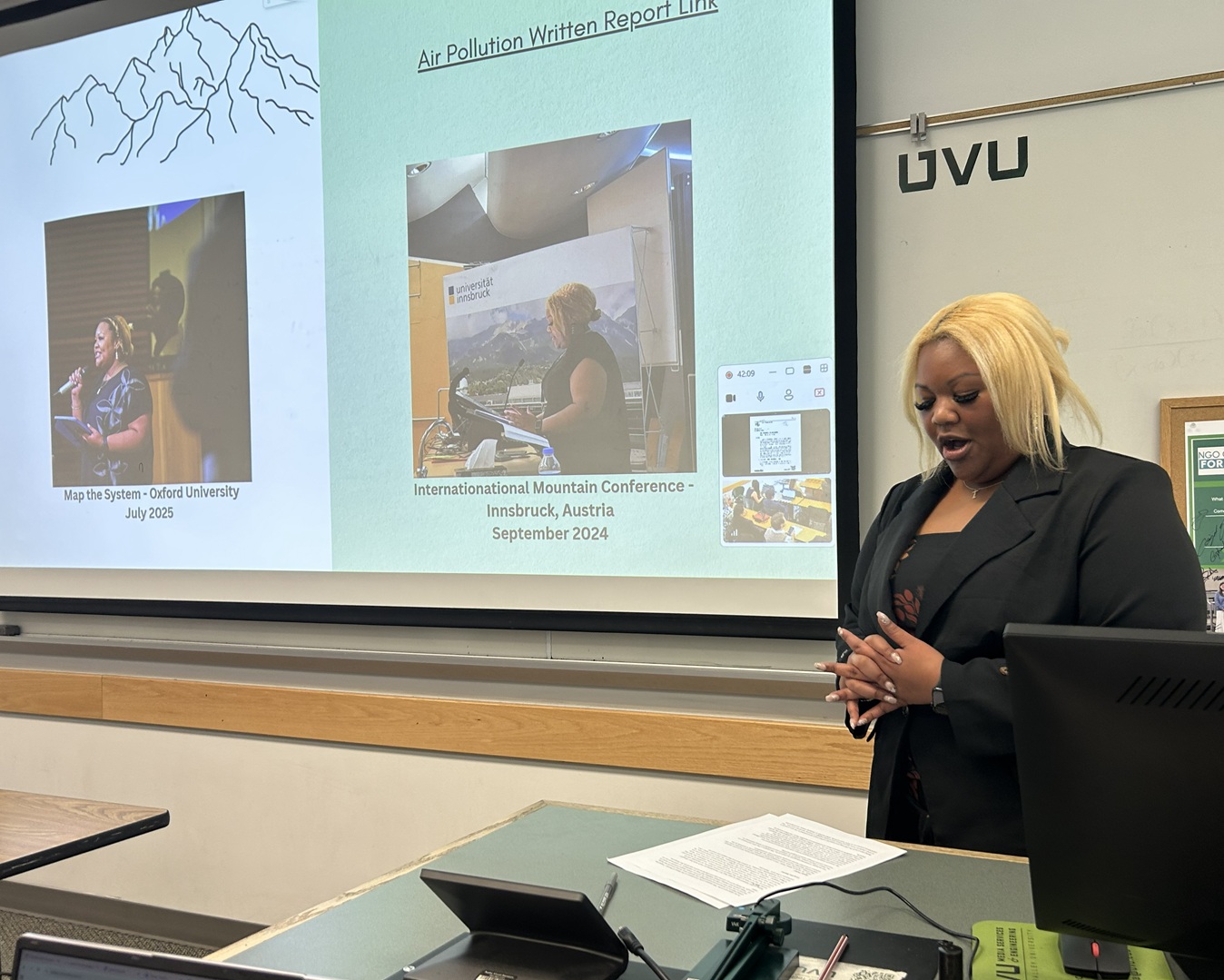
Janessa-Michelle Purcell presenting to dignitaries
Louyoko Nianza: Louyoko Nianza, a Political Science and International Relations student at Utah Valley
University and President of Smart-Africaine NGO, addressed the Commission on the Status
of Women, urging the inclusion of mountain women and girls in its final document.
She emphasized the critical role mountain regions play in global ecosystems and food
security, while highlighting the inequalities and violence faced by women in conflict-affected
areas such as the Democratic Republic of the Congo and Sudan. Drawing from her experiences
with the Utah International Mountain Forum and the Gary R. Herbert Institute of Public
Policy, she demonstrated how education and student-engaged learning can empower communities
and support vulnerable populations. She concluded by calling on the United Nations
to ensure mountain women’s voices are central to achieving sustainable development
and justice.
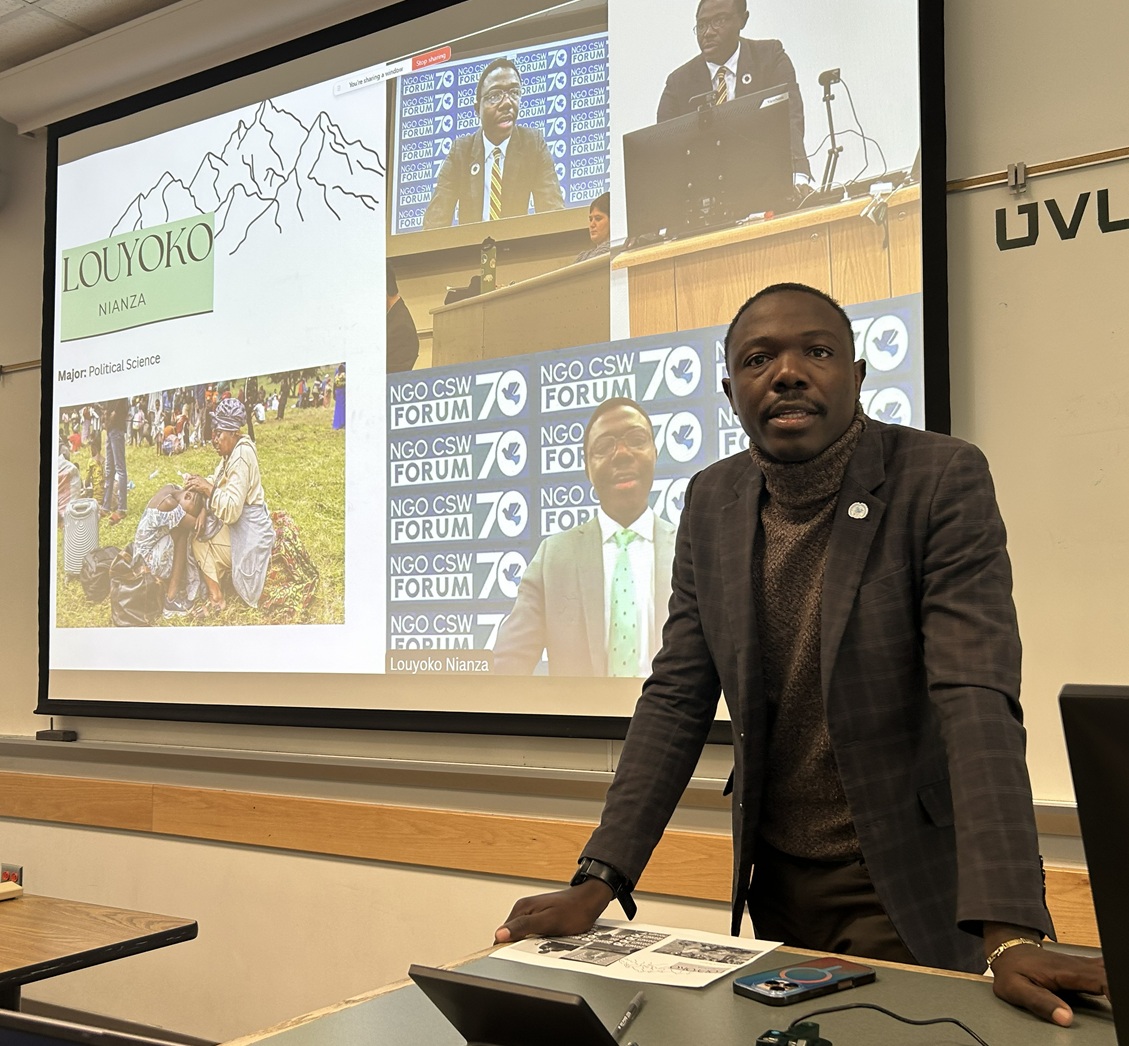
Louyoko Nianza presenting to dignitaries
Abbie Fisher: Abbie highlighted how marginalization of women and girls in Utah and China interact
deeply with green governance and mountain-specific challenges, creating tertiary outcomes
that are obscure, overlooked, and severely understudied. When systems in these landscapes
do not engage in equitable policy leadership, we see correlations that systematize
and externalize damaging outcomes for these populations. Such outcomes can be meaningfully
addressed by UN member states through building local and global data infrastructure
that connects the complex lived realities of local mountain women with research, policy,
and action. These efforts, rather than peripheral, are central to achieving the UN’s
goals of equitable, sustainable, inclusive, and just governance for all.
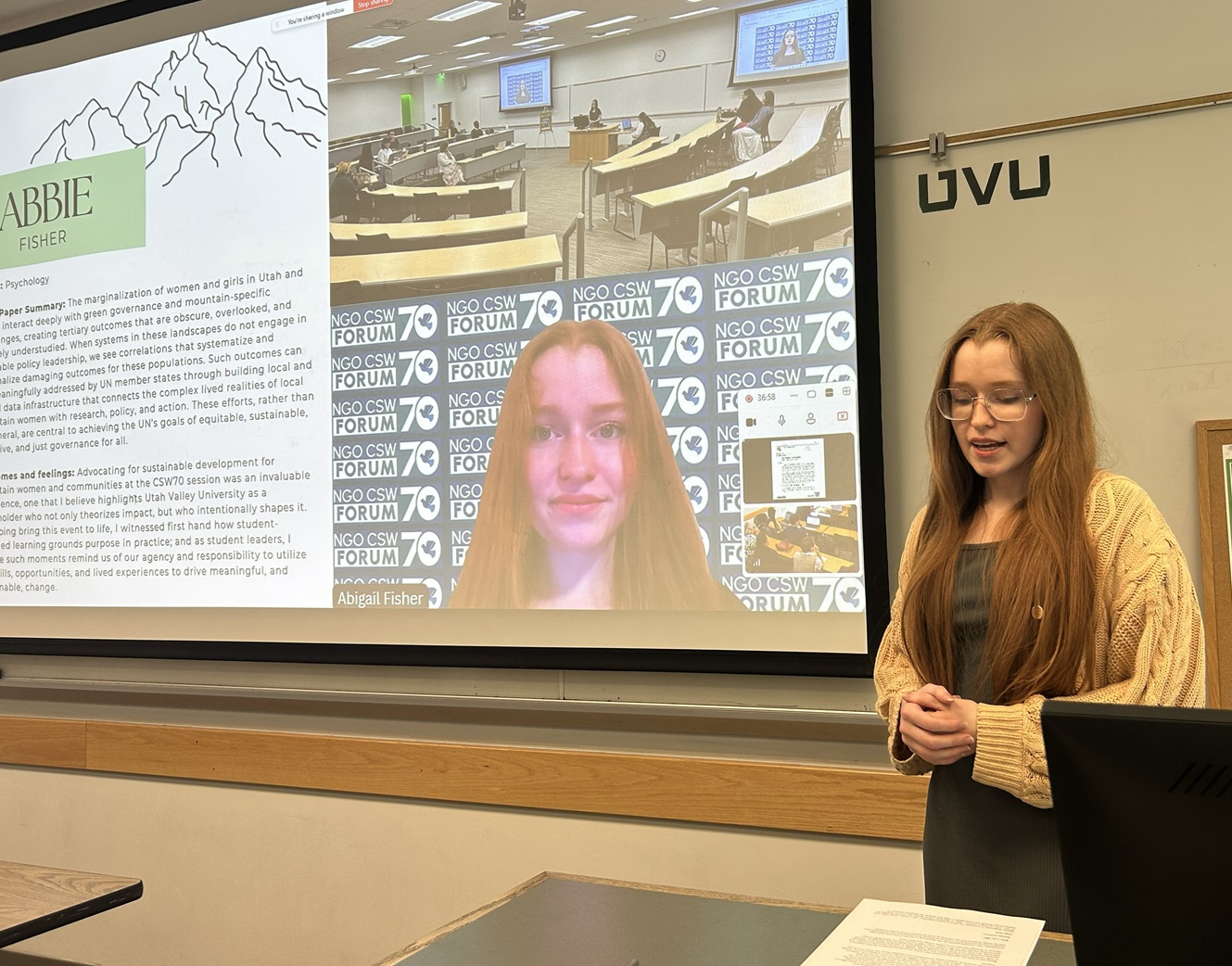
Abbie Fisher presenting to dignitaries
Sophie Jackson: Sophie explored the challenges facing women in rural mountain communities in Japan.
Young Japanese women are leaving their rural, mountainous hometowns in Japan for its
big cities. These women are moving to big cities in search of better employment opportunities,
to escape rigid social and religious gender norms, and to escape gender discrimination
in both education and business. While their reasons for leaving are admirable, these
women are becoming increasingly vulnerable to forced prostitution and forced participation
in Japan's lucrative sex industry. Forced prostitution, manipulation, and violence
against women are on the rise in Japan due to an increase in demand known as sex tourism,
new waves of organized crime focusing on trapping women into prostitution, and a lack
of legal repercussions placed on buyers.
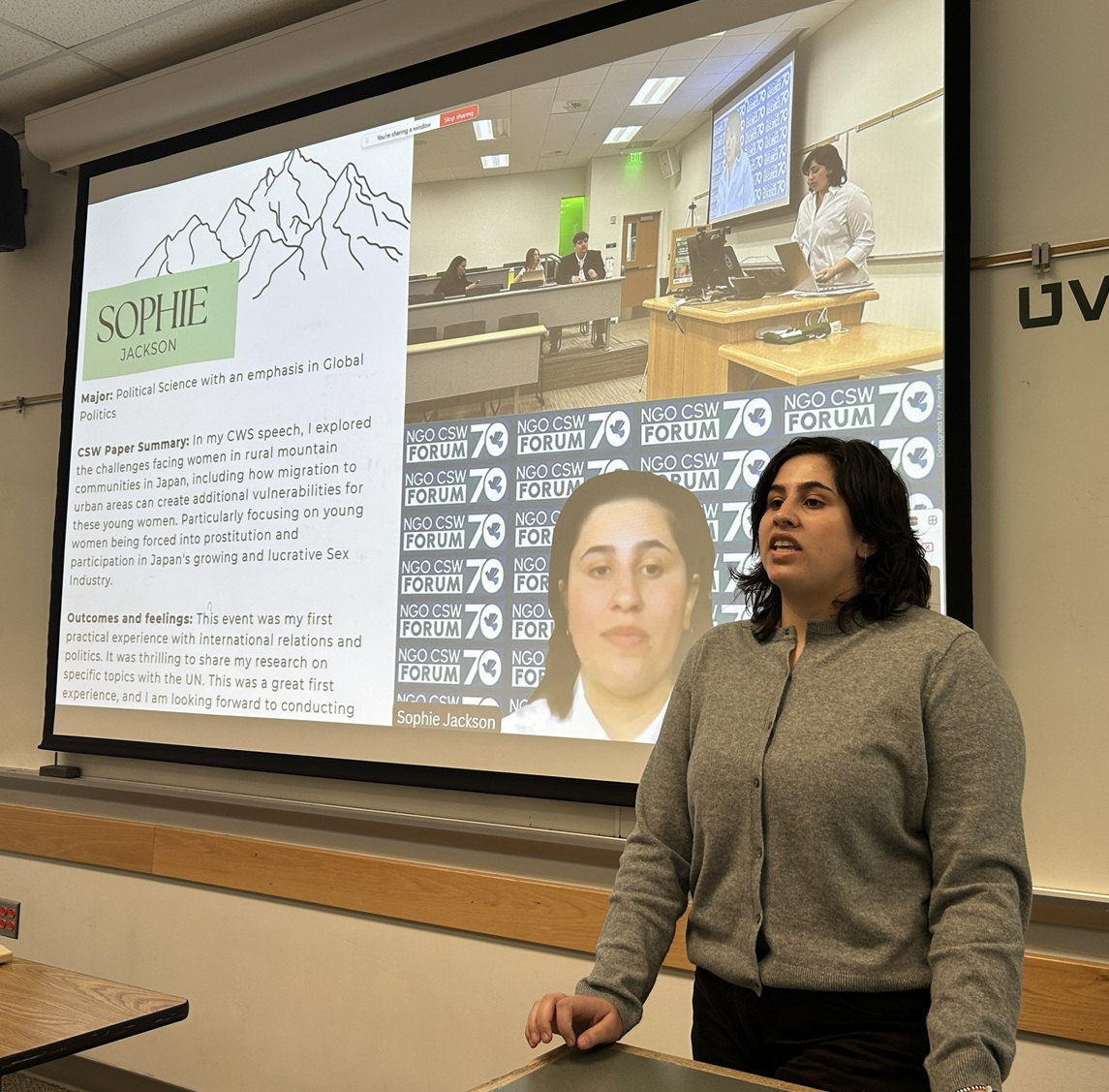
Sophie Jackson presenting to dignitaries
Alley Holt: During the CSW Alley advocated for providing spaces for mountainous women's voices
through the Student Engaged Model of Learning's advocacy for sustainable mountain
development. As a woman of the mountains who has been positively impacted by the SEL
model, I was able to speak on my experience on how it can empower women as well as
non-traditional students. Studying the partnership between the mountainous regions
of Utah and the Kyrgyz Republic. This research has focused on the exchange of knowledge
in building sustainable livelihoods between the two States and how adopting engaged
learning processes has mutually benefited both mountain communities and their women
and families over the last 20 years.
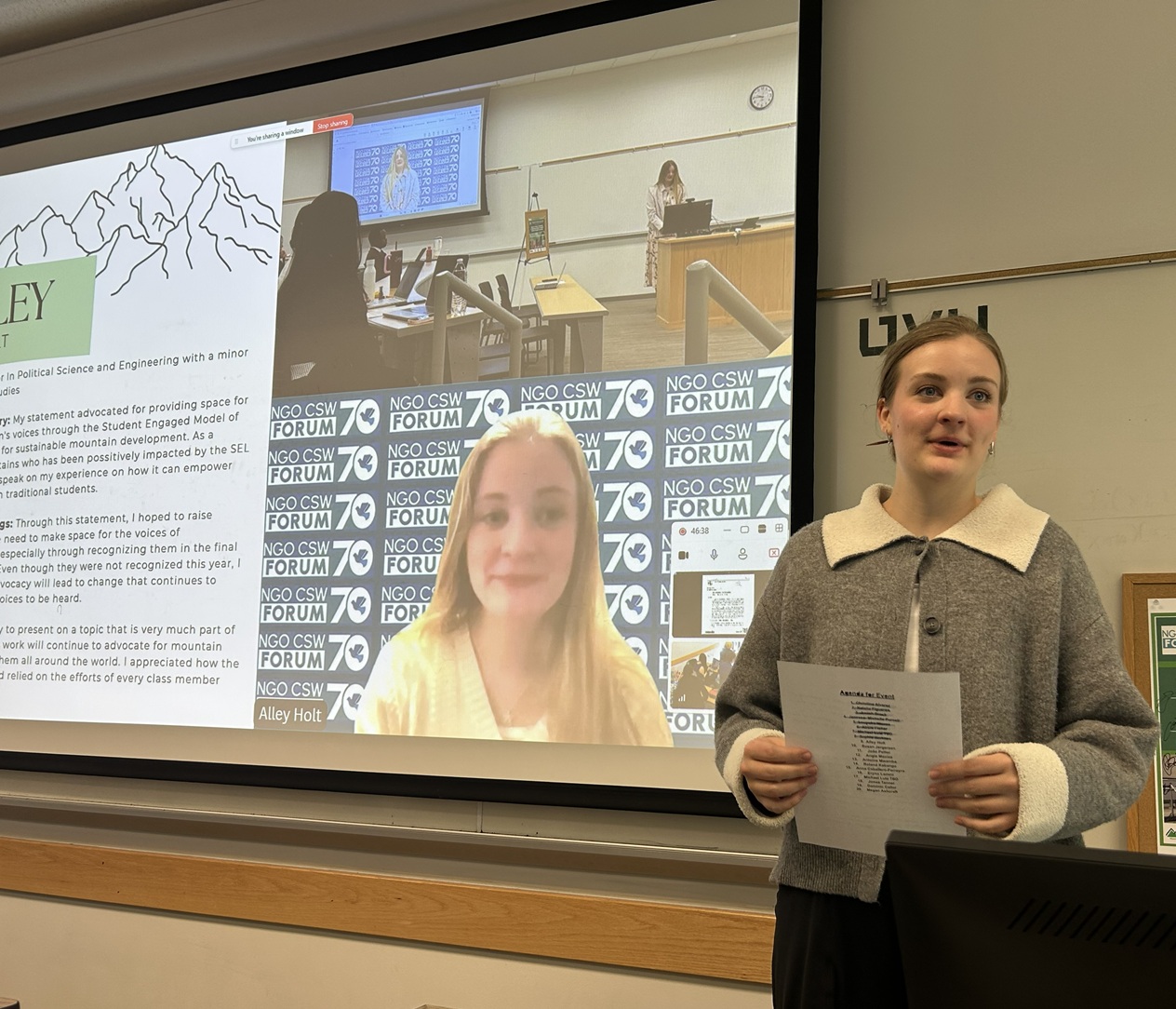
Alley Holt presenting to dignitaries
Susan Jergersen: Susan presented on Indigenous mountain women in Norway, focusing on health, policy,
and environmental challenges. I discussed ongoing gaps in healthcare access, economic
support, and representation, as well as policy progress like expanded parental leave.
Norwegian mountain women continue to be neglected, despite the efforts made by the
Norwegian governments. They have made strides with new policies such as, increased
access to healthcare, financial aid for farming, encouraging their voices in the public
sector and enhanced safety in their environments. One major policy that has been highlighted
recently in Norway is the change of parental leave, both parents are now encouraged
to take an equal amount of leave, this encourages women to continue in the workforce.
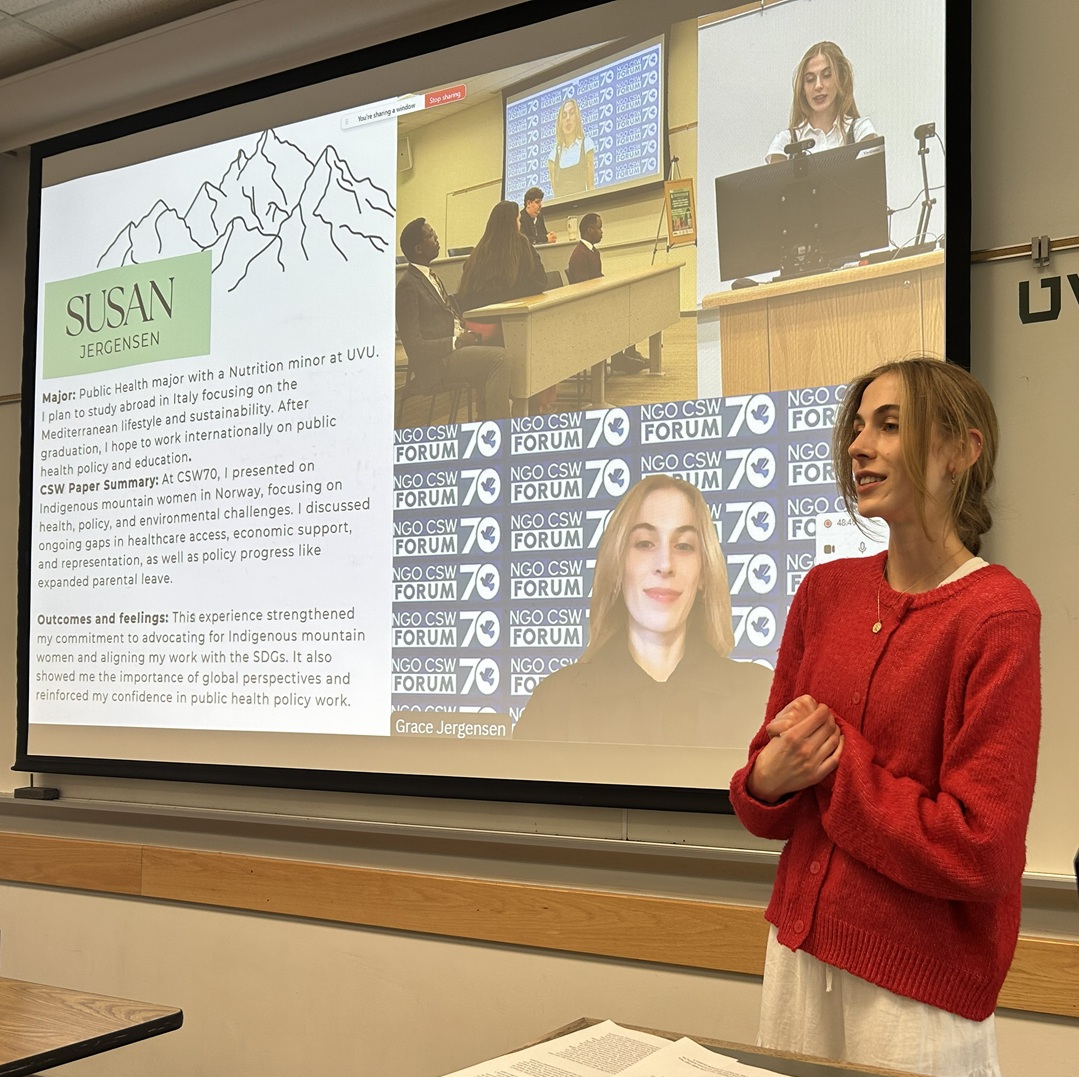
Susan Jergersen presenting to dignitaries
João Petter: João highlighted how in Bolivia, mountain geography widens the gap between rights
on paper and justice in practice. Bolivia has formal legal protections for women,
but Indigenous women in highland areas face distance to services, limited legal support,
language barriers, and institutional delays that make justice difficult to access.
The lesson is clear: discrimination is not only a problem in laws; it can also appear
in everyday practices that prevent women from receiving equal protection.
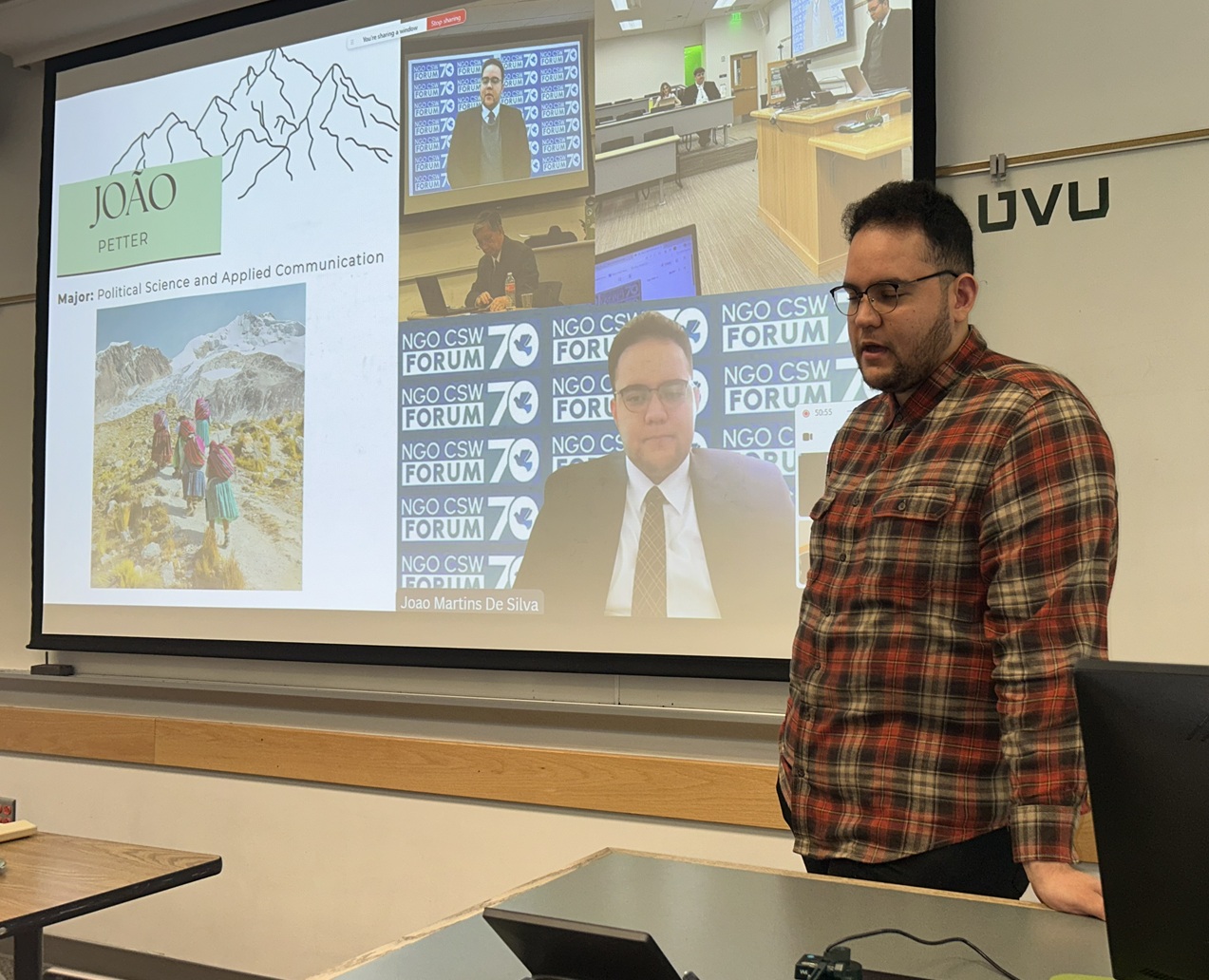
João Petter presenting to dignitaries
Angie Macias: Angie presented how Mountain women face systemic inequality from a young age, especially
in rural and mountainous areas where access to education, legal protection, and institutional
support is limited. In Armenia, this is intensified by geographic isolation and traditional
gender norms, leading to poverty, unpaid domestic labor, low property ownership, limited
leadership roles, and lower income compared to men. These conditions highlight the
urgent need for greater awareness, resources, education, and protection for mountain
women.
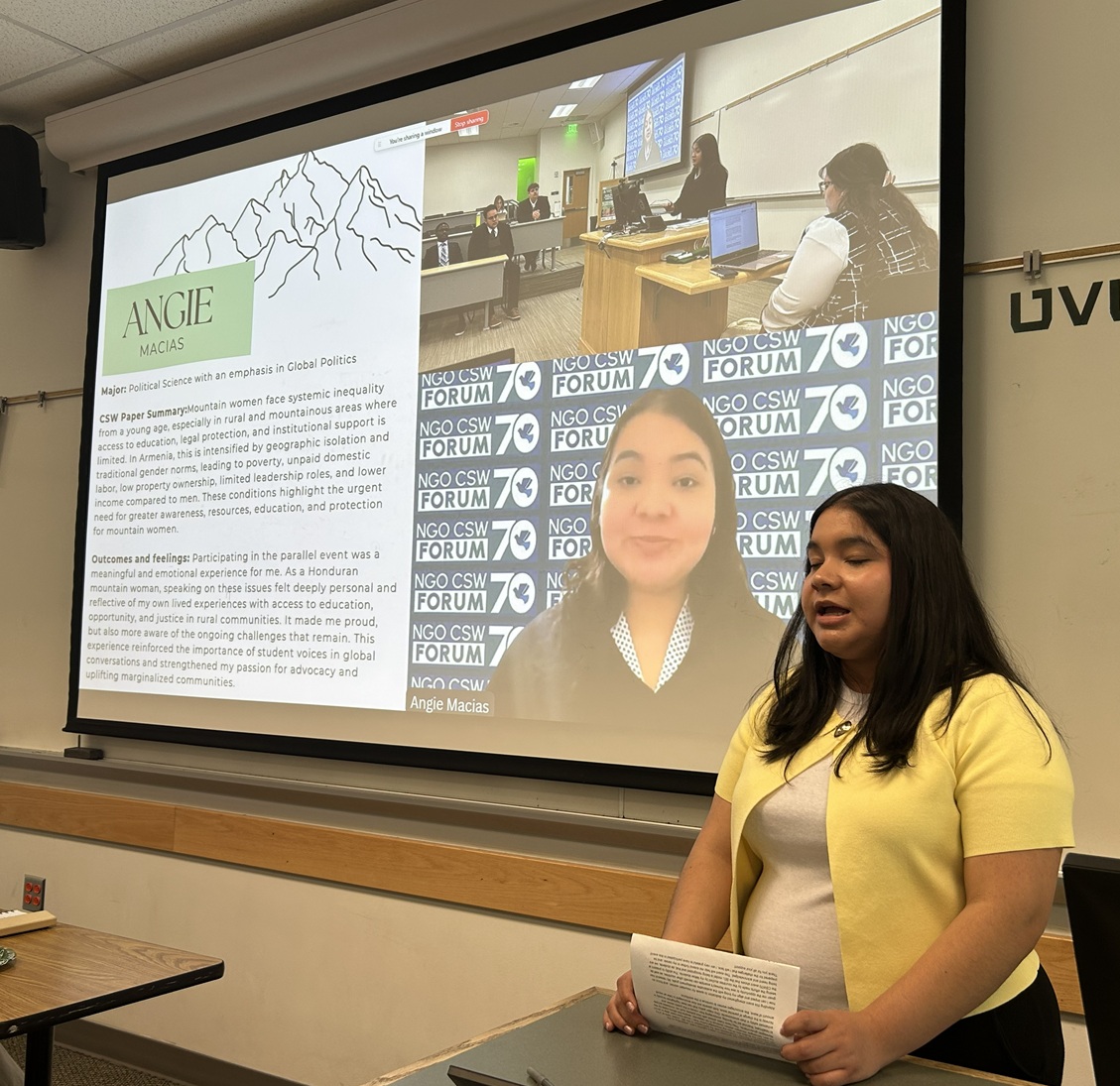
Angie Macias presenting to dignitaries
Antoine Mwamba: Antoine advocated for justice and legal accessibility for mountain women globally,
with a particular focus on the Democratic Republic of the Congo, highlighting how
conflict, geographic isolation, and weak institutions prevent them from receiving
protection and accountability. His focus was to ensure these women are explicitly
recognized in international policy and to promote solutions such as mobile justice
systems so that access to justice is not determined by location. In eastern Congo,
because of mountainous terrain and ongoing conflict women often struggle to reach
police stations, courts or medical centers. Sexual violence has been used as a weapon,
and weak legal systems make justice difficult to obtain. In 2025 the Muzenze prison
in the DRC 150 women were reportedly raped and killed. This shows extreme risks mountain
women face.
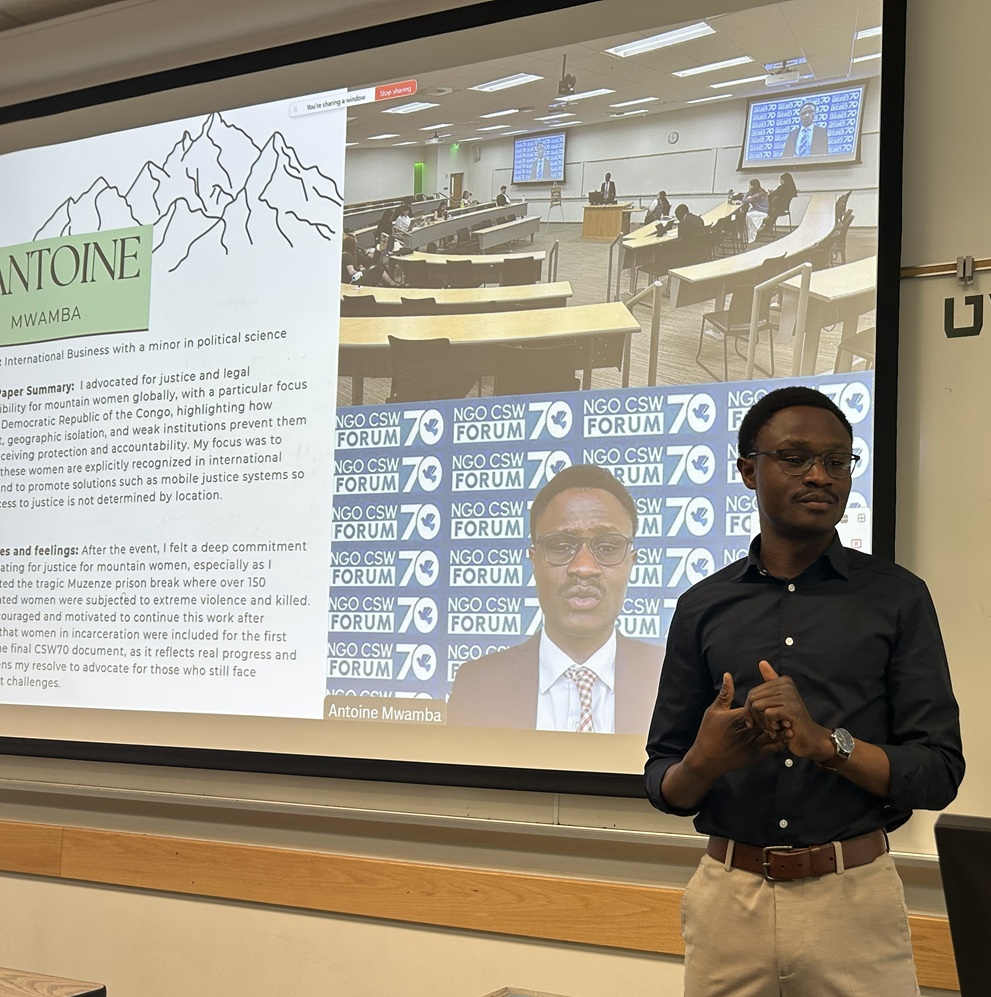
Antoine Mwamba presenting to dignitaries
Roland Kabango: Roland presented on The Virunga Mountains, the highlands of Kivu are places where
local communities including women and girls have learned to endure hardship, protect
their land, and rebuild again and again. Growing up around those mountain regions
has taught me and the women in these regions what it means to stand tall even when
life is difficult.
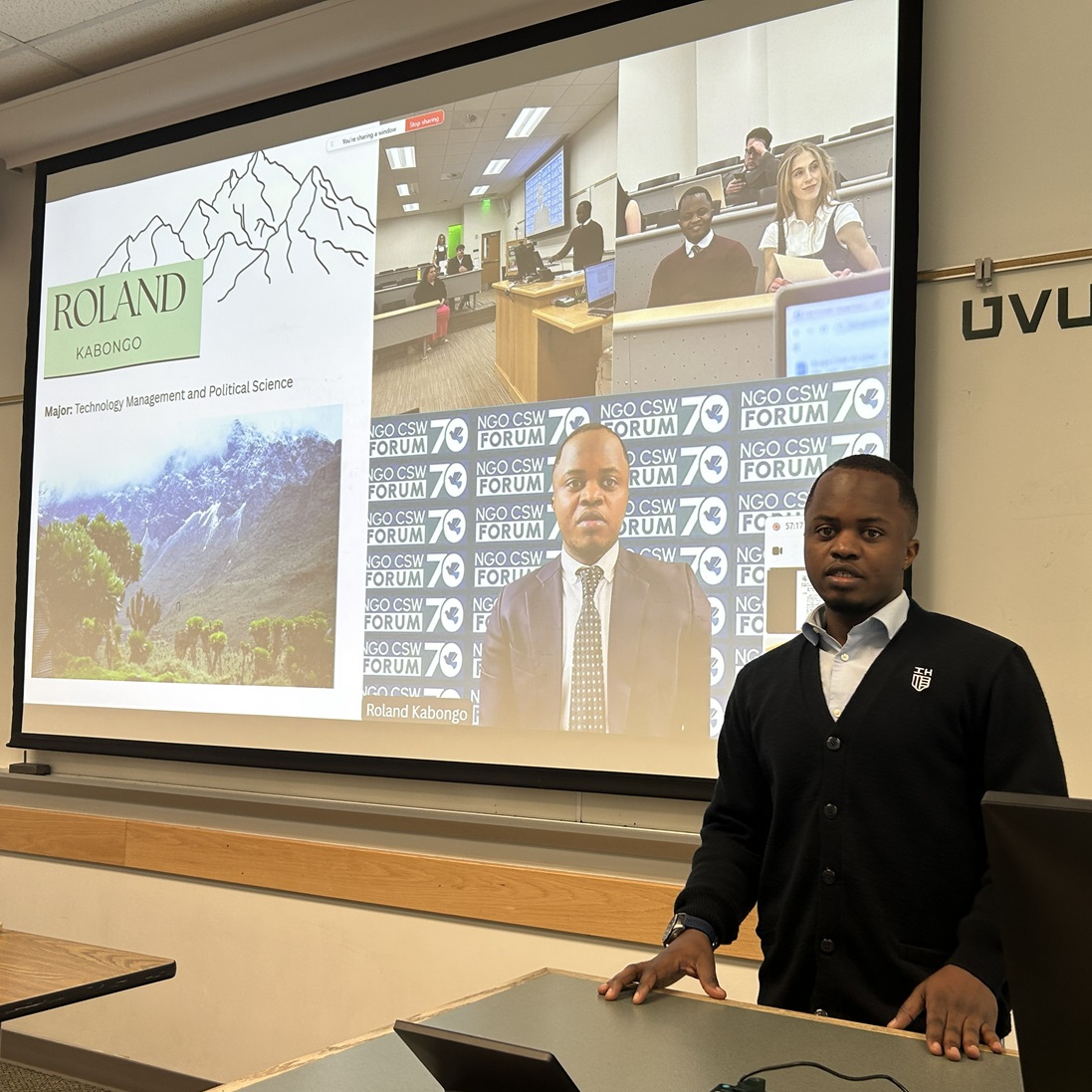
Roland Kabango presenting to dignitaries
Ana Caballero-Ferreyro:Ana’s research focuses on mountain women in Georgia, a country in the Caucasus region,
and the critical role they play in their communities. In remote regions such as Svaneti
and Racha, women are the backbone of daily life. They manage households, farm land,
care for children and elders, and support local economies, often while men migrate
for work. Despite this, their contributions are largely invisible in legal systems
and public policy.
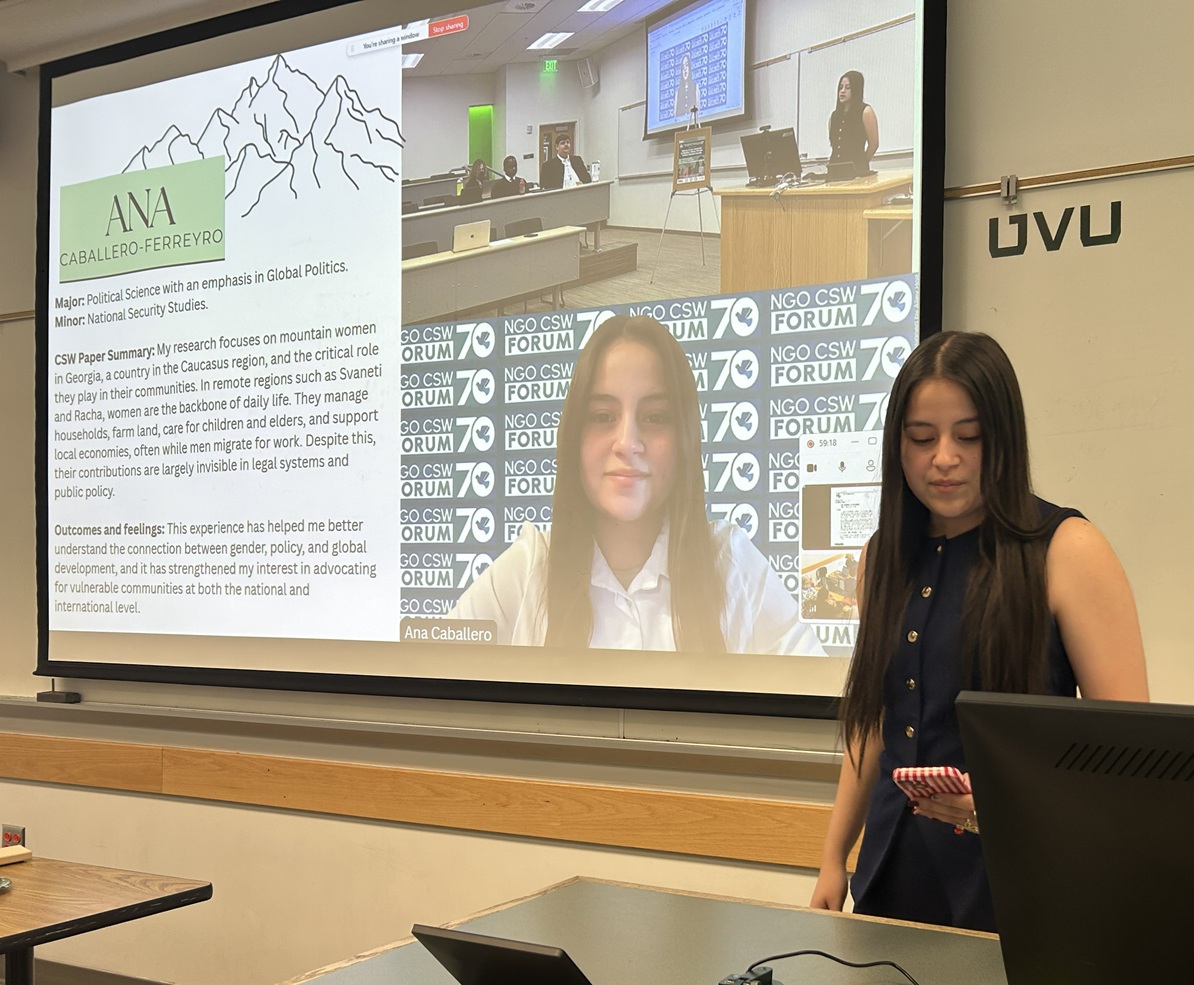
Ana Caballero-Ferreyro presenting to dignitaries
Erynn Lammi: Erynn highlighted that women and girls in mountainous regions, particularly in Greece
face serious injustices due to limited access to education, employment, and policy
participation, and therefore must be explicitly included in international gender-equality
frameworks. I have highlighted how Utah Valley University’s Student Engaged Learning
model, combined with community partnerships, can empower these women through civic
and legal literacy, leadership development, and expanded opportunities for meaningful
participation in their communities.
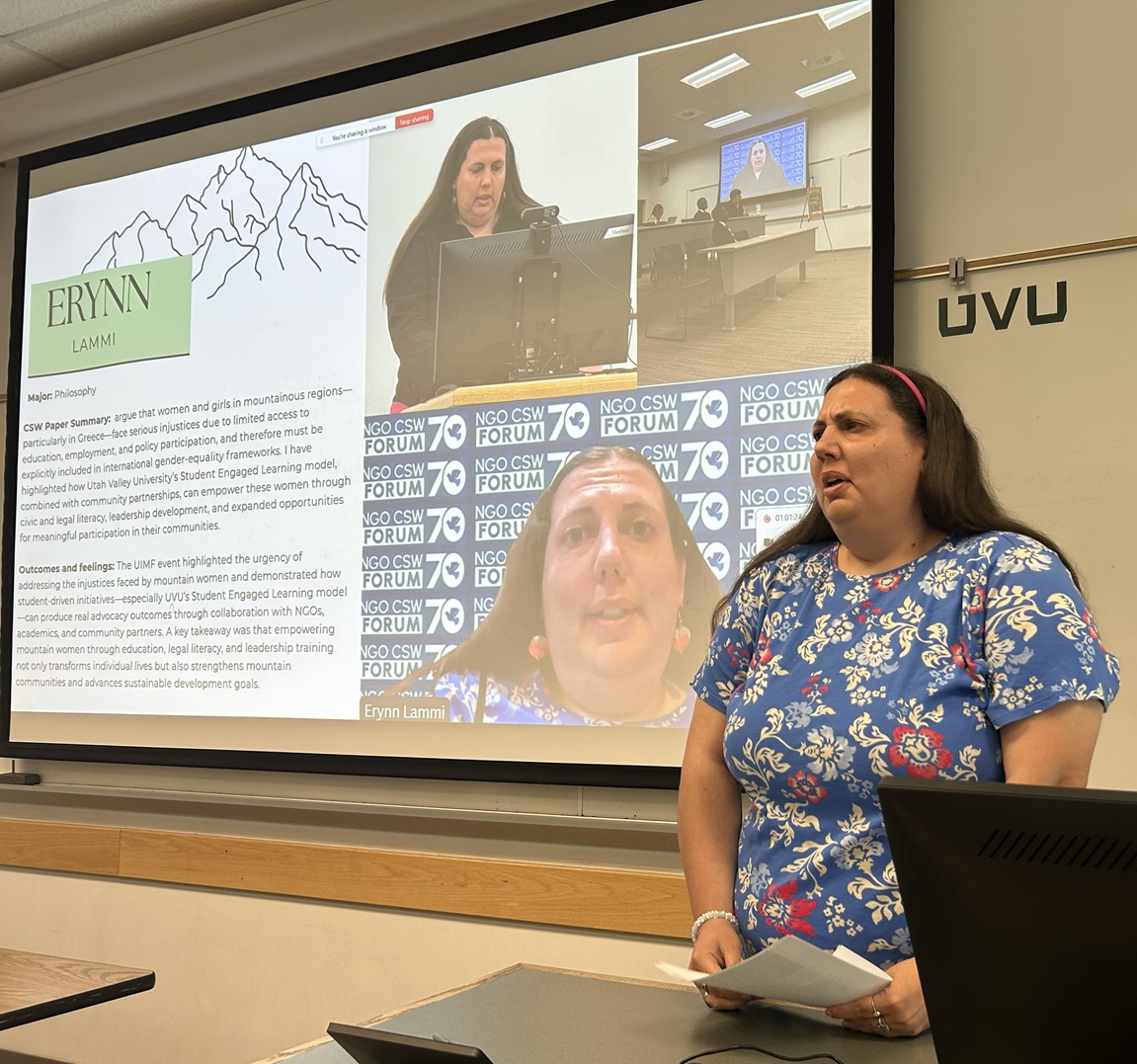
Erynn Lammi presenting to dignitaries
Jonas Tanner: Jonas advocated for the inclusion of mountain women and girls in the 70th session
of the Commission on the Status of Women to ensure no group is left behind in global
sustainability efforts. Utah Valley University’s "Engaged Learning Model" is a successful
framework for student-led research and inclusive social change. Drawing on lessons
from women's rights in China we must emphasize that empowering underrepresented mountain
communities requires a combination of bottom-up advocacy and strong institutional
support. He studied women’s rights in China and provides a vital backstory to the
issues confronting mountain women all over the world. The lessons I learned from studying
the policies in China made me realize the necessity of bottom-up organization and
institutional backing in advocacy. China has a long, thousand-year history of family
connections and relevance. However, there still remains a significant problem with
gender roles in its patriarchal dominated society, which often makes it difficult
for women to find fair and equal treatment in some circumstances.
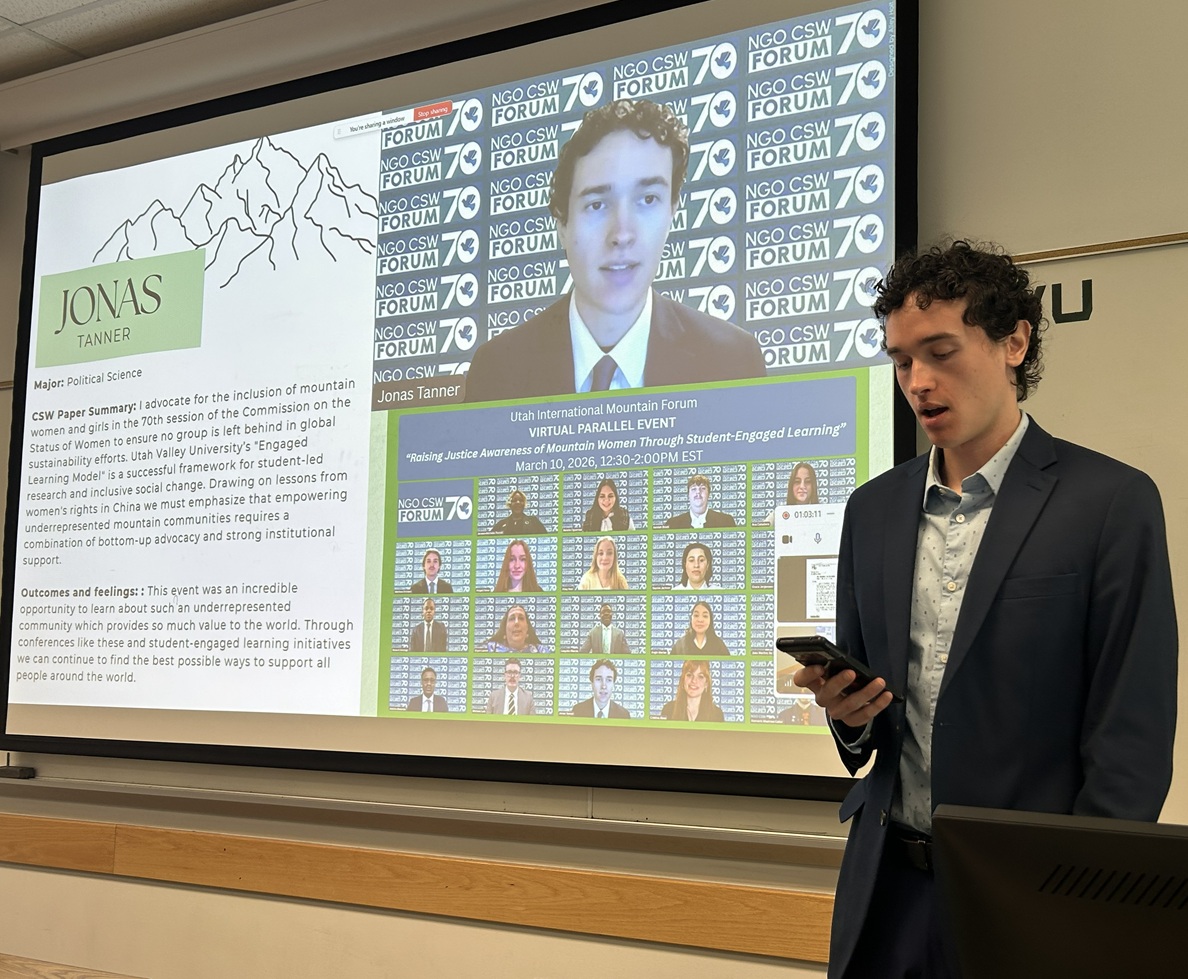
Jonas Tanner presenting to dignitaries
Christina Alvarez:Cristina highlighted her research on Rwanda, and found that despite national progress
in women’s rights, mountain women remain excluded in practice due to isolation, limited
services, and barriers to justice, especially for survivors of gender-based violence.
Cristina also mentioned that she was in person in NYC during the CSW and looked at
what the UN does.
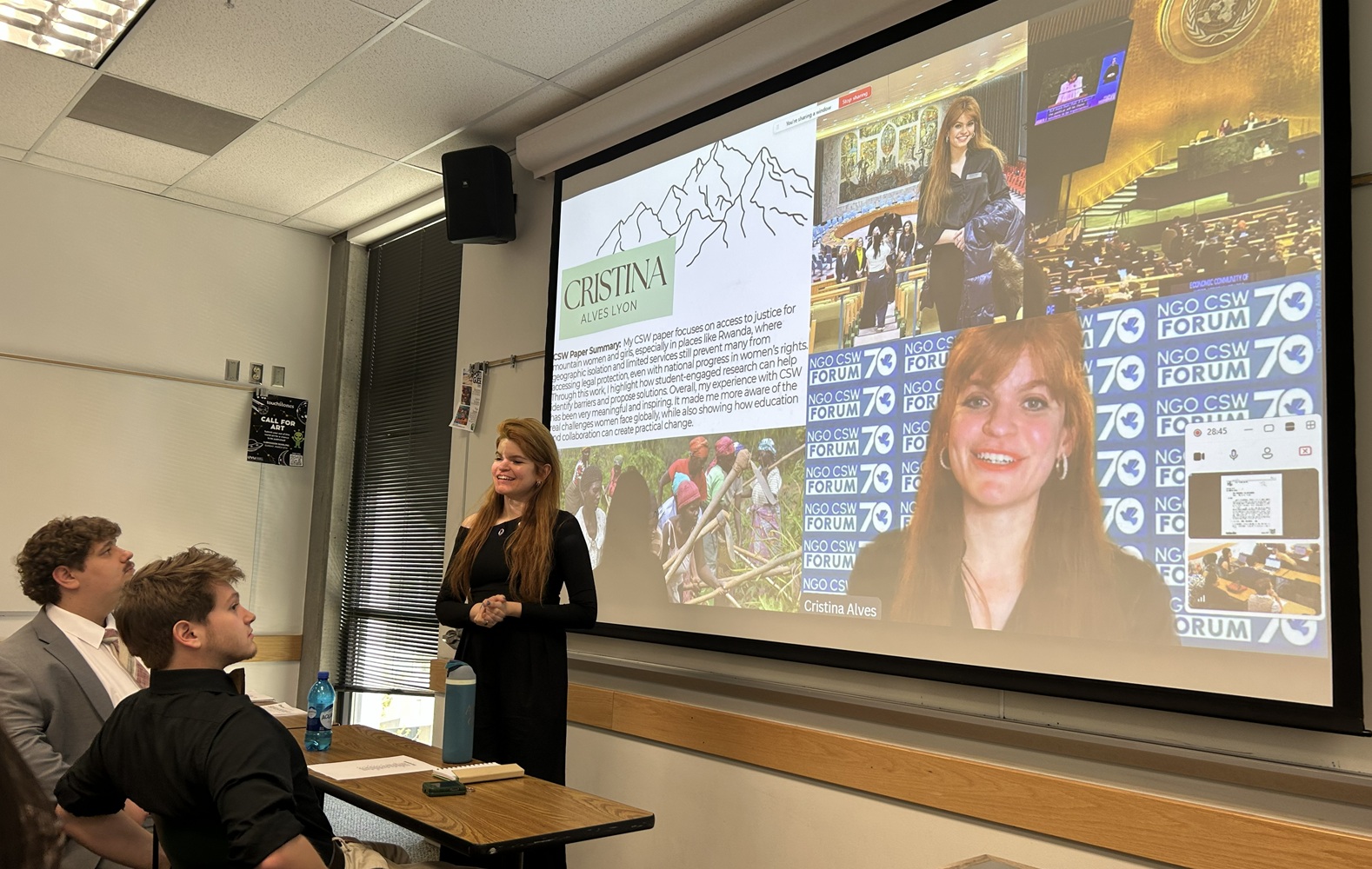
Cristina Alvarez presenting to acting President Wayne Vaught
Dominic Callor: Dominic showed that two of the seventeen sustainable development goals adopted by
the UN in their 2030 agenda are Quality Education and Gender Equality. In Italy, the
accomplishment of these goals is under way as stricter education requirements are
being given to school systems. It is our hope that this development in education can
reach the women and children in Italy's more rural mountainous communities; these
mountain communities being hotspots for gendered inequality
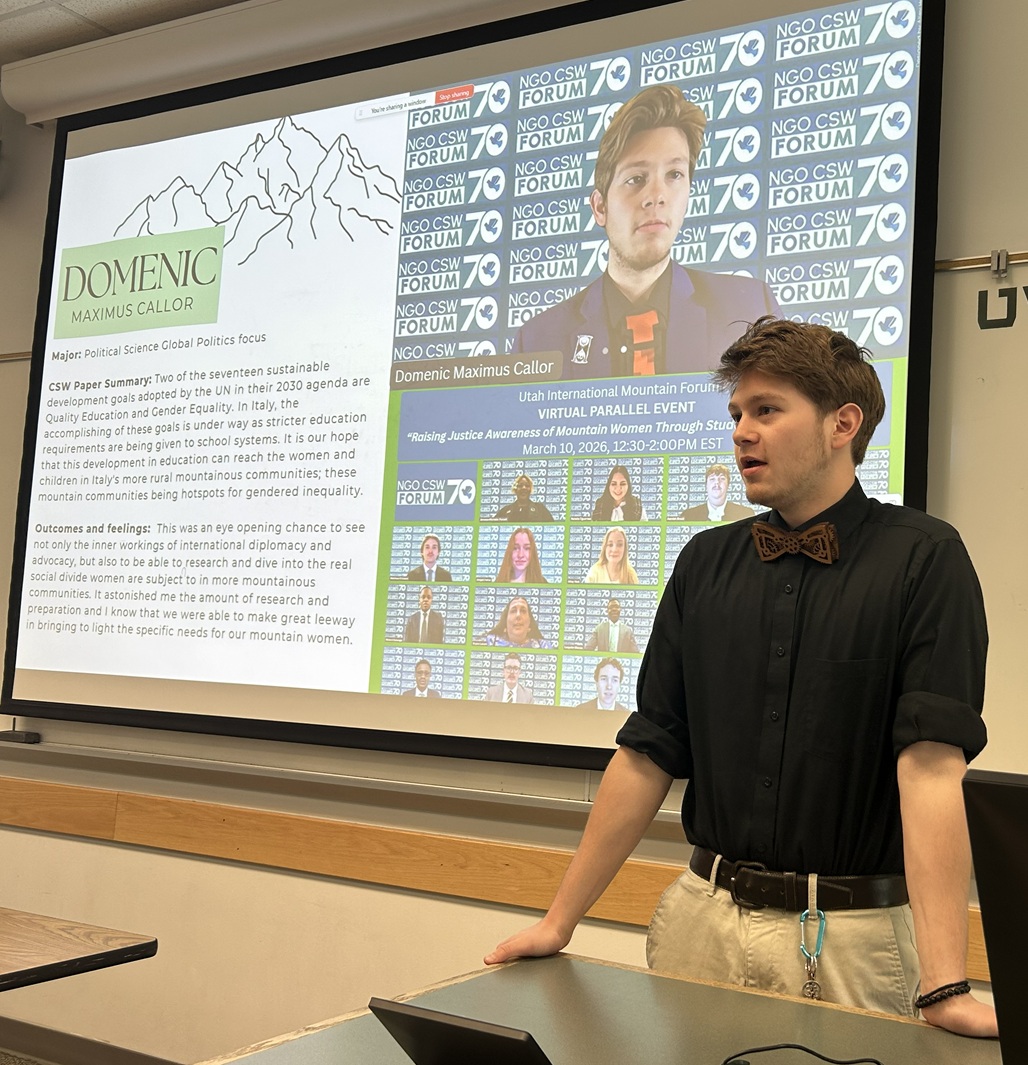
Dominic Callor presenting to dignitaries
Megan Ashcraft: Megan is a Humanities major who aims to pursue a master’s degree in intercultural
communications and become a United Nations ambassador. For her Geneva research project,
she is studying the shortcomings in legislation and enforcement of healthcare equality
for people with disabilities in Utah and Appalachia. As a member of the delegation
attending the Commission on the Status of Women, she did not present but actively
engaged in learning and observing global discussions. The experience left her inspired
and motivated to advocate for important issues, recognizing that persistent voices
can lead to meaningful change.
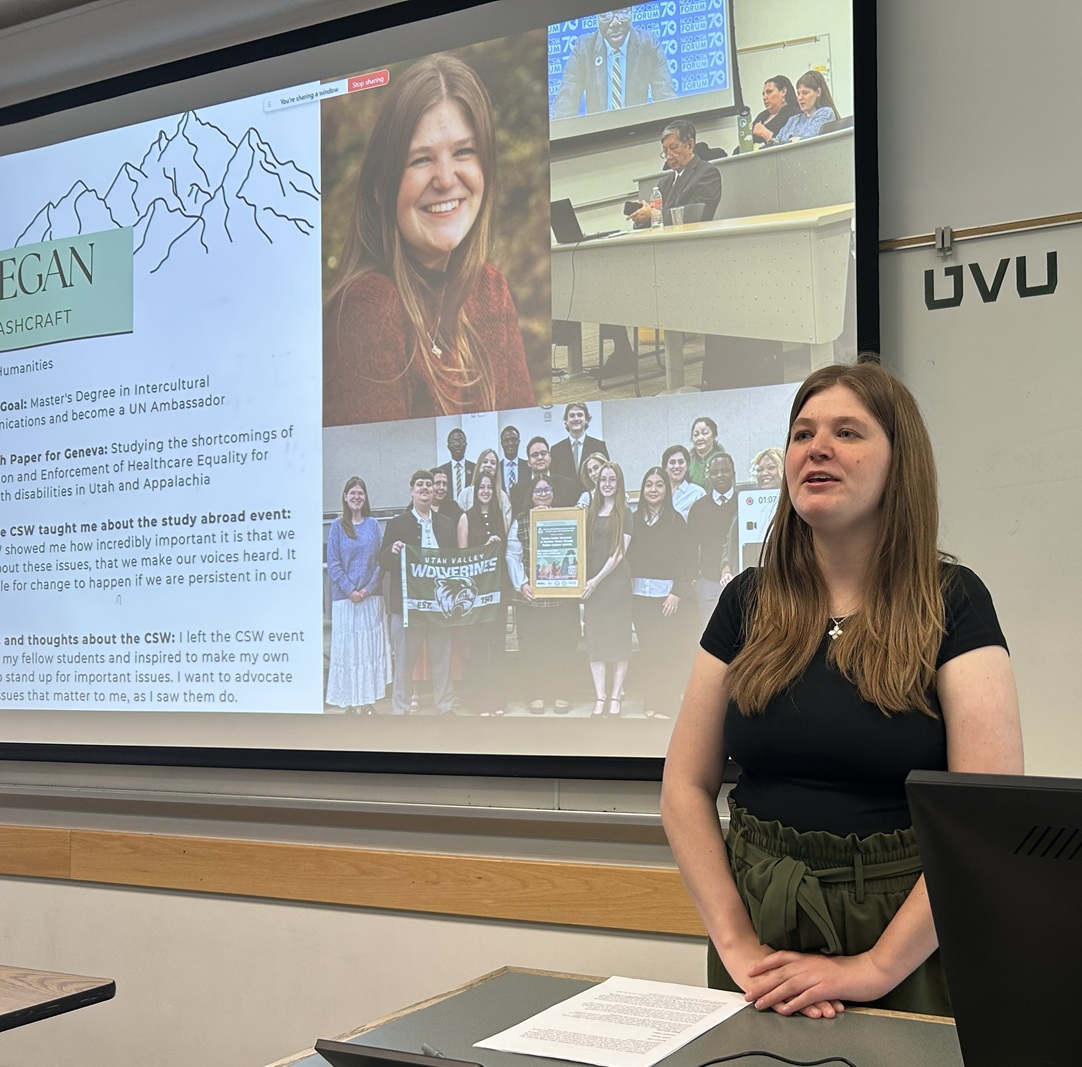
Megan Ashcraft presenting to dignitaries
ByMegan Ashcraft and Natalia Figueroa

