Master of Science Department of Psychology and Counseling
The UVU Clinical Mental Health Counseling M.S. program prepares graduates to provide counseling services that address mental health concerns, including cognitive, emotional, and behavioral symptoms, across individuals, couples, families, and groups. Graduates are prepared for licensure as Clinical Mental Health Counselors in Utah and for careers in mental health agencies, private practice, education, government, military, and community health settings.
60
Credit Hours
Master of Science degree
5
Semesters
Full-time completion (about 22 months)
700
Clinical Hours
Practicum + Internship I & II
NoThesis
Required
Practice-focused curriculum
In-Person
Program Format
Orem, Utah; afternoon & evening classes
CohortModel
Summer & Fall Entry
Students progress through the program together
Clinical Training Depth
UVU CMHC offers clinical assessment training that goes well beyond the screening tools typical of master's-level programs. Students gain hands-on experience with standardized psychological instruments through direct partnerships with Pearson (Q-Global), PAR, and WPS, the same platforms used in professional clinical settings. This depth of assessment training reflects the program's scholarly identity and prepares graduates for the full range of roles they will encounter in practice.
Specialty Areas
The UVU CMHC program offers training in Play Therapy through faculty expertise woven into the curriculum, equipping students to work therapeutically with children using developmentally appropriate approaches. An Animal-Assisted Therapy Certificate is currently in development, reflecting the program's commitment to expanding specialized clinical training options for students.
Animal-Assisted Therapy Certificate: Coming Soon
Clinical Foundation
Faculty expertise in Common Factors therapy shapes how clinical skills are taught across the program. Grounded in decades of psychotherapy research, the Common Factors approach emphasizes the relational and contextual elements (empathy, alliance, hope, and cultural responsiveness) that predict therapeutic outcomes across theoretical orientations. Students develop a research-informed clinical identity that is both theoretically flexible and practically grounded.
Professional Preparation
The UVU CMHC program is designed to take students the full distance, from admission through licensure. Every student is assigned a faculty advisor upon entry. CACREP accreditation supports license portability across states. As an NBCC Approved Continuing Education Provider, the program also serves licensed counselors beyond the degree program. AY 2025–2026 marked a milestone: the first UVU CMHC graduates achieving full independent licensure as Clinical Mental Health Counselors.
The UVU CMHC program is accredited by the Council for Accreditation of Counseling and Related Educational Programs (CACREP) under the 2024 Standards. Accreditation cycle: February 2026 to 2034. CACREP accreditation signals that the program meets nationally recognized standards for curriculum, faculty, and clinical training, and supports license portability for graduates across states.
Our program grounds students in foundational counseling skills before building toward evidence-based theories studied in depth, with advanced specialties recommended for post-graduation training.
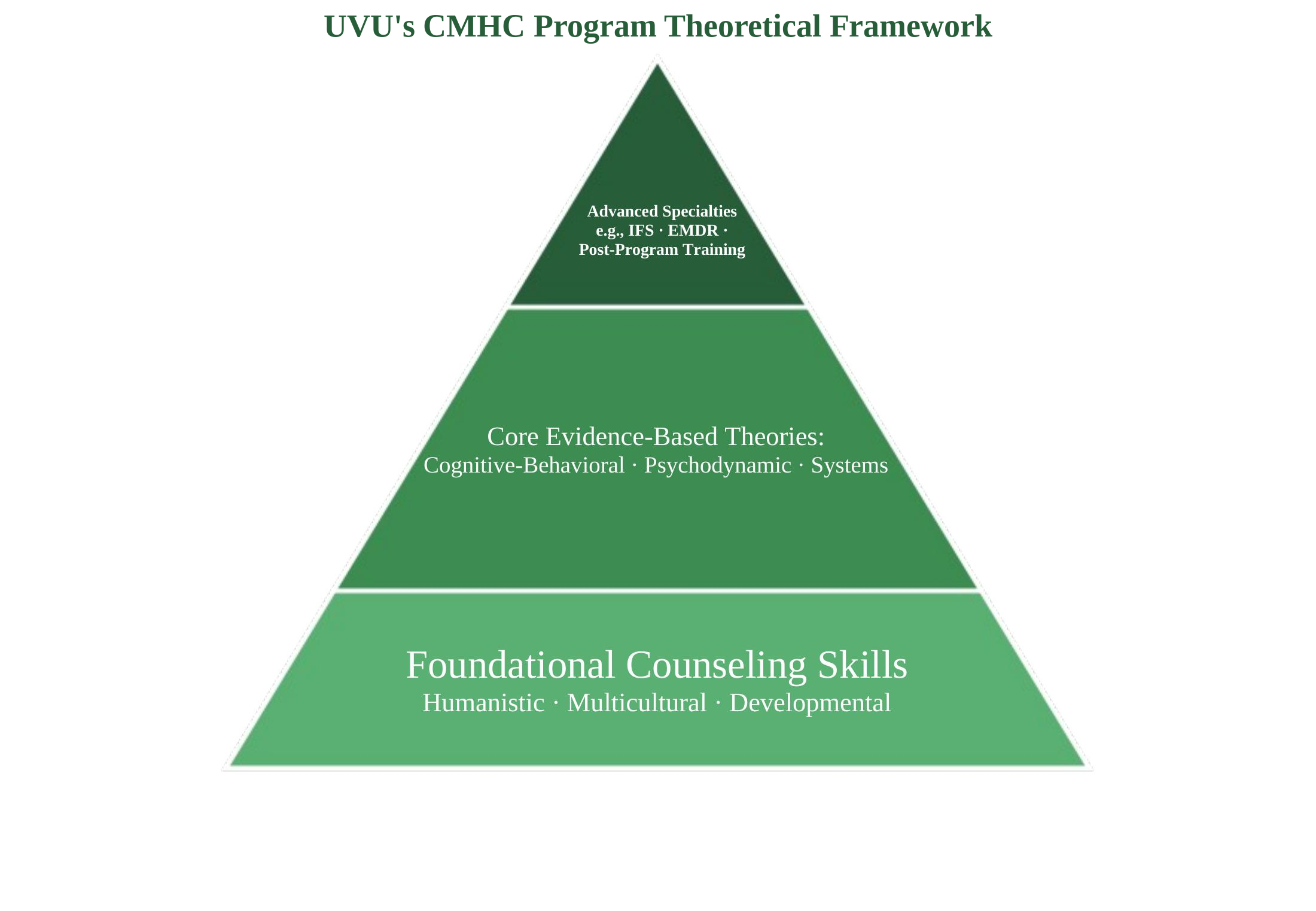
View the framework diagram at full size
The base of our program, grounded in humanistic, multicultural, and developmental frameworks. These core skills are emphasized throughout practicum and internship and inform every level of clinical training.
Cognitive-Behavioral, Psychodynamic, and Systems theories form the program's in-depth emphasis. Dedicated coursework prepares students to apply these evidence-based frameworks across clinical presentations.
Students may be introduced to advanced approaches such as Internal Family Systems (IFS) and EMDR in clinical placement; however, the program emphasizes foundational skills and evidence-based theories as the primary training focus.
Aligned with CACREP 2024 Standards
Graduates of the UVU Clinical Mental Health Counseling program demonstrate the following nine Program Learning Outcomes, organized across three core areas of professional preparation.
CACREP Accreditation Standard 2.E
The UVU Clinical Mental Health Counseling program is committed to transparency and continuous improvement. Each year, we collect and analyze data on student outcomes, program quality, and graduate success. This information, reported as our Annual Program Report, is published here in accordance with CACREP accreditation standards and shared openly with students, faculty, and the broader community.
Below you will find key program outcome data for the most recently completed academic year, followed by a link to the full Annual Program Report.
96%
Completion Rate
Within published program timeframe
100%
Exam Pass Rate
NCMHCE, first attempt (graduate self-report)
100%
Job Placement Rate
Employed in counseling or a counseling-adjacent role within 12 months of graduation
26
Graduates
Degrees conferred AY 2025–2026
Service Hours
Counseling service contributed to Utah communities
| Indicator | AY 2023–24 | AY 2024–25 | AY 2025–26 (most recent) |
|---|---|---|---|
| Students Enrolled | 48 | 53 | 81 |
| Graduates | 21 | 24 | 26 |
| Completion Rate | 91% | 96% | |
| Credentialing Exam Pass Rate | 100% | 100% | |
| Job Placement Rate | 100% | 100% |
Dashes (—) indicate data not systematically collected before the alumni and graduate-survey infrastructure launched in AY 2024–2025. Credentialing exam pass rate reflects NCMHCE first attempt via graduate self-report. Job placement reflects alumni employed in counseling or a counseling-adjacent role within 12 months of graduation.
Outcome data, site supervisor evaluations, and alumni feedback are reviewed each year by program faculty to guide concrete improvements. In AY 2025–2026, this process led to standardized clinical training assignments across the practicum and internship sequence, curricular updates to the Diagnosis course (CMHC 6030), and new hands-on assessment partnerships with Pearson, PAR, and WPS, giving students direct practice with the instruments they encounter in clinical settings.
Download Full Annual Report: AY 2025–2026 (PDF)
The UVU CMHC program is led by faculty who are active scholars, licensed clinicians, and dedicated mentors. Every student is assigned a faculty advisor upon entering the program.