

Whether you're writing your first college essay or diving into a senior thesis, one thing is universally true: your argument is only as strong as your sources. Knowing where information comes from and how to judge whether it's worth using is the foundation of credibility in any field.
Fortunately, this is a skill the Fulton Library is here to help you build. This guide will walk you through everything from the basic building blocks of research sources to the frameworks researchers use to decide whether a source deserves their trust.
What is a Research Source?
A research source is any document, publication, or piece of information you use to support the claims in your work. It could be a journal article, a government report, a book, a speech transcript, or even a photograph. Sources form the foundation of evidence-based academic writing. They allow readers to verify your claims, trace your reasoning, and engage with the broader scholarly conversation you're joining.
Not all sources are created equal, though. And understanding the differences between them is the first step to using them well.
What are the Different Types of Research Sources?
Sources are generally divided into two categories based on their relationship to the original information or event: primary and secondary.
What is a Primary Source?
Primary sources are first-hand accounts or original materials that arise directly from a particular event, time period, or study. Think of these as the raw evidence—the original data, unfiltered by interpretation. Examples include:

- Original research studies (with data, methods, and findings)
- Historical documents (letters, speeches, government records)
- Literary works (novels, poems, plays)
- Oral histories, interviews, and surveys
- Photographs, film footage, or artwork
If you're writing about climate change, an original scientific study measuring ocean temperatures is a primary source. If you're writing about the Civil Rights Movement, a photograph from a 1963 march is a primary source.
What is a Secondary Source?
Secondary sources interpret, analyze, or summarize primary sources. Most scholarly journal articles, academic books, and literature reviews fall into this category. Examples include:
- Journal articles that review or synthesize existing research
- Biographies and historical analyses
- Documentaries
- Critical essays and commentaries
A secondary source takes the raw material of primary sources and draws meaning from it. Much of what you read in your courses will be secondary literature, and that's completely appropriate — it gives you access to expert interpretation.
Quick tip: Whether a source is "primary" or "secondary" isn't always fixed. That distinction depends on how you're using it. A newspaper article from 1945 is a secondary source if you're researching World War II history, but a primary source if you're studying journalism of that era.
What Is a Scholarly Source?
A scholarly source is one written by experts in a field, intended for a specialized academic audience, and produced through a rigorous vetting process. You'll hear the terms "scholarly," "academic," and "peer-reviewed" used almost interchangeably. These sources typically:
- Include full citations and references
- Use formal, discipline-specific language
- Are published in academic journals or by academic presses
- Provide methodological detail and evidence-based conclusions
- Have passed through peer review
Scholarly sources are the gold standard for academic research because they've been scrutinized by the broader academic community before reaching you.
What Is Peer Review, and Why Does It Matter?
Peer review is one of the most important quality-control mechanisms in academic publishing. It’s what sets scholarly sources apart from everything else.
When a researcher submits an article to a peer-reviewed journal, the journal sends it to other experts in the same field (the "peers") who evaluate its methodology, accuracy, and contribution to the discipline before it can be published. The peer review system exists to validate academic work, improve the quality of published research, and maintain standards across disciplines.
When a source is peer-reviewed, it means it has passed a meaningful professional evaluation. That doesn't make it infallible, but it does make it a far more reliable starting point than a lot of other sources.
What is the Difference Between a Scholarly Source and a Popular Source?
The core difference comes down to who writes it, who reads it, and whether it has been peer reviewed. A scholarly source is written by a subject-matter expert for an academic audience and vetted by other experts, while popular sources are written for the general public and published without the same assessments.
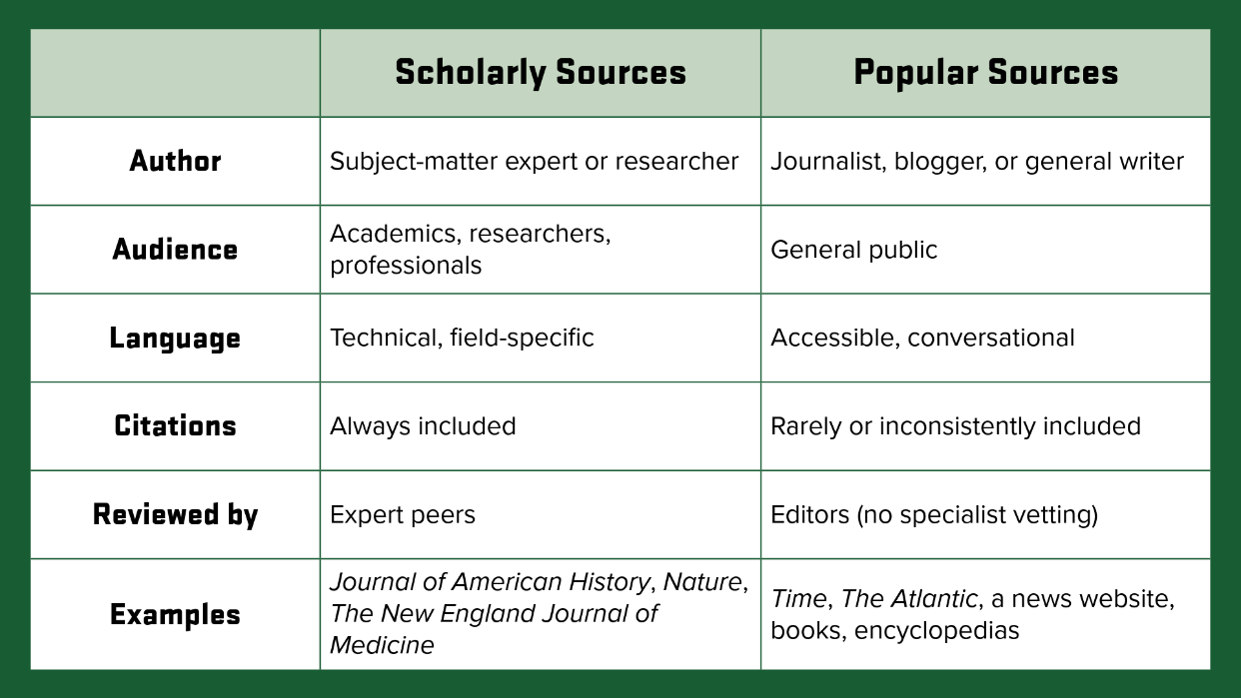
This doesn't mean popular sources have no place in academic research. A news article can be a legitimate primary source if you're studying media coverage of an event. A well-reported piece of investigative journalism might provide useful context. However, if you're making a factual or analytical claim that needs to hold up academically, a scholarly source is where the weight of your argument should rest.
How Do You Evaluate a Source?
Finding a source is one thing. Knowing whether to trust it is another. One shaky source can quietly undercut everything else in your paper, no matter how well it’s written. The habit of evaluating a source before you commit to it will help you far beyond your grade. Spotting weak evidence is a professional skill you’ll use throughout your career and life. There are many strategies for evaluating sources. One popular choice, recommended by librarians at the Fulton Library, is the SIFT Method.
The SIFT Method
Developed by digital literacy expert Mike Caulfield, the SIFT method is built around one core insight: instead of reading a source more carefully in isolation, you should quickly step outside it and check what other sources say about it. It has four parts:
- Stop — Before you dive in, pause. Ask yourself: what do I know about this source? Headlines are often designed to hijack your attention. With this in mind, check your own emotional reaction to the content and look for more information before you trust the source.
- Investigate the source — Who is behind it? Open new tabs and read laterally across multiple sites to get a fuller picture, rather than spending all your time within the source itself. Take the time to look up the author and determine their authority on the topic and any potential biases or conflicts of interest.
- Find better coverage — If a source seems low-quality or unverifiable, look for stronger reporting or analysis of the same claim. You don’t have to use the first source you find that supports your argument. If you find additional coverage on the same topic, use the source that has the best track record of accurate reporting with minimal to no bias.
- Trace claims to the original context — If a statistic or quote has been re-reported, follow it back to where it originated. Claims get distorted as they travel through the internet and are stripped of context. Identifying the claim’s origination helps you ensure that you’re understanding it in the way it was intended.
Credibility is built one source at a time. Evaluating your evidence is what separates an argument that survives scrutiny from one that doesn’t. It may take a little extra work upfront, but assessing your sources before you cite them can save you from rewriting your whole argument if your professor flags a weak source.
Know Your Sources
The ability to find and evaluate sources is a skill that will carry through your academic career and beyond. The same habits that sharpen your argument in a research paper will help you cut through misinformation, make confident professional decisions, and engage critically with the world around you.
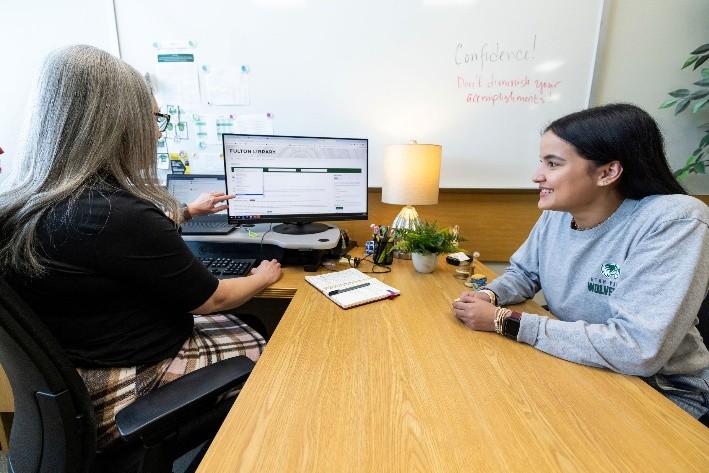
If you have questions about evaluating a specific source or want guidance on what types of sources are appropriate for your assignment, your subject librarians are here for exactly that.
Have other research questions? Check out our Ultimate Guide to Academic Research, stop by the library's reference desk, book a one-on-one research consultation, or reach out through our online chat.