This April, four papyri from the Buried Library at Herculaneum will be on display for only the second time in the United States during the Herculaneum Papyri and AI Conference.
They may have been separated by thousands of years and thousands of miles, but when 11 students from Utah Valley University’s College of Humanities and Social Sciences traveled to Italy to study the ruins of Pompeii and Herculaneum, they didn’t realize how much they’d have in common with the people who lived in those ancient cities.
“You see the plates they have are the same, the bowls, the jewelry, the way the artists haggled,” UVU student Jessi Ferrin said. “You can learn, I think, exponentially more from understanding the history of people who were exactly like you.”
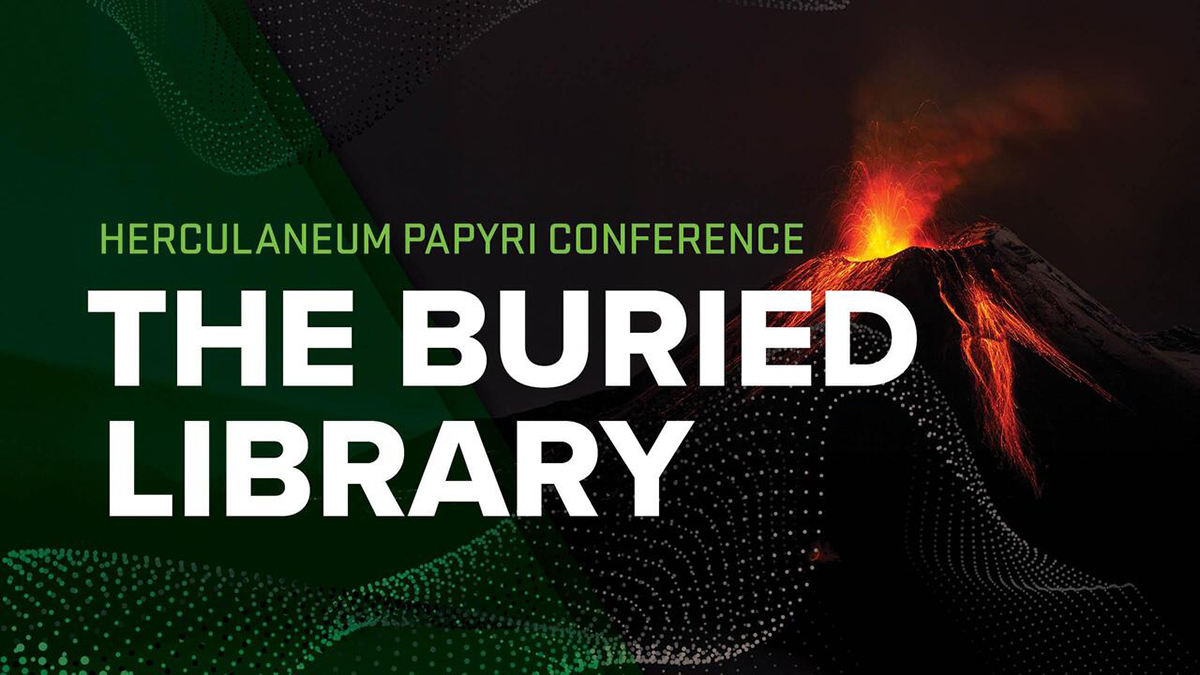
This April, the entire UVU community will have a similar opportunity, as four papyri from the Buried Library at Herculaneum will be on display for only the second time in the United States during the Herculaneum Papyri and AI Conference, held April 7-10 on UVU’s Orem Campus.
“The people working on this project are scattered around the world,” UVU philosophy Professor Michael Shaw said. “This conference allows them to come together and work directly with each other, which we expect will really enhance the research.”
Herculaneum, along with Pompeii and other ancient Roman cities, suffered catastrophic destruction during the eruption of Mount Vesuvius in 79 AD. As with Pompeii, the resulting pyroclastic flow — a combination of superheated mud, ash, and gases — preserved much of the city, including human remains and several hundred papyrus scrolls.
As UVU’s student cohort toured the region, they found themselves amazed by the opportunity to compare their classroom study to the “soul-lightening” reality.
“There’s something really deeply human about going into these ruins,” UVU student Greene Rollins said. “Seeing the very visceral reality of people being in that exact place a little bit less than 2,000 years ago is so very real and incredibly profound. It’s kind of soul-lightening. I don’t know how to describe it other than that.”
“You can learn about history, but until you see what you’re learning about and see the origins of everything that you think you know, it’s hard to really feel it,” UVU student Charlitte Francom said. “I personally just felt that love for the history of culture actualized in seeing where it all began.”
Because of the way the pyroclastic flow preserved so many of the scrolls — charring them but leaving them otherwise intact — the library at Herculaneum is the only one preserved from the classical world. But this process left the scrolls unreadable, because they could not be opened without destroying them.
However, advances in artificial intelligence, along with new imaging and digital scanning techniques, have allowed researchers to virtually “unwrap” the scrolls and detect ink patterns inside the papyri.
“All of the papyrus scrolls were carbonized, so they didn’t decay like the rest of the papyri from the ancient world,” Shaw said. “We now have something like 800 scrolls that can be digitally scanned and virtually unrolled.”
Teams of researchers from across the United States and around the world, including Brigham Young University, the University of Kentucky, the Institut de Français, and more, have collaborated to utilize this technology and read the scrolls. They appear to contain the writings of Philodemus, a philosopher and poet who lived in Herculaneum and may have compiled the library.
“This is one of the most famous uses of AI in the world right now,” Shaw said. “It’s doing things that were considered fundamentally impossible for years.”
The Herculaneum Papyri and AI Conference in April will not only provide a rare opportunity to display these scrolls to the public — it will also bring interdisciplinary academics from across the world together to share their knowledge with each other and the UVU community.
Experts in fields, including classics and philosophy, papyrology, artificial intelligence and computer science, imaging and physics, archaeology and anthropology, and volcanology and geology, will come together during the conference.
“The people working on this project are scattered around the world. This conference allows them to come together and work directly with each other, which we expect will really enhance the research,” Shaw said.
The conference is free to attend with registration. For more information, visit https://www.uvu.edu/philhum/herculaneum/ .

