As artificial intelligence (AI) becomes more prevalent in modern society, the need for AI education has grown. And Utah Valley University (UVU) is rising to meet that challenge.
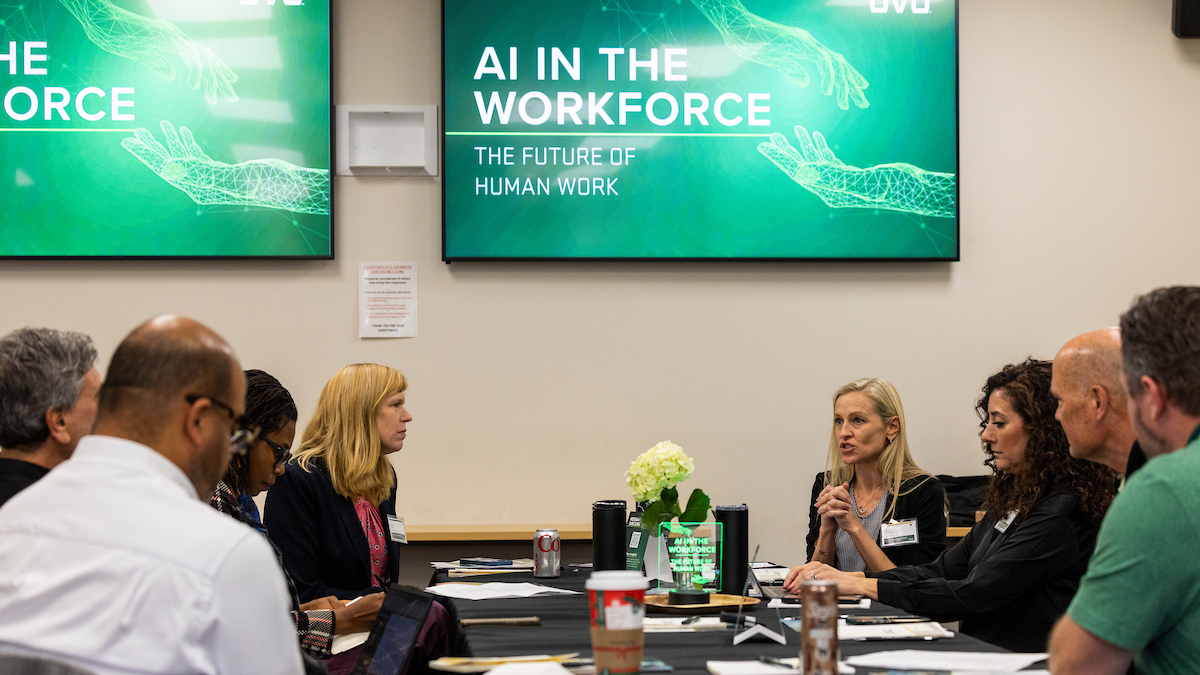
As artificial intelligence (AI) becomes more prevalent in modern society, the need for AI education has grown. And Utah Valley University (UVU) is rising to meet that challenge.
Recent studies show a sharp rise in AI usage. A 2025 Reuters report indicated that more than 60% of people have at least used an AI tool once. And according to a September 2025 survey by the Pew Research Center, 21% of working Americans said some portion of their work is done using AI. More than 60% of teens use chatbots daily, especially for schoolwork.
To respond to this rapidly changing technological landscape, UVU launched the Kahlert Applied Artificial Intelligence Institute in 2025. Anchored by a $5.2 million gift from the Kahlert Foundation, the institute is a living laboratory for the application of artificial intelligence in higher education.
By focusing on applications of this new technology, UVU brings its trademark focus on engaged learning into the AI world, offering a master’s degree in applied AI, a bachelor’s degree in information systems with an AI emphasis, and two certificate programs.
A huge factor in the Kahlert Foundation’s decision to create an applied AI institute at UVU — the first of its kind in Utah — is UVU’s long history of training Utah’s future workforce. More than 90% of UVU students are from Utah, and 74% of UVU alumni still live in the state 10 years after graduation.
On top of that, UVU’s focus on engaged learning and its status as a teaching institution allow for greater flexibility and response to community need, something that’s vital in the constantly shifting AI landscape.
“What excites me most about partnering with UVU is how the university looks to the future, and there is no better example than the Applied AI Institute,” said Heather Kahlert, executive vice president of the Kahlert Foundation. “We see a powerful alignment with UVU’s mission to make education accessible and relevant for every student, and we are proud to help launch this groundbreaking institute.”
Tyson Riskas, Ph.D., one of the UVU professors teaching courses in these programs, said UVU’s focus on application is perfect for preparing students for the workforce.
In one course, Riskas said, “The students come up with one problem they want to solve. And then I have them get into groups, find a problem that they all feel interested in. And then the rest of the semester, they're designing and customizing an AI to solve that problem.”
Grace Wingate, a UVU senior majoring in operations and supply chain management, said her classes in the AI certificate program have tackled practical problems such as customer service request management and chatbot bias testing.
“I know it’s really difficult to get professors to adopt a new technology and be willing to teach something that they're not intimately familiar with,” Wingate said. “But I've really seen at UVU people taking the challenge and really trying to integrate it.”
Brandon Amacher, director of UVU’s Emerging Tech Policy Laboratory (EMTECH) and an instructor in the Center for National Security Studies, has led a team of student researchers in analyzing “deepfakes” — videos created by generative AI that often feature misinformation.
“Something that I really love is that UVU, across departments, has a very strong focus on practical learning,” Amacher said. “UVU had all the necessary pieces to put together a project like this.”
“Before we started any of this, I had a little bit of experience with AI, but I had to train a model from scratch,” UVU student Hope Fager said. “So that's not necessarily something that I had done before, and I had to learn how to do that very quickly.”
The deepfakes project highlights another reason why AI training is so important, especially for students who will be expected to use AI tools in their careers: The technology requires expertise to use effectively, and it’s easy to be deceived, either by erroneous responses or by malicious users.
“When people don't fully comprehend what's going on with AI, they put too much faith in it,” Riskas said. “They over-rely on its answers. And I think that's a dangerous precedent. And I think that's kind of where the ethical boundary is. If I can't validate it, I shouldn't be using it for that.”
“The best thing that I could really tell people is, if something sounds way too good or way too bad to be true — if it's making you way too happy or way too angry — that is something you want to really double check and verify,” Amacher said.
UVU’s students will be forearmed against some of those pitfalls because of their training, Wingate said.
“I think one of the most important things I'm seeing is just students that are willing to use AI and that can use it as more than a search engine,” Wingate said. “They can use it to actually take their work and make it more efficient. Those efficiency gains are what employers really care about.”
For more information on the Kahlert Applied AI Institute at UVU and UVU’s AI degree programs, visit https://www.uvu.edu/ai-institute/.

