Twelve Utah Valley University political science students advocated for mountain and landlocked communities at the World Trade Organization (WTO) and the United Nations (U.N.) this summer, implementing a student-engaged learning model.
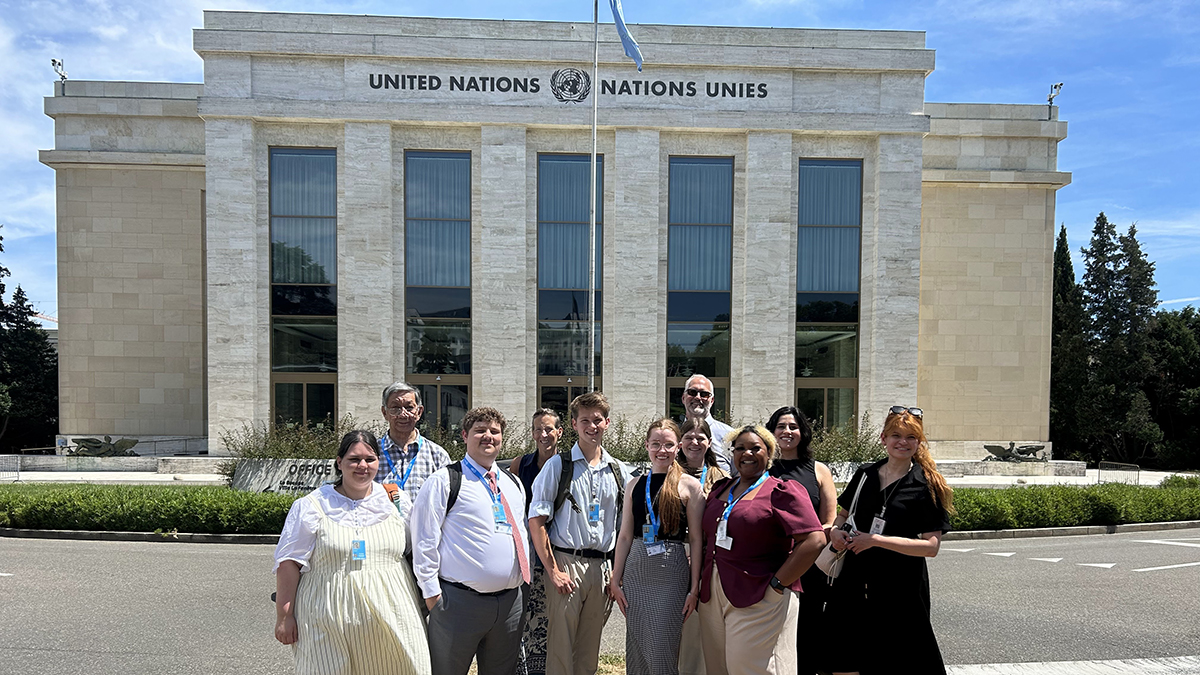
Twelve Utah Valley University political science students advocated for mountain and landlocked communities at the World Trade Organization (WTO) and the United Nations (U.N.) this summer, implementing a student-engaged learning model. The trip was part of a study abroad program led by Baktybek Abdrisaev, Ph.D., a history and political science lecturer, and Jay DeSart, Ph.D., chair of the UVU Department of History and Political Science.
The students are members of the Utah International Mountain Forum (UIMF), a coalition of student clubs at UVU. They advocated for sustainable mountain development in Utah and around the world, with Utah as a model for that development. UIMF president and political science major Natalia Figueroa led the group.
Students also moderated and presented at a WTO event in Geneva, hosted by the Kyrgyz Republic and co-organized with students from Ala-Too University in the Kyrgyz Republic. The event, titled "Empowering Mountain and Landlocked Communities Through Trade Facilitation, Market Access, and Student-Centric Learning," was moderated by Figueroa and Gulsun Toktobaeva, a student from the Kyrgyz Republic. Panel speakers included Raul Torres, WTO focal point for landlocked developing countries; Julia Wolf, U.N. Mountain Partnership coordinator; Nurbek Maksutov, representative of the Kyrgyz Republic to the WTO; David Bisbee, deputy chief of the United States Mission to the WTO; and Zolzaya Dorjtsoo, counselor of the Permanent Mission of Mongolia to the WTO. Faculty mentors Muktar Djumaliev, Ph.D., Abdrisaev, and DeSart participated as panelists.
"This trip is a high-impact educational practice (HIPs) in action; [it] encouraged students to gain skills of entry-level diplomats, which allowed them to successfully moderate, make expert-level presentations, and act as watchdogs at different U.N. forums on sustainable development," Abdrisaev and DeSart said.
While in Geneva, the delegation met with officials from the World Health Organization, the Aga Khan Foundation, and The Church of Jesus Christ of Latter-day Saints charities, and joined a dinner with rotarians and rotaractors from Geneva and Utah, including members of the Orem-Lindon Rotary Club. In New York, students attended the 2026 High-Level Political Forum on Sustainable Development at U.N. Headquarters, where they took part in side events hosted by mountain states and reviewed implementation of the U.N.’s Target Goal 6.6 on protecting water-related ecosystems.
"I saw how political science can lead to careers across human rights, international law, diplomacy, and global institutions, and I realize there is more than one path to meaningful international service,” said Figueroa.
"Being at the United Nations in Geneva and New York, and seeing the countless organizations both inside and outside the U.N. system, showed me how vast the opportunities in multilateral politics are," said Aemish Brock, a political science major with an emphasis in global politics and UVU Foreign Affairs Club president.
Speaking with Ambassador Aida Kasymalieva, permanent representative of the Kyrgyz Republic to the U.N., students and faculty also discussed plans for joint sustainable mountain development advocacy within the U.N.’s Five Years of Action for the Development of Mountain Regions. This built on the program's student-engaged learning model to expand future cohorts' roles in international diplomacy and policy work.

