At UVU’s Business Impact DEN event, Joe Staples shared powerful insights on how mentorship accelerates career growth, builds trust, and strengthens leadership. Learn why great mentors—and becoming one—can transform your professional path.
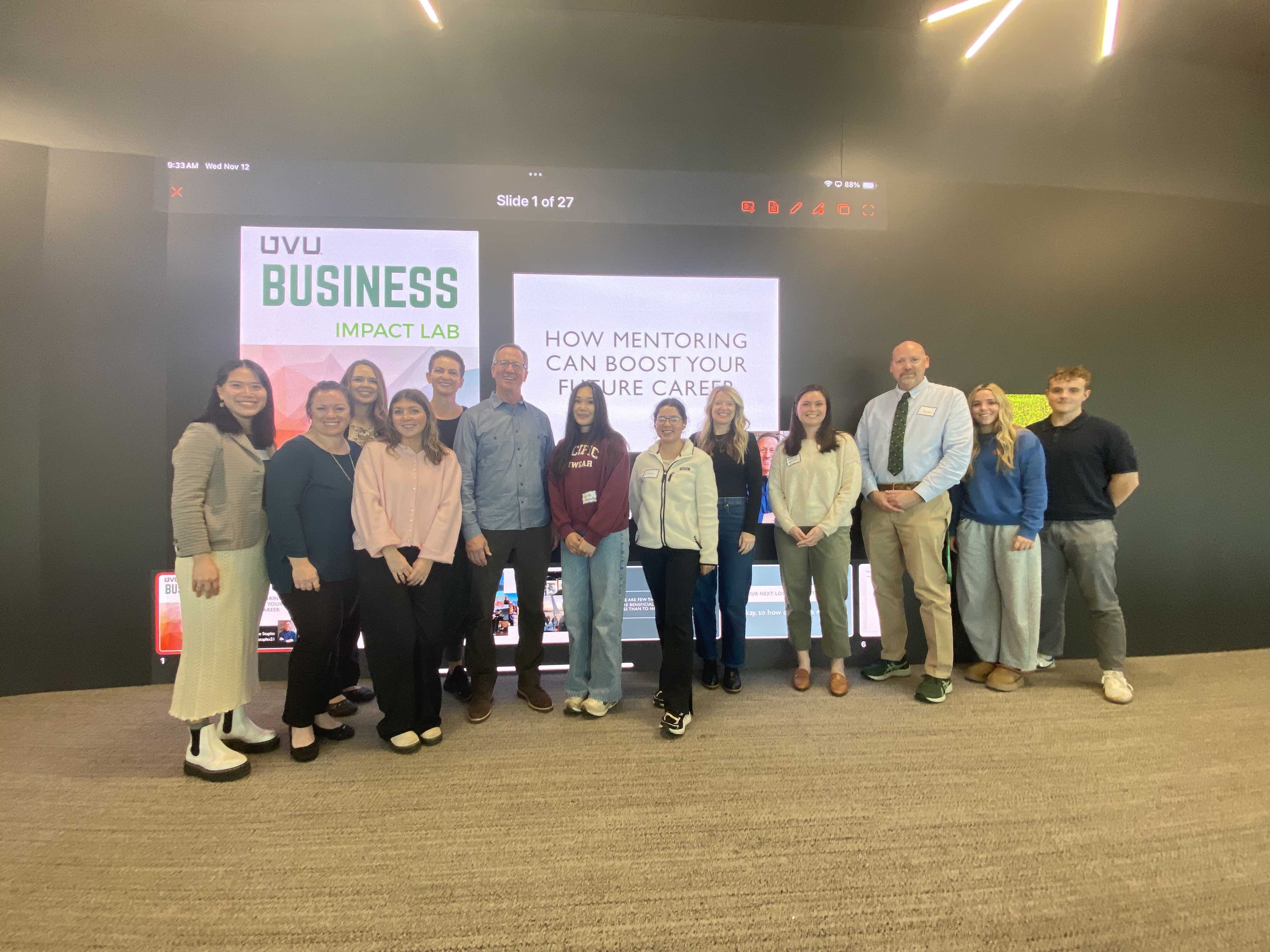
On November 12th, theBusiness Impact Lab hosted another inspiring Impact DEN event, featuring Joe Staples, adjunct professor of organizational behavior and marketing at UVU. Beyond the classroom, Staples brings more than two decades of executive leadership to his teaching. He served more than 20 years in the techsector as a senior B2Bmarketing executive (CMO and SVP of Marketing)and now advises companies on go-to-market strategy while serving on the board of directors for two successful organizations.
A thought leader and speaker, Staples has authored and co-authored articles on customerexperience, marketing, branding, leadership, employee engagement, and work management, and has presented at major global events such as Dreamforce, Enterprise Connect, Interop, CTIA Wireless Expo, and Computer Telephony Expo. He holds a master’s degree in organizational leadership from Arizona State University and is an alumnus of Brigham Young University.
Drawing from this deep well of professional and academic experience, Staples shared one clear message with the audience: few things will accelerate your career more than having great mentors—plural.
From his research, Staples found overwhelming evidence that mentorship profoundly shapes career success. Nearly all participants in his study agreed that mentors made a positive difference in their professional paths—especially early in their careers, when confidence, clarity, and direction are still developing.
When asked what they valued most, mentees consistently cited guidance, confidence, advice, opportunities, and perspective. Remarkably, almost half of respondents said they would trade part of their salary for a truly great mentor—a testament to the long-term return of mentorship on career growth.
At the heart of every strong mentoring relationship is trust, and Staples emphasized that it has two essential forms:
Both are essential. Without personal trust, vulnerability disappears; without competence trust, advice loses credibility. Staples noted that in surveys, trust consistently ranks as the top factor in effective mentoring, followed by time, understanding, and mutual respect—all forms of relational investment.
Staples connected the principles of mentorship to leadership performance, referencing research by author Clint Pulver, who identified four leadership styles based on accountability and connection:
The “mentor” leader—one who combines expectations with empathy—is the most effective. These leaders don’t just produce results; they inspire loyalty, trust, and long-term commitment from their teams.
So, how do you actually find a mentor? Staples reminded the audience that mentorship isn’t a matchmaking service—it’s a journey. Most relationships form naturally through curiosity, respect, and consistent follow-up.
His practical advice included:
Staples illustrated these lessons through personal stories—one about a senior executive who mentored him early in his career, and another about his humorous, unanswered email to billionaire Mark Cuban. The lesson: not every attempt will succeed, but every effort teaches persistence.
When asked how to maintain a mentor relationship without being “too pushy,” Staples encouraged attendees to think from the mentor’s perspective. Mentors gain fulfillment from helping others succeed, so mentees can sustain relationships by showing gratitude, following through on advice, and respecting time boundaries.
He also reminded the audience that most mentoring relationships are informal. Many people realize only in hindsight that someone was a mentor. A simple, authentic question—like “I really admire how you handled that challenge; how did you learn to do that?”—can open the door to meaningful mentorship.
Staples closed with a powerful reminder: you don’t need a title to be a mentor. Everyone is further along the path than someone else. If you’re a sophomore, mentor a freshman. If you just finished an internship, share your insights with someone applying for one. Giving guidance to others puts you in a “mentoring mindset” and often attracts mentors to you in return.
If you’re ready to put Staples’ insights into action:
Show curiosity, take action, and build mutual trust—because mentorship isn’t just about career advancement. It’s about connection, growth, and the lifelong adventure of helping others rise as you do.

