Learn how compensation strategy, market data, and internal equity shape salary decisions. Key insights from UVU’s BIL D.E.N. event on pay and career readiness.
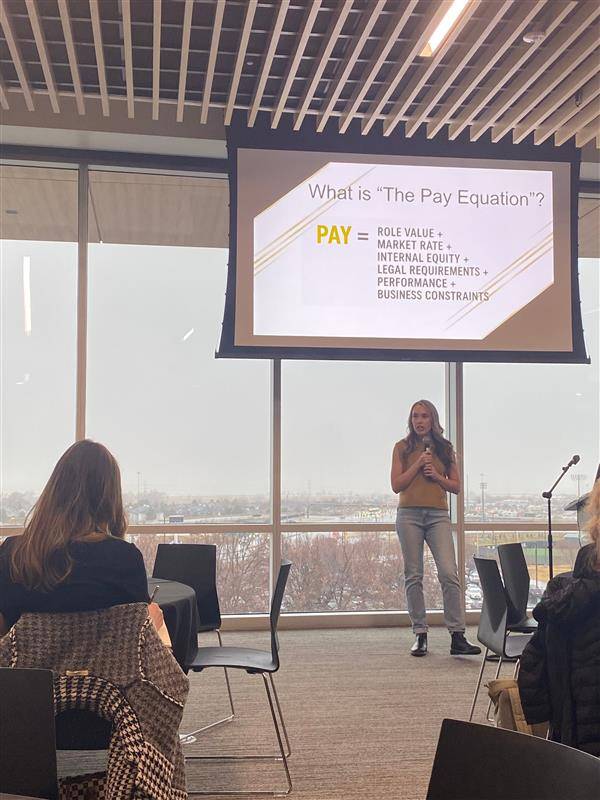
On February 18, Utah Valley University’s Business Impact Lab (BIL) hosted an Impact D.E.N. (Develop • Engage • Network) session focused on compensation strategy and career readiness. The event featured Brittany Davies, Head of People and Culture at Fullcast, who led a conversation titled “Arrive Prepared: The Compensation Strategies Driving Salary Choices.” With a room of students, faculty, and community members, the session created space for practical learning, thoughtful discussion, and real-world tools for navigating pay conversations with confidence.
Brittany opened by explaining that compensation is rarely “just a number.” Salary decisions are shaped by an organization’s compensation philosophy, its approach to attracting and retaining talent, and often fall into one of three strategies: leading, matching, or lagging the market. She shared that companies may choose to lead the market for roles that are essential to their strategic priorities (such as highly competitive, specialized talent); while matching or lagging may be more common in roles that are easier to fill or in industries with tighter budget constraints.
Brittany began by breaking down compensation philosophy, the approach organizations use to attract and retain talent. She explained that companies typically aim to lead, match, or lag the market when setting salaries, depending on their strategic priorities, financial position, and the difficulty of recruiting specific talent.
A key message of the session was that salary decisions are rarely arbitrary. Instead, they are influenced by several interconnected factors, including:
By understanding these drivers, employees and job seekers can better interpret salary offers and engage in more informed conversations about compensation.
Brittany introduced the concept of the “pay equation,” emphasizing that compensation is a balance between external market value and internal organizational value. She explained how companies evaluate roles through job architecture, performance expectations, and market benchmarking to determine fair and competitive pay ranges.
One of the most impactful insights for attendees was the distinction between equity and equality in compensation. Fair pay does not always mean identical pay; rather, organizations strive to distribute compensation in ways that align with role responsibilities, performance, and business needs.
The session also addressed how individuals can prepare salary discussions and long-term career growth. Brittany encouraged attendees to:
She noted that significant salary increases often come through promotions rather than annual merit raises, making it essential for professionals to develop skills beyond their current job scope.
In addition to compensation strategies, Brittany explored how emerging technologies, especially AI, are reshaping the nature of work and value creation. Drawing on historical examples from the Industrial Revolution to the digital age, she highlighted that every technological shift has required workers to rethink how they contribute value.
Rather than viewing AI as a threat, she encouraged participants to see it as a catalyst for new opportunities. Just as previous generations adapted to new industries and roles, today’s workforce will help define the next frontier of work.
Her message was clear:
Continuous learning and curiosity remain the most valuable skills in any era of change.
Key Takeaways from the Session
Looking Ahead
The Impact D.E.N. series continues to create space for meaningful conversations around professional development, leadership, and career readiness. Brittany’s session provided attendees with practical tools and a deeper understanding of compensation systems—empowering them to approach their careers with greater clarity and confidence.
We would also love to invite you to the final session in our series:
Negotiate Like a Pro: Tools & Tactics to Earn Higher Salaries.
Date: March 18, 2026 | 8:30 AM (MT)
Location: Scott C. Keller Business Building, KB 401
In this interactive workshop, you’ll learn how to translate your achievements into compelling value statements, use tactical phrases that command respect, and apply negotiation strategies that can positively shift conversations in your favor.
Registration is free, and breakfast will be provided. We hope you’ll join us as we conclude the series.

