Salary negotiation strategies from Jo Dailami at UVU’s Business Impact Lab D.E.N. event to boost earnings, confidence, and career growth.

Negotiate Like a Pro: Tools & Tactics to Earn Higher Salaries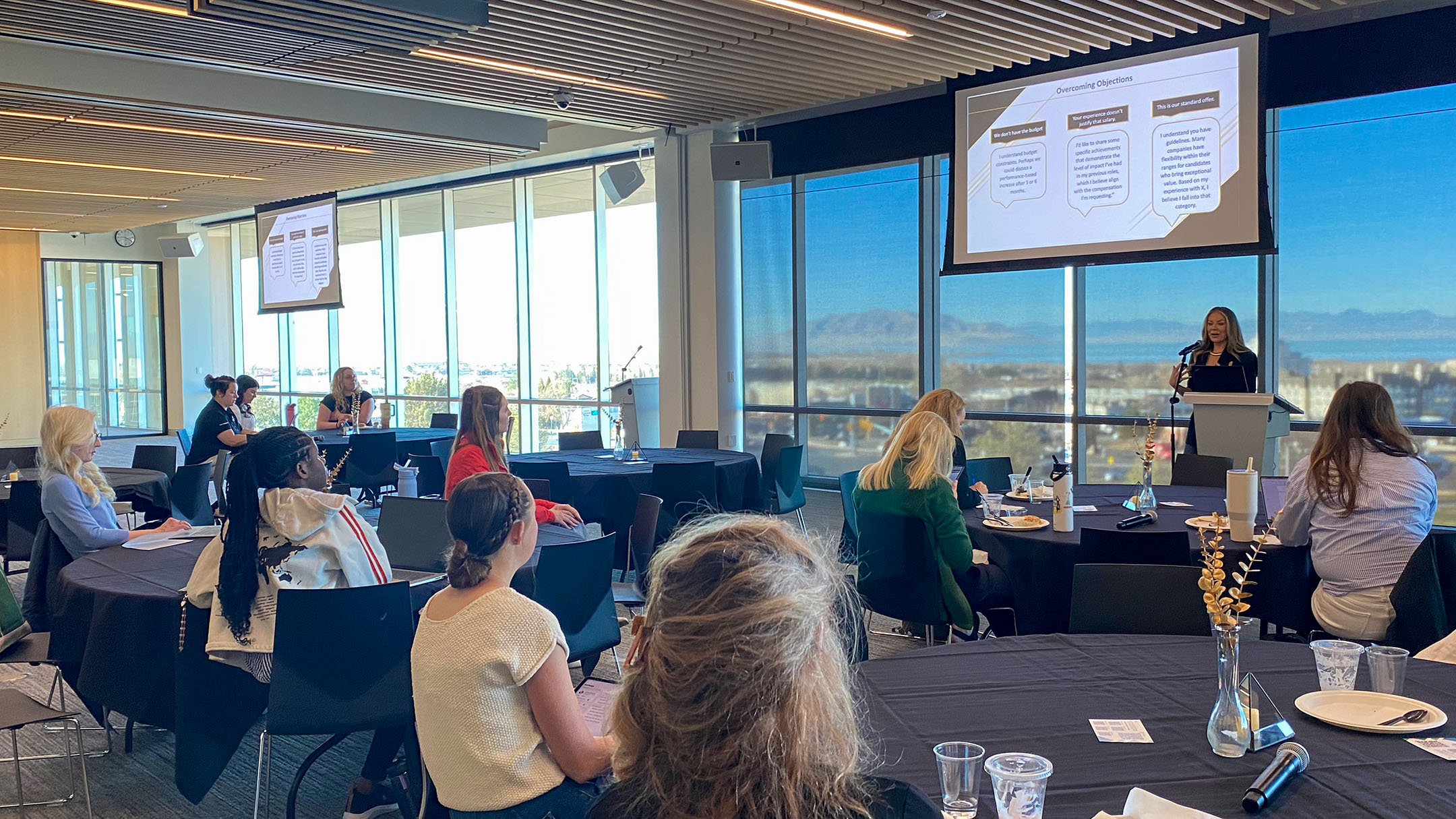
By Alisa Chen, BIL Team Member
The Business Impact Lab recently welcomed Jo Dailami back for an engaging and practical D.E.N. (Develop, Engage, Network) event focused on one of the most critical yet often overlooked career skills: salary negotiation.
Drawing from her expertise in learning and development, leadership training, and performance strategy, Jo delivered a powerful session titled “Effective Salary Negotiation,” designed to equip
participants with actionable tools, strategic language, and the confidence to advocate for their value.
Why Negotiation Matters: It’s About Your Financial Trajectory
Jo began by reframing negotiation as more than a single conversation. Instead, she emphasized that negotiation is about shaping your long-term financial trajectory. As highlighted in her training, even a modest increase, such as negotiating a $5,000 higher starting salary, can compound significantly over time, impacting earnings across 5, 10, and even 30 years.
Her message was clear:
Every negotiation decision today has a ripple effect on your future opportunities, financial security, and overall quality of life.
The Psychology of Negotiation: Overcoming Internal Barriers
A key focus of the session was understanding the mental and emotional barriers that prevent
individuals from negotiating effectively. Jo identified several common limiting beliefs,
including:
•“I should just be grateful for what I’m offered”
•“Negotiating might make me seem greedy”
•“They might withdraw the offer”
•“I don’t have enough experience”
 Through open discussion, participants recognized that fear, scarcity thinking, and
self-doubt often drive hesitation. Jo encouraged attendees to reframe negotiation as a mutual conversation, not a confrontation.
Rather than a win-lose scenario, effective negotiation is about aligning value between
both the individual and the organization.
Through open discussion, participants recognized that fear, scarcity thinking, and
self-doubt often drive hesitation. Jo encouraged attendees to reframe negotiation as a mutual conversation, not a confrontation.
Rather than a win-lose scenario, effective negotiation is about aligning value between
both the individual and the organization.
Preparation is Power: The Work Happens Before the Conversation
One of the strongest themes of the session was that successful negotiations begin long before entering the room. Jo emphasized the importance of data-driven preparation, highlighting tools such as:
•Glassdoor
•Payscale
•LinkedIn Salary Insights
•Bureau of Labor Statistics
•Transparent.Utah.gov (for local salary benchmarking)
She also stressed the need to understand:
•Compensation structures (salary bands)
•Organizational philosophy
•Promotion timelines and criteria
Preparation transforms negotiation from uncertainty into confidence backed by evidence.
From Tasks to Impact: Translating Your Value
A standout concept from the session was “Achievement Translation.” Jo explained that employers are not just evaluating effort; they are evaluating impact. Participants were encouraged to reflect on their contributions by asking:
•What problems have I solved?
•How have I improved processes?
•What measurable results have I created?
•How have I contributed to business goals?
She talked about the STAR Method (Situation, Task, Action, Result) as a powerful way to communicate value clearly and professionally. By transforming daily tasks into measurable outcomes, individuals can confidently demonstrate how they contribute to organizational success.
Communication Matters: Presence, Language, and Confidence
Jo highlighted that negotiation is not only about what you say, but also how you say it. Key communication strategies included:
•Strong, confident posture and body language
•Controlled tone and pacing
•Avoiding overly apologetic or uncertain language
•Practicing clear and assertive statements
She referenced research showing that “power posing” can increase confidence and reduce stress, reinforcing the connection between physical presence and performance.
One of the most practical and memorable tools Jo shared was the power of silence. After stating a salary expectation or request, many individuals instinctively try to fill the silence. However, Jo emphasized that pausing creates space, allowing the other party to respond, and often leading to better outcomes. This small but powerful technique can shift the dynamic of a negotiation significantly.
Strategic Language: Framing Your Ask
Jo provided participants with practical phrases to confidently navigate negotiation conversations, such as:
•“Based on my research of similar roles in this market…”
•“Considering the value I bring to this position…”
•“The market range for professionals with my background is…”
•“I’ve consistently delivered results that exceed expectations…”
These statements help shift the conversation from opinion to evidence-based positioning.
Handling Objections: Staying in the Conversation
Jo reminded participants that hearing “no” is not the end. It is part of the process. Instead of withdrawing, effective negotiators:
•Reaffirm their value
•Provide evidence of impact
•Explore alternatives (e.g., performance reviews, future increases)
Self-advocacy, she emphasized, is essential. Opportunities rarely improve without asking.
Looking Beyond Salary: Understanding Total Compensation
Another critical takeaway was the importance of evaluating total compensation, not just base salary. Jo encouraged participants to consider:
•Flexible work arrangements
•Additional PTO
•Professional development funding
•Bonuses and equity
•Mentorship opportunities
•Technology support
•Career growth pathways
These elements can significantly enhance both financial and personal outcomes.
Jo concluded the session by integrating the key pillars of effective negotiation:
•Preparation → Research, data, and understanding the market
•Mindset → Overcoming limiting beliefs and building confidence
•Communication → Clear, strategic, and confident delivery
•Value Translation → Demonstrating measurable impact
•Strategy → Handling objections and considering total compensation
Final Reflection
This session reinforced that negotiation is not about being aggressive or demanding. It is about being prepared, intentional, and confident in your value.
Even small improvements in how individuals approach negotiation can lead to significant long-term impact in both career growth and financial outcomes.
The Business Impact Lab extends sincere appreciation to Jo for sharing her expertise and to all participants for contributing to a thoughtful and engaging discussion.

