Professional development takes more than training. Learn how practice, feedback, and room to experiment help employees build lasting capabilities.
Over the past few years, I have spent a considerable amount of time learning how to use AI effectively in my teaching and research.
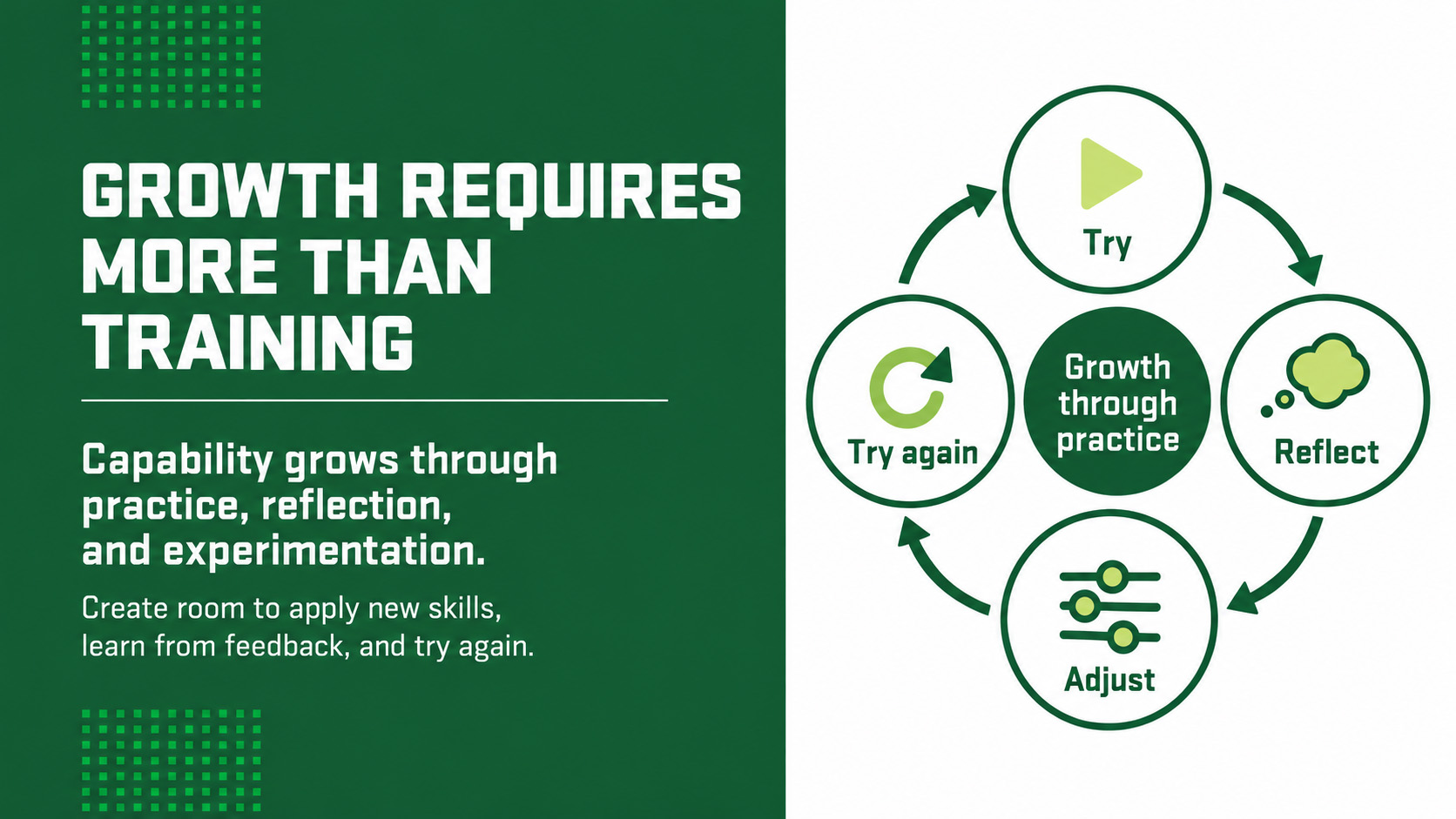
There was no single workshop or training session that taught me what I needed to know. Much of the learning happened through doing: trying something, discovering that it didn't work as expected, adjusting my approach, and trying again. Each successful application made the next experiment a little easier.
That experience has made me think differently about professional development.
Organizations devote significant resources to teaching employees new skills. But learning something and becoming capable of using it are not quite the same thing.
Experiential learning theory helps explain why. Kolb (1984) describes learning as a cycle involving experience, reflection, conceptualization, and experimentation. We learn not simply by acquiring information, but by doing something with it, thinking about what happened, making sense of the experience, and trying again.
My experience learning to use AI has followed this pattern repeatedly.
I might learn about a new capability and immediately think of a potential application. Sometimes it works. Sometimes the result is disappointing. Either way, I learn something from the experience. I adjust the prompt, reconsider the task, or decide that AI isn't particularly useful for that purpose.
Then I try something else.
Over time, those individual experiences accumulate into something quite different from knowing about AI. They develop the ability to make judgments about when and how to use it.
That distinction matters for organizations because most professional development ultimately has the same goal. We don't simply want employees to know more. We want them to become more capable.
One of the persistent challenges in workplace learning is transfer: whether something learned in training is actually applied on the job.
Research on training transfer has long demonstrated that what happens in the work environment matters to whether employees use what they have learned (Baldwin & Ford, 1988).
An employee can attend an excellent workshop and leave with new knowledge, useful tools, and good intentions. But back at work, competing demands return. Existing routines take over. There may be few opportunities to practice the new skill, little feedback, or even subtle pressure to continue doing things the way they have always been done.
The training may have been successful.
The transfer was not.
This suggests that evaluating development solely by the quality of the learning experience misses an important part of the equation.
We also need to consider the environment employees return to.
Learning something new almost always involves a period of being less efficient at it.
That can be uncomfortable in organizations that place a premium on immediate competence.
Experimentation also means that some attempts will not work. If every unsuccessful attempt is treated as a failure, employees quickly learn that sticking with established approaches is safer than trying something new.
This is where psychological safety becomes relevant to development. Edmondson (1999) describes psychological safety as a shared belief that a team is safe for interpersonal risk-taking. In psychologically safe environments, people are better able to ask questions, acknowledge uncertainty, discuss mistakes, and offer ideas.
When employees are developing new capabilities, those behaviors are essential.
They need to be able to say, "I'm not sure how to do this yet."
They need opportunities to test an approach.
They need feedback.
And occasionally, they need the freedom to discover that an idea simply doesn't work.
If organizations want professional development to result in changed capabilities rather than completed training, several things need to happen after the formal learning ends.
Create immediate opportunities for application. New knowledge is more useful when employees can connect it to real work rather than waiting months for an opportunity to use it.
Allow experimentation. Employees need some latitude to try different approaches and learn from the results.
Build in reflection. Experience alone does not necessarily produce learning. Asking what worked, what didn't, and what should change next time turns experience into insight.
Provide feedback. Employees developing a new capability need information that helps them refine what they are doing.
Make repeated practice possible. One successful attempt rarely creates expertise. Capability develops through continued application across different situations.
My experience with AI has reminded me that learning rarely happens in a straight line.
It is iterative.
We learn something. We try it. We make mistakes. We adjust. We try again. Gradually, something that initially required considerable thought becomes easier, and our judgment becomes more sophisticated.
Organizations cannot create that kind of development simply by providing information or sending employees to training.
They also have to create the conditions in which learning can continue after the training ends.
That may be one of the most important distinctions between organizations that provide professional development and organizations that truly develop people.
Growth requires opportunities to learn.
But it also requires an environment in which people have the opportunity—and the permission—to put that learning into practice.
References
Baldwin, T. T., & Ford, J. K. (1988). Transfer of training: A review and directions for future research. Personnel Psychology, 41(1), 63–105. https://doi.org/10.1111/j.1744-6570.1988.tb00632.x?utm_source=chatgpt.com View Baldwin, T. T., & Ford, J. K.'s Transfer of training
Edmondson, A. (1999). Psychological safety and learning behavior in work teams. Administrative Science Quarterly, 44(2), 350–383. https://doi.org/10.2307/2666999?utm_source=chatgpt.com View Edmondson, A.'s Psychological safety and learning behavior in work teams
Kolb, D. A. (1984). Experiential learning: Experience as the source of learning and development. Prentice-Hall.

