Explore Stuart J. Green’s approach to regeneration and how vulnerability, compassion, and psychological safety support leadership and growth.
As part of my responsibilities as a member of the Business Impact Lab team, I am privileged to co-host a podcast that highlights business and thought leaders who come from vastly eclectic fields with such unique and enlightening perspectives. These guests leave me inspired as well as grateful that these individuals are choosing to create meaning from their own experiences and share it in a way that provides learning and insights for whoever is listening. Today was especially impactful as our guest on the podcast shared his experiences and subsequent findings that circled around the concept of regeneration.
Stuart J. Green hails from the UK, but much of his work was conducted in the Asia-Pacific region, where he lived for many years and devoted much of his professional life to effectuating real change in the lives and communities there. It was against this backdrop – along with other experiences he shared – that Green developed what would eventually become the thesis for his book The Regenerate Leap (2026). He helped businesses and communities shift from operating in one industry to transitioning into others, as laws and trends required many challenging adaptations to continue thriving and surviving.
As Green described the painstaking process of walking individuals, companies, and communities through these adjustments, he mentioned “resilience” as a term often used as encouragement for those facing some sort of crisis that demanded rebuilding. Green challenged the usefulness of resilience when circumstances have fundamentally changed. While resilience can help individuals and organizations recover from temporary setbacks, he posits that it can become a trap when recovery means attempting to return to conditions that no longer exist. In those circumstances, regeneration offers a more productive path forward.
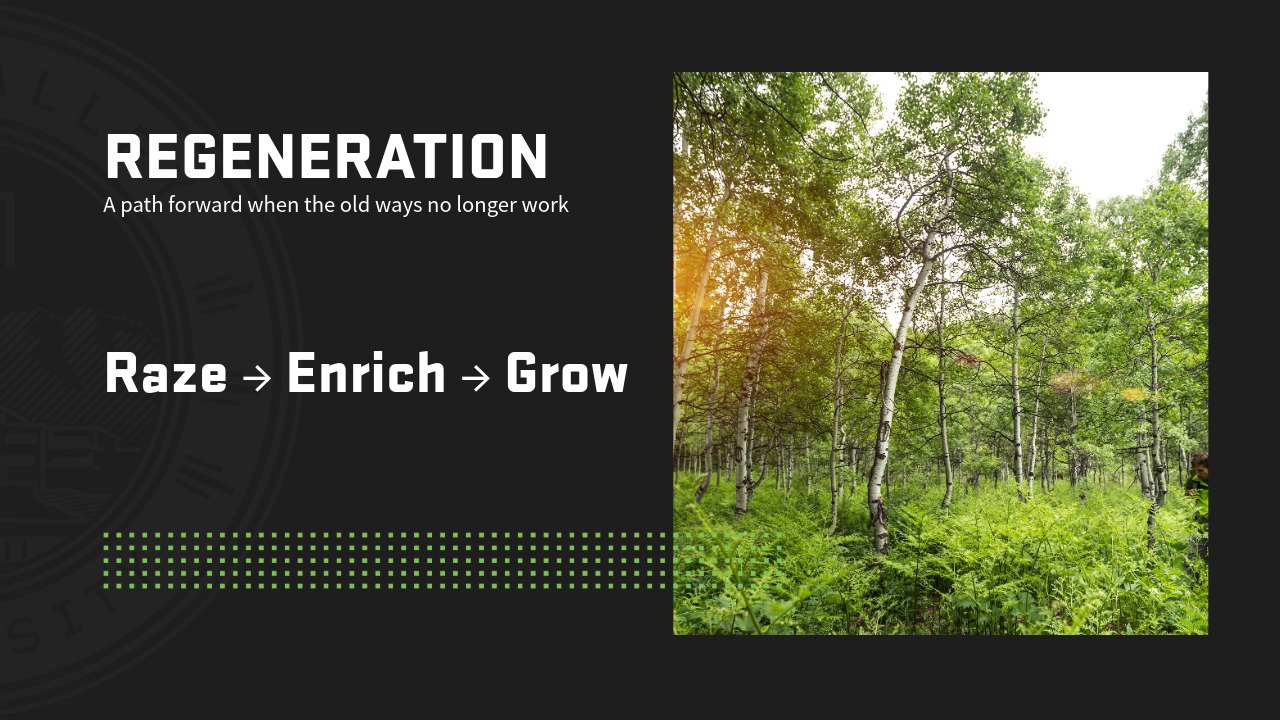
Green described a beautiful road trip with his children near Crater Lake where there were three separate views they experienced in just a few hours of travel. First, they encountered a blockade due to an active fire in the area. Next, they entered a scene in which new growth was emerging after a fire. Finally, they came upon a forest full of vibrant, mature growth. Green’s son pointed out that the progression of the forest mirrored their own personal growth (Owens-Jackson & Erickson, 2026, 12:05). Green explained that this imagery sits at the heart of his book, which lays out a path to regeneration and growth in the face of disruption or crisis, as it applies personally as well as organizationally.
Green’s framework has three phases:
Raze: A phase in which it is necessary to let go of assumptions, systems, and practices that are no longer serving their purpose.
Enrich: The phase where fertile ground has been laid for new possibilities, capability, and relationships to emerge.
Grow: This is a development phase for a new system that adapts well to the changed environment.
This process safeguards what is still valuable and allows for innovative solutions to propel a person, company, or community forward.
Green then shared that his own work took on new meaning when he experienced his own crisis. Suddenly, the very methods he was applying in his professional life were now needed in his personal life. This was a turning point in the podcast I was not expecting. Green’s vulnerability and courage to outline his family’s tragedy and subsequent path of healing and regeneration were the catalyst for his book, and it is also a beautiful illustration of how the regeneration concepts can be successfully applied. Green’s willingness to make his private journey a shared experience for anyone who reads his book or hears his voice elevates his message in a profound way.
I will leave the rest of the narrative to Green (you can find the podcast here). However, I want to expand upon ideas that support Green’s concepts on regeneration by considering the role of vulnerability and compassion as they relate to hardship in the workplace. I was struck by Green’s observation that his own vulnerability had opened the door for others to acknowledge struggles they had been carrying silently for years. He referred to these individuals as the “walking wounded.” By sharing his own pain, Green became aware of who they were and that they were suffering: “Myself being able to share my vulnerability, I unlocked their vulnerability” (Owens-Jackson & Erickson, 2026, 29:48). His observation raises an important question for organizational leaders: How many people within our organizations are carrying invisible burdens, and what responsibility do leaders have to create environments where those individuals feel seen, supported, and respected?
Research offers a useful lens. Edmondson (1999) introduced the concept of team psychological safety, “a shared belief held by members of a team that the team is safe for interpersonal risk taking” (p. 350), and found it was associated with learning behavior in work teams. Compassion in organizations, according to Kanov et al. (2004), involves three subprocesses: noticing another’s pain, feeling an emotional reaction to it, and acting in response. Organizational compassion emerges when members of a system collectively notice, feel, and respond. Dutton et al. (2006) further argue that the same structures designed for the normal work of organizations can be redirected to respond to members’ pain. However, disclosure regarding pain and crises is never risk-free. A review of employees disclosing mental health conditions at work documents both positive and negative impacts that follow (Richard et al., 2026). That is why the climate that leaders create matters so much.
Green’s story in combination with the research on adjacent issues, stands out to me because of what it asks of us before we act: to notice and be willing to do things differently. Compassion in organizations begins when people notice, feel, and respond to another person’s pain (Kanov et al., 2004). Noticing also often depends on people feeling safe enough to be seen. Being willing to be vulnerable by sharing our own pain may be just the impetus for creating a space of safety for others to be vulnerable. That said, vulnerability should be invited, not expected, because disclosure carries real risk (Richard et al., 2026).
Psychological safety, in turn, is associated with the kind of learning behavior that growth requires (Edmondson, 1999). Taken together, this research suggests that when people feel safe enough to acknowledge their struggles, they may be better positioned to seek support, build connection, and take part in the learning and change that growth involves. Vulnerability alone does not guarantee healing, but it can open a door to compassion and connection that might otherwise stay closed. Regeneration may begin with one person willing to say, “This is what happened to me,” and another who is ready to listen.
Second region (Section 1)
References
Dutton, J. E., Worline, M. C., Frost, P. J., & Lilius, J. (2006). Explaining compassion organizing. Administrative Science Quarterly, 51(1), 59–96. https://doi.org/10.2189/asqu.51.1.59 View Dutton, J. E., Worline, M. C., Frost, P. J., & Lilius, J.'s Explaining compassion organizing
Edmondson, A. (1999). Psychological safety and learning behavior in work teams. Administrative Science Quarterly, 44(2), 350–383. https://doi.org/10.2307/2666999 View Edmondson, A.'s Psychological safety and learning behavior in work teams
Green, S. J. (2026). The regenerate leap: How leaders transform crisis into enduring growth. Blue-Green Advisors Ltd.
Kanov, J. M., Maitlis, S., Worline, M. C., Dutton, J. E., Frost, P. J., & Lilius, J. M. (2004). Compassion in organizational life. American Behavioral Scientist, 47(6), 808–827. https://doi.org/10.1177/0002764203260211 View Kanov, J. M., Maitlis, S., Worline, M. C., Dutton, J. E., Frost, P. J., & Lilius, J. M.'s Compassion in organizational life
Owens-Jackson, A., & Erickson, L. (Hosts). (2026, October 19). Beyond resilience: Rethinking leadership when the old ways no longer work with Stuart J. Green (Season 8, Episode 7) [Audio podcast episode]. In Business Impact LabPodcast. https://www.podbean.com/ew/pb-g3wa3-1b8b6c2 View podcast episode: Owens-Jackson, A., & Erickson, L. (Hosts). (2026, October 19). Beyond resilience: Rethinking leadership when the old ways no longer work with Stuart J. Green
Richard, C., Corbière, M., Fiset-Renaud, H., Caiada, M., Lamontagne, J., Diotte, F., Kik, A.-M., Merlo, R., & Lecomte, T. (2026). Disclosure impact of mental health conditions in the workplace: A scoping review and a thematic analysis. Journal of Occupational Rehabilitation, 36(1), 131–166. https://doi.org/10.1007/s10926-025-10288-1 View Richard, C., Corbière, M., Fiset-Renaud, H., Caiada, M., Lamontagne, J., Diotte, F., Kik, A.-M., Merlo, R., & Lecomte, T.'s Disclosure impact of mental health conditions in the workplace

