Untold

Spring 2026

Photo titled Rain and Fire by Benjamin Lopez

Newborn Dreams

Sydney Sijan

Newborn Dreams

I dreamt
Of holding

My newborn son.


Red fingers
Wrapped around
My callused thumb.

His mother walked beside me.
Our soles on the cold garden’s sacred steppingstones
were the polyphonic harmony
That played in perfect plucking the winter night


The lavender of her hand graced mine.
Late season crocuses blossomed,
Whose pollen sang of delicate nights that would become May days.


I smelled
His skin,
Softness against mine,


Her-like,
Womb-fruit,
He was divine.


In the moonlight,
Stray strands of her hair were captured like spun sugar.
Umber to the most vivid pieces of blue.


In the dewy light’s glory,
A single hair upon her head
Shamed the snow’s beauty.


I awoke
And held his mother,
hands on her stomach,
unpregnant.

Map Close

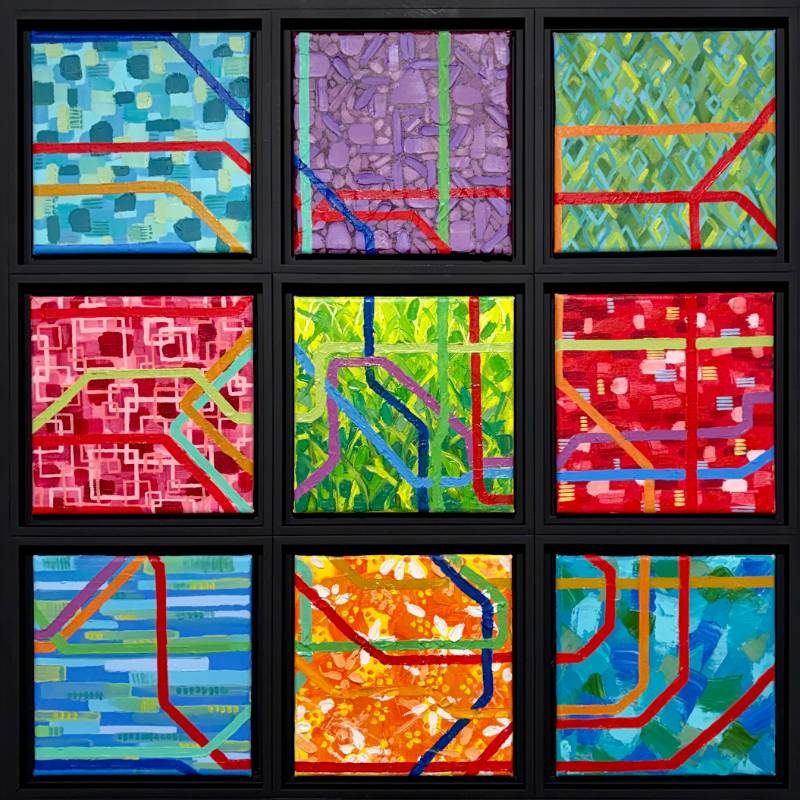
Metro Moquette

Mckenna Mitchell

Featuring moquette—the durable fabric of
transit seating—this piece layers vibrant
Tokyo textile patterns over a condensed
blueprint of the metro map. It is a collision
between the soft comfort of the commute and
the beautiful maze of the city itself.


SEE MORE

Map Close

Featuring moquette—the durable fabric of
transit seating—this piece layers vibrant
Tokyo textile patterns over a condensed
blueprint of the metro map. It is a collision
between the soft comfort of the commute and
the beautiful maze of the city itself.


Context Framework
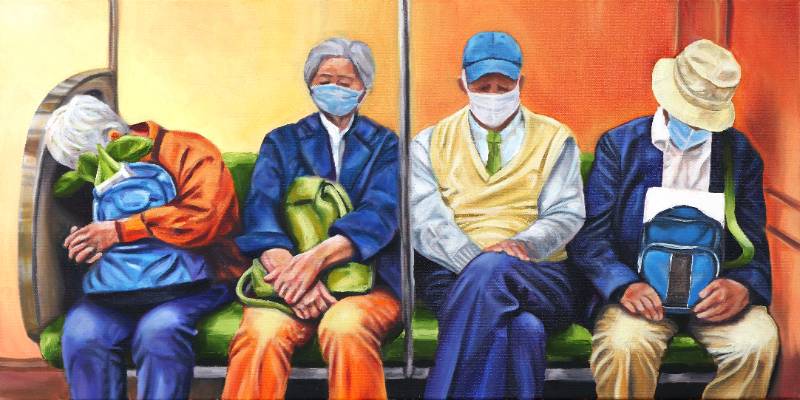
This series is part of my broader artistic inquiry into identity within constructed
environments. I am compelled by the tension between organic figures and artificial
structures—architectural, digital, and social. Tokyo’s commuter train is more than a vehicle;
it is a "machine" in the anthropological sense—a complex system that dictates the rhythm,
posture, and silence of millions of people daily. My series, "Tokyo Transit" explores the
intersection of this physical infrastructure with the invisible, yet powerful, design of the "attention economy"; Having lived in Tokyo for two years as a young adult, I returned in May
2025, sponsored by the Undergraduate Creative Research Grant, to document the distinct
beauty of a commuter culture unique to Japan.


Aesthetic Approach
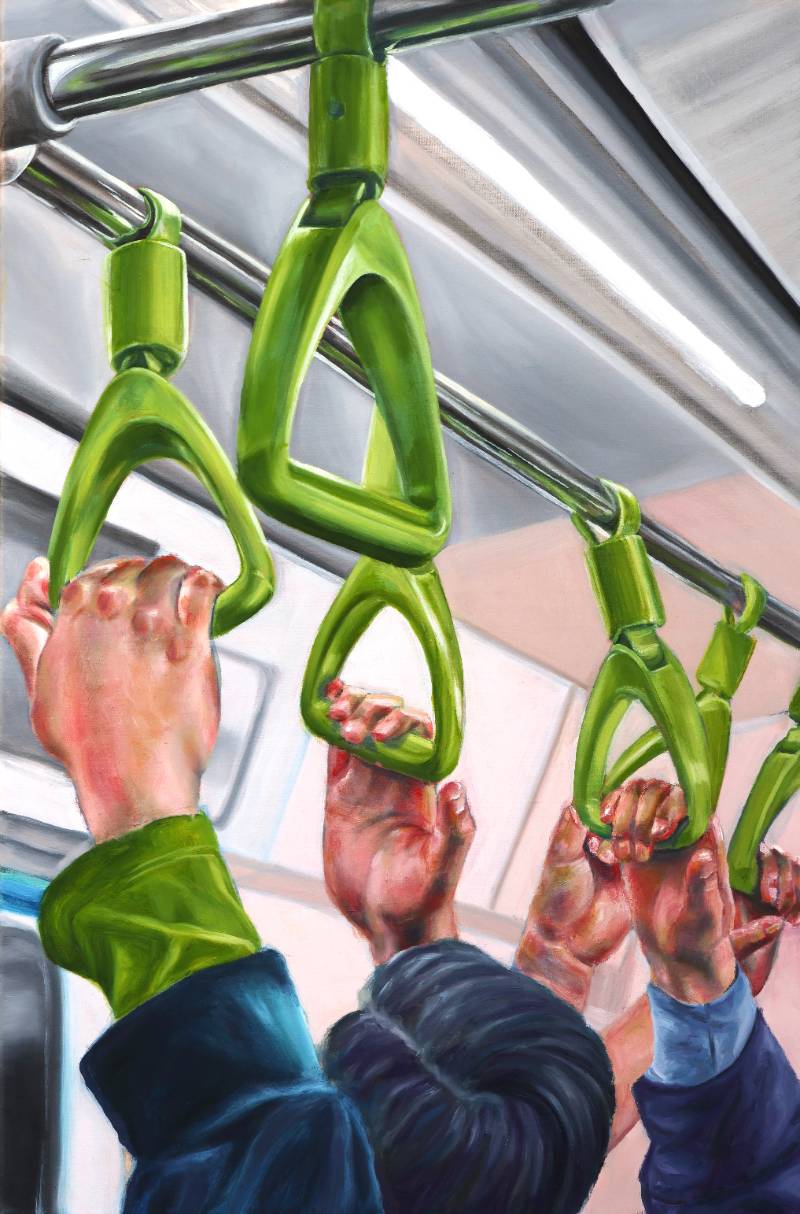
I deliberately chose oil paint—a slow and rich medium—to challenge the frenetic yet dull
energy of the daily commute. Through oil, I give physical weight and vibrancy to moments
designed to disappear, whether it be the distinct play of artificial light on a tired face or the
accidental harmony of commuters' clothing. I employ a thoughtful and vibrant color palette to
each painting, elevating the setting’s mundanity. I intentionally utilize specific geometric
layouts and repeating shapes to mirror the mechanical rhythm of the train schedule, creating a
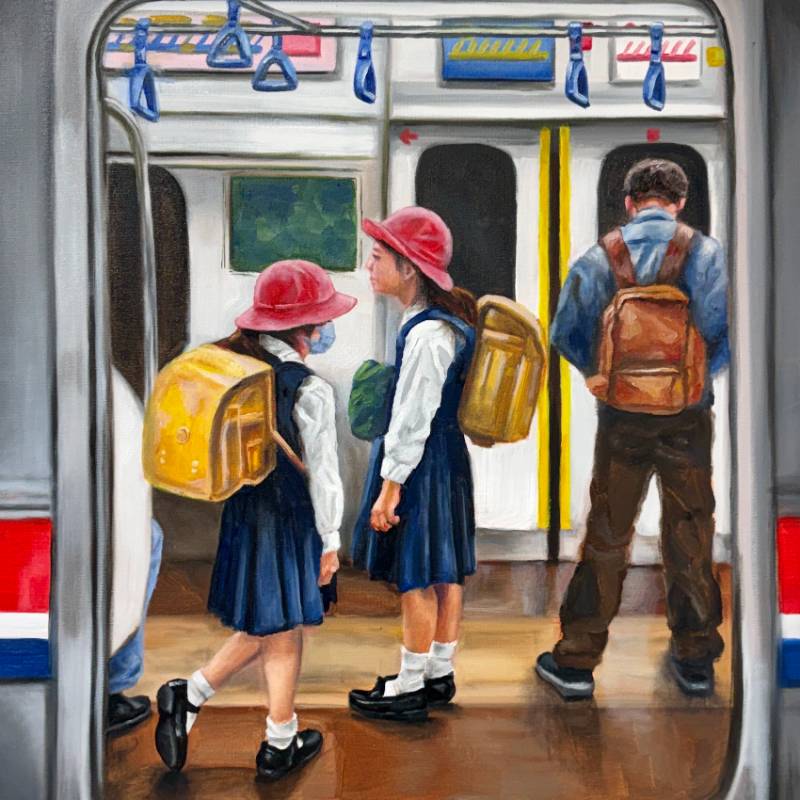
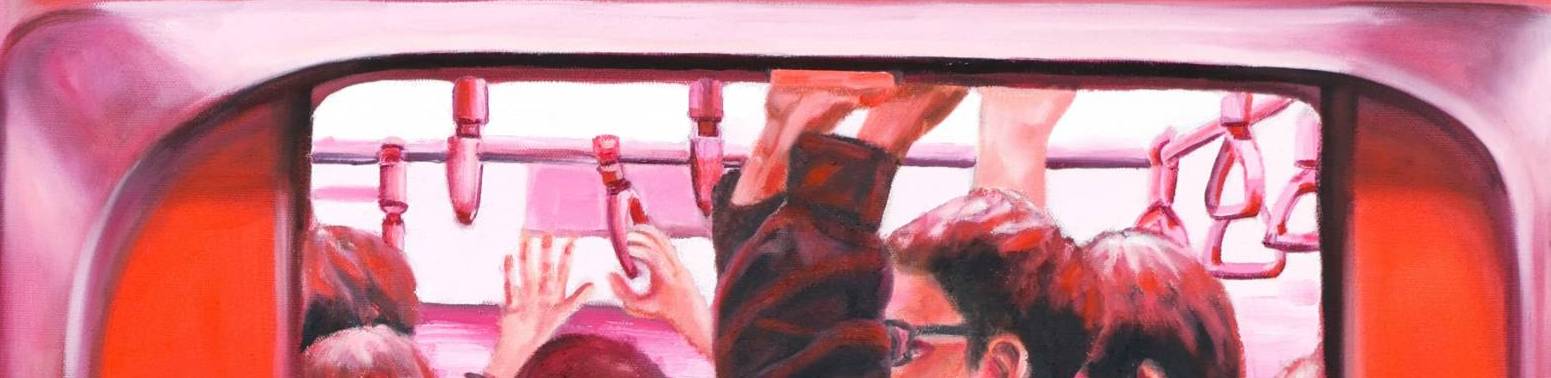
sense of routine that frames my subjects. I aim to capture the paradox of proximity: strangers
pressed shoulder-to-shoulder, each navigating a divergent path in life, from the chaotic crush
of rush hour to the peaceful quiet of early mornings shared by schoolchildren and sleepy
elders.


Cultural Observation
This project is grounded in ethnographic fieldwork, utilizing on-site sketching and
observational journaling to document commuter culture across diverse routes and times of
day. My field notes record a rigorous social etiquette characterized by profound silence, precise queuing on platforms, and the respectful yielding of seats to those in need. Passengers
carefully minimize their physical footprint, often clutching bags against their chests rather
than wearing them to avoid encroaching on the shared space of others. This ethnographic
research methodology of my art practice allows me to frame my paintings not merely as
aesthetic objects, but as qualitative sociological data that reveal the & "invisible" psychological
nuances of the Tokyo commute.
The collective mindfulness of the passengers in Tokyo creates a quiet sanctuary within the
metal box, allowing for a vulnerability unique to this environment. By rendering these
fleeting moments with structural intentionality, I hope to give these passengers a place to be
truly seen, transforming the anonymous swarm of the crowd into a study of modern human
dignity.


Research and Influences
This project is built upon the sociological concept of the "Techno-Social Machine"; a term
coined by Michael Fisch to describe how the Tokyo train network dictates the behaviors and
social interactions of its riders. Fisch’s work further highlights the fragility of the system and
the commodification of time, emphasizing why the mental escape into a phone or sleep is
such a necessary survival mechanism in Tokyo’s high-pressure environment. My work
visualizes Fisch&#39s theory by depicting the physical discipline of the commuter, overlaid with
Herbert A. Simon’s "Attention Economy" which proposes that my figures lost in "cocoons" (Ito, et al.) represent the human cost of an information-rich world. I also draw
heavily on Brigitte Steger’s research into inemuri, contextualizing sleeping figures as diligent
workers using the train as a space for "productive recovery".
While the subject matter is distinctly Japanese, my aesthetic approach bridges Eastern and
Western traditions. I recontextualize Ukiyo-e "pictures of the floating world" for the modern
era, replacing the fleeting pleasures of Edo with the digital pleasures of the smartphone.
Furthermore, I look to George Tooker’s The Subway for his mastery of liminal space and the
segregation of figures within architectural stalls, alongside Edward Hopper’s use of artificial
light to expose psychological vulnerability, ultimately translating the sense of isolation into
the Japanese context of being physically crowded yet psychologically solitary.

In what ways does Faulkner’s As I Lay Dying confine women’s roles in the 1900s? 

Maria Teresa Bonaminio

Known as the Progressive Era, the United States in the 1900s transformed women’s roles in two significant forms: socially and culturally. Socially, women were expected to adhere to homestead and traditional roles, while having no political nor educational rights, resulting in “spiritual finders” becoming a catalyst due to their “progressive nature” (Nowak 2016). Culturally, women’s workforce and legal advances were challenged in unthinkable ways, including being “[terrorized in] patriarchal discourse” (Forte 225), diminishing their purpose in society. Within As I Lay Dying, Addie Bundren’s indirect presence as the dead corpse’ journey through the Mississippi reflects life in a nihilistic view, where addicting roles, such as being a mother or wife, drain her very essence. Therefore, Faulkner utilizes the character as a means to represent the cold absence of an essential component of a  conventional household. On the other hand, Cora Tull, the Bundren’s neighbor, contrasts Addie’s character by embodying the matronly ideal of a Southern woman and possesses a hypocritical attitude that opposes those of Addie’s, resulting in a pitiful yet caring relationship for the duration of the novel. Lastly, Addie’s daughter, Dewey Dell, is a youthful woman who struggles to be understood and accepted for her actions, including dealing with a pregnancy she does not desire, and therefore faces scrutiny by her family members and outsiders throughout the novel. 

Addie’s single chapter towards the middle of the novel, details the only time she is able to express her experience and perception of Anse Bundren, her husband, who she is convinced has stripped her away from the girl she once was, as well as being caged by his abusive nature. Additionally, Addie emphasizes with her acute awareness of the linguistic and social oppression she’s endured, how unorthodox female agency interprets the concept of sin as a woman. The cultural practice and societal norm surrounding the confinement of a woman reflects the disappearance of autonomy for the female species, significantly indicating restrictive gender-specific experiences and their effects towards the individual. Knowingly, Addie cannot find the word, within the man-made symbolic order, to represent her body in the way she perceives it. Addie implies her inability by stating that “the shape of [her] body where [she] used to be a virgin is in the shape of a ________ and [she] couldn’t think Anse” (Faulkner 173). Addie is aware of the lack of uncommunicative diction and therefore resolutes to describe any action or thought of her sexuality or gender as sin. The term is significant as it showcases the disheveled expression of the sexual desire or sex act, which is usually presented in a negative light. Consequently, Addie Bundren longs to find her identity outside of traditional constructs that are not always definable by dictionary terms. Moreover, sin is controversially misused by Addie through contextual mediums, including her reconciliations of an affair with a priest, textualizing it as “thinking of [herself] as dressed also in sin, he the more beautiful since the garment which he had exchanged for sin was sanctified” (Faulkner 175). The last part of her statement exemplifies Addie’s mode of thinking, meaning although she and the priest are both condemned to sin, the priest is excused as his sin is justified because of his position. 

Faulkner uses devout forms to conceptualize female participation because it individualizes the woman’s finer understanding of their particular role in society. Cora Tull wields her religious faith as a weapon, utilizing the scripture to condemn and judge others around her. For instance, Cora explicitly admits to have “tried to live right in the sight of God and man, for the honor and comfort of [her] Christian husband and the love and respect of [her] Christian children” (Faulkner 23), revealing her deep-rooted beliefs and convictions to the reader. Throughout the novel, Faulkner references the Bible in order to confine Cora as the purest and most mature woman in comparison to other females. In doing so, Cora’s character is spotted living her life based on religious foundations, such as persisting on “woman’s place [being] with her husband and children, alive or dead” (Faulkner 23), to which allow her to embody the epitome of Christian womanhood. For hundreds of years, the traditional role of women in the fabric of American society has been confined by rigid religion, passive spirituality and multiple interpretations of community. In real-world context, women’s rights leaders have originated from Quaker backgrounds, where religion directed movements against the hierarchy. Paradoxically, women were oppressed by religion, yet purposefully used its liberal and spiritualistic context to justify the scripture. There are rudimentary verses that reflect the root of misuse within certain collectives and individuals: “Let your women keep silence in the churches: for it is not permitted unto them to speak” (King James 2019). Due to the declaration demanding women to not speak as they do not possess the right to, monumental works, such as the Christian Bible, appear to be the main source of societal repression and forefront of women's expectations in a patriarchal setting. As a consequence, gender specified forms and socialist ideals lead communities to neglect the stark concept of equality and revert to manifestations of unspoken traditions and historical patterns. In effect, Cora’s domestic behavior is constructed by rigid societal expectations rooted in Christian communities, causing a withdrawal from external influences or customs from the world around her. 

Faulkner establishes women’s social capabilities in a maternal and sexual light. Pharmacist, Moseley, offers a glimpse into Dewey Dell’s hardship and does so through the literary device of dramatic irony. Moseley highlights his understanding of the normality of viewing a female sensually and underlines how he cannot offer his skills or products if certain standards are not met. Consequently, Dewey Dell is objectified by Moseley, a “respectable druggist, that’s kept store and raised a family and been a church-member for fifty-six years” (Faulkner 200), as she visits the pharmacy in hopes to receive an abortion. Therefore, even though there are no written regulations as to how a woman should act, what a woman should do when they hit puberty, or when particular bodily events are supposed to happen, the society surrounding females in As I Lay Dying conveys unwritten ideologies and expectations of acting, which come with persistent consequences. The Code of Hammurabi is one of the oldest deciphered writings in the world, dating back to the 1750s. It consisted of 282 laws regarding brutal punishments based on social status including slaves, men and women located in the ancient city of Babylon in Mesopotamia, Iraq. Law 128 of the code states: “If a man take a woman to wife, but have no intercourse with her, this woman is no wife to him” (King, Code of Hammurabi). The revelation asserts that if a woman and man do not commit a sexual act with one another, then the woman is useless, thus drawing the conclusion that if intimacy is not accomplished by the woman, then she has no more use. Dewey Dell is undoubtedly portrayed as a subordinate subject to man, meaning there are certain behaviors and social interactions that limit her societal status, reflecting the ideal of treating women as property. Once again, Moseley, unfortunately, showcases the stereotypical male behavior towards a woman like Dewey Dell by describing how she “[has] a complexion like hers and use it herself, let alone not being much more than old enough to barely know what it [is] for”(Faulkner 199-200), insinuating how her body cannot go to waste but rather be utilized for male pleasure and temporary satisfaction, specifically for Moseley himself. 

In each of these women –Addie Bundren, Cora Tull, and Dewey Dell – societal and cultural reflections of confinement bound the female agency to forceful roles that do not allow for individual nor personal expression of certain desires. William Faulkner, through these characters, defines the limitations and struggles young women encounter due to vivid depictions of the 1900s constraints. Addie  Bundren, though dead for most of the novel, is only able to express few dissatisfactions with her life, representing the emotional entrapment that exacerbates voluminous words and inflictions from others. Addie’s desire to retain her small portion of identity mirrors societal consequences of male dominated areas of human nature. Cora Tull, with her devotional and self-sacrificial ideals as mother and wife, highlights the conservative expenses, the loss of individuality and limited open-mindedness. Cora’s inability to comprehend external detachments or rebellions against patriarchal roles confines her own moral and maternal duties. Perhaps the most directly attacked woman in As I Lay Dying, Dewey Dell physically and emotionally symbolizes limited autonomy. Her unwanted pregnancy, as well as sexual harassment by attempting to abort, mirrors the female complexion as a burden and prison. The stigma surrounding her harsh reality underscores the theme of suppression. Faulkner’s portrayal of women as a male novelist illustrates the ways gender disparities not only restrict personal freedom and self expression, but also offer poignant prescribed identities and limited possibilities for women to evolutionize. Ultimately, the novel suggests that the 1900s did not allow for physical, emotional or psychological movement, consequently confining women’s broader implications as human beings.

Works Cited 

Faulkner, William. As I Lay Dying. Vintage Books, 1990. 

The Holy Bible. King James Version ed., 2019. 

King, L. W. The Code of Hammurabi. Yale Law School, Lillian Goldman Library, https://avalon.law.yale.edu/ancient/hamframe.asp. Accessed 4 December 2024. Nowak, Donna M. “The Church and Equality.” The Religious Paradox, Buffalo State University, 2016, 

https://digitalcommons.buffalostate.edu/cgi/viewcontent.cgi?article=1039&context=histo ry_theses#:~:text=Throughout%20the%201800s%2C%20women%20were,States%20thr ough%20increasingly%20tumultuous%20times. 

Peters, R. S. “Freud's Theory.” The British Journal for the Philosophy of Science, 1956, doi:https://www.jstor.org/stable/685932. Accessed 16 December 2024. 

Ragland-Sullivan, Ellie. “THE PATERNAL METAPHOR : A LACANIAN THEORY OF LANGUAGE.” Revue Internationale de Philosophie, 1992, 

doi:https://www.jstor.org/stable/23949429. Accessed 16 December 2024. 

“Viewing Addie Bundren Through a Feminist Lens.” SEMO, Southeast Missouri State University, 

https://semo.edu/faulkner-studies/teaching-faulkner/feminist-lens-bundren.html. Accessed 10 December 2024. 

Warder, Dr. Graham. “Women in Nineteenth Century America.” VCU Libraries Social Welfare History Project, 2015, 

https://socialwelfare.library.vcu.edu/woman-suffrage/women-in-nineteenth-century-ameri ca-2/. Accessed 16 December 2024.


I draw hymn notes
On my clitoris

Gregorian chant the tongue
flavor of a remembered
femicide upon our womb roots

Her
Words are my cell coding
Mitochondrial Eve

This Isn't About Masturbation

Sydney Sijan

Sterilization, bound
Fallopian tubes, a secret

Hysterectomy, a hot water
ablation to burn away the
uterus lining

Johns Hopkins Hospital was the
birthplace
Of womanhood’s modern
slavery


Womb contractions
my next period

Fingers rust-stained in their
glistening pull away

My power
does not stop with
a tampon in

Phones

Tunnel Visions

Mckenna Mitchell

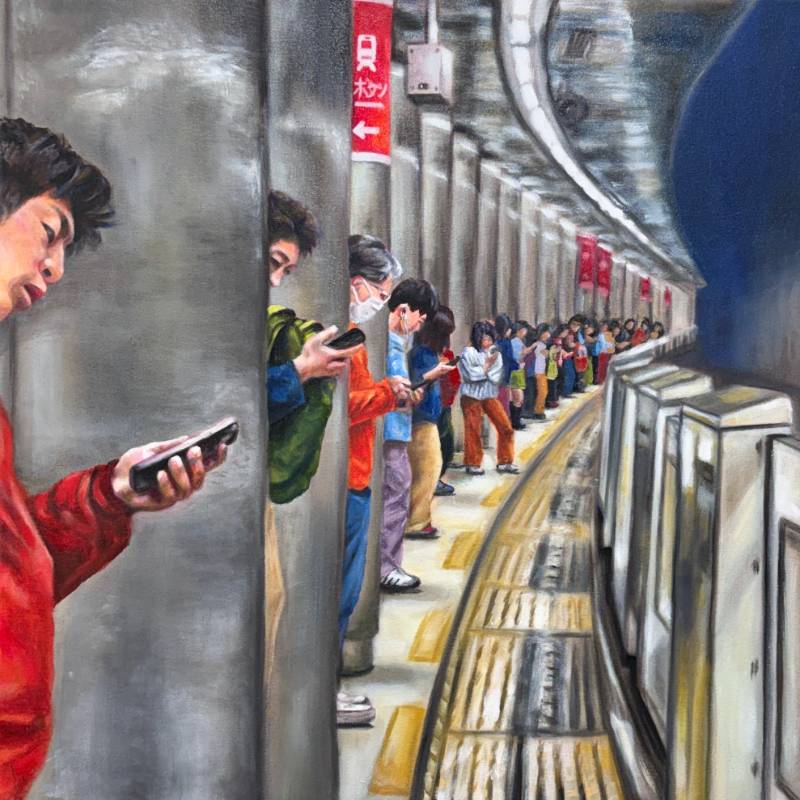
Segregated by pillars and silenced by devices, these figures demonstrate the voluntary blindness of the commute. Their vision is doubly confined—physically narrowed by the dark tunnel, and psychologically narrowed by the screen.

SEE MORE

Phones
Segregated by pillars and silenced by devices, these figures demonstrate the voluntary blindness of the commute. Their vision is doubly confined—physically narrowed by the dark tunnel, and psychologically narrowed by the screen.

Death
She was beautiful. This wasn’t an awful surprise, far from it, I chase beauty. I hunt the lovely things in life that breathe pink air and summer breezes. Whose chests rise and fall in waves, thudding with heart beats like drums. A twisted dance of rose lips and golden flesh. I’ve sought the pretty things in the shadows that beckon with painted nails and cocked hips. Reflected light from silken hair and deep eyes in magazines, these things have always excited me, tracing lightning up my spine and hands down my back.

Death wasn’t pretty like that. Her waist was small, not breakable and carefully formed like molten glass ready to be pulled into position, but thin and frail. Her bones arched under her robes and pressed skeletal imprints into the silk. She looked at me with light eyes, eyes that didn’t mirror the ocean or burn with cinnamon fire. No, her eyes were flat and full of intrigue, like a moonlit pond or a wavering mirage. Her lips weren’t plush and red but prunish and sickly
purple. She had long hair, not the kind to pull, tug, and tangle, but thick dark locks one could drown in. Her hair hung like seaweed clinging to wet skin. The strands coiled around her hollow collarbones and dripped down the space between her covered and sagging breasts

Honestly, I was frightened. She stared at me in that dark bedroom. Her hip propped against an end table and an empty expression on her face. The woman atop me didn’t see her, but I know she came to me that night, and I wanted her. Yet I looked away in a moment of foolish fear. I crave her still. Since then I’ve been searching and waiting. I will see her again. I’ve never failed a hunt before

nude-drawing

Nude Vulnerability

Anna Marie Denfeld

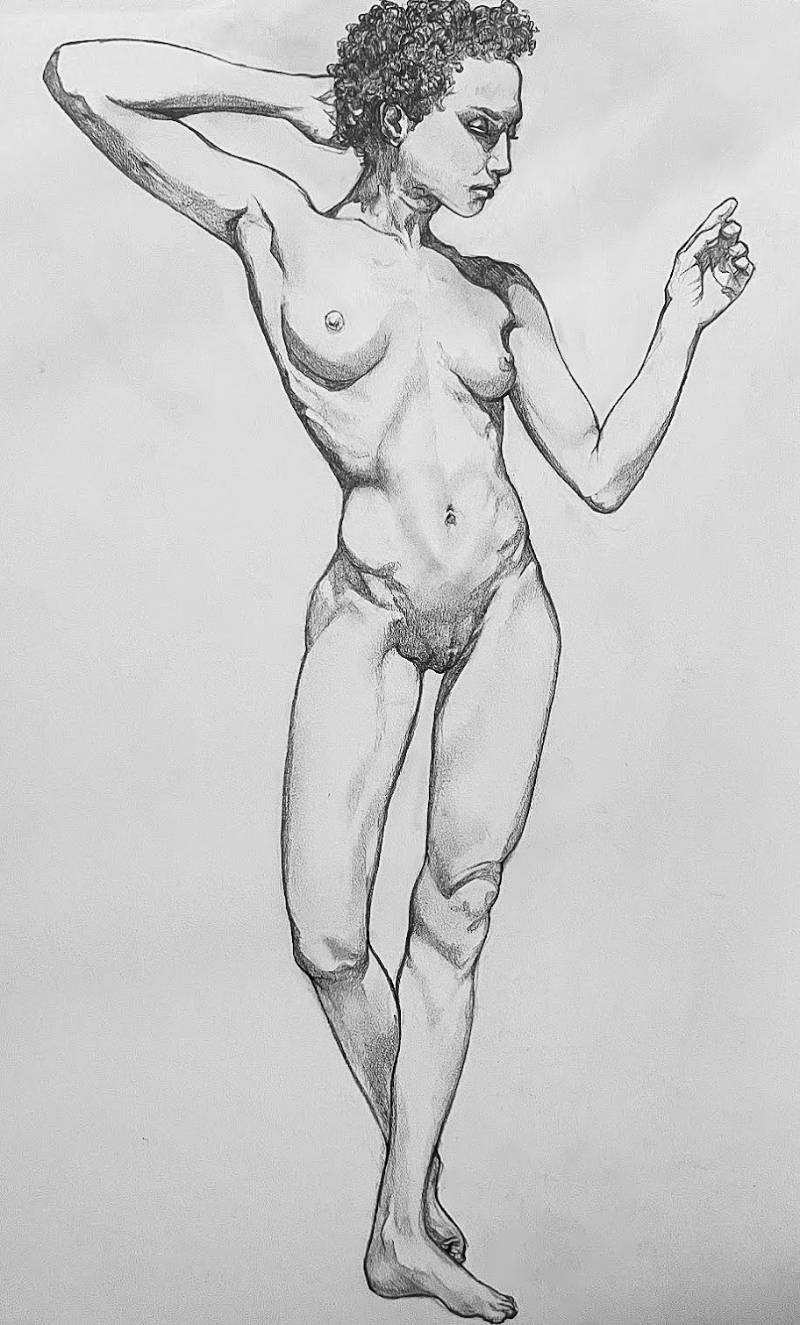
This piece explores vulnerability through the bareness of the human figure. I want to force the audience to engage with the body as a representation of human expression, emotional exposure, and identity. I focused on gesture, posture, and gentle tension, posing the figure in quiet stillness; existence without performance. The vulnerability lies not in the nudity itself but the act of being. This work invites the viewer to sit with their own discomfort and genuinely explore what vulnerability means to them.

SEE MORE

nude-drawing
This piece explores vulnerability through the bareness of the human figure. I want to force
the audience to engage with the body as a representation of human expression, emotional
exposure, and identity. I focused on gesture, posture, and gentle tension, posing the figure
in quiet stillness; existence without performance. The vulnerability lies not in the nudity
itself but the act of being. This work invites the viewer to sit with their own discomfort and
genuinely explore what vulnerability means to them.
Arches

Greco-Roman Triumphal Arch

Kisara Blake

SEE MORE

Arches

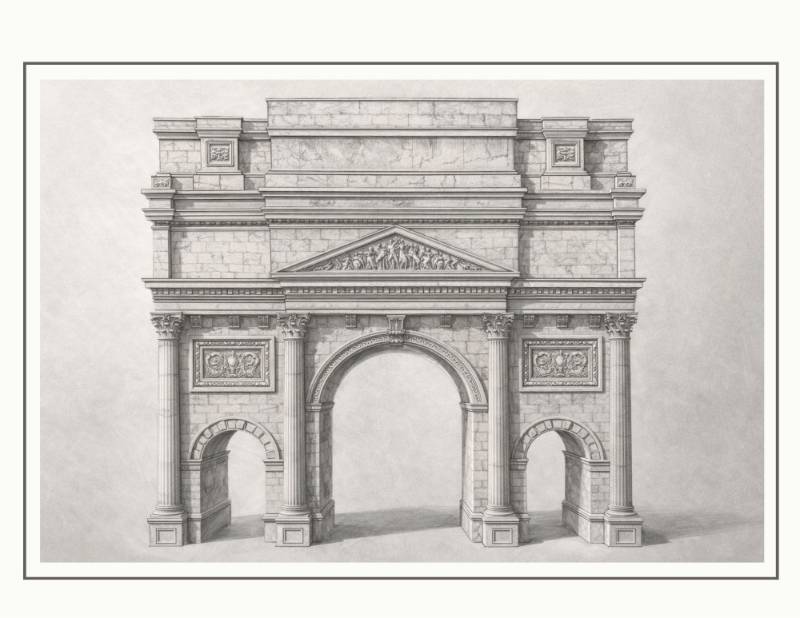
This Greco-Roman triumphal arch explores the relationship between monumentality and memory. Historically, triumphal arches commemorated victory and civic identity, transforming stone into narrative. In this rendering, classical proportion and Corinthian order are treated not only as stylistic choices but as structural language, emphasizing balance, hierarchy, and permanence.

The detailed filigree and controlled line work contrast ornament with mass, inviting the viewer to consider how embellishment enhances rather than overwhelms structure. By studying historical form through contemporary drafting techniques, the piece reflects an ongoing dialogue between ancient architectural ideals and modern interpretation.

Beowulf: An Allegory of Power

Daniel Driskill

Beowulf: An Allegory of Power

Daniel Driskill


Introduction

Central to the epic poem, Beowulf (c. 700-1000 CE), is both a descriptive and a prescriptive philosophy on the nature of power. The tale serves in large part as an allegory of the character of power, the path to its attainment, and how it can be successfully retained. Represented through the intentions and actions of the story's characters and the resulting consequences, and recounted in the sagacious voices of the tale's narrators, we discover that the character of power consists of an eager desire to serve others, a fatalistic indifference to death, a preference for courageous action, deadly formidability, a strong mind, and constant readiness; we see that the path to power is paved with admirable deeds and legendary feats, upholding a superior reputation of devotion to the weak, to their defense and inspiration; and lastly, we learn how power is retained through the cultivation of a healthy level of paranoia, meticulous planning, the tempering of one’s pride, making amends, remaining moderate in the measure of one’s strength, active concern for others, promoting collective unity, exercising virtue, and embodying benevolence.

Anglo-Saxon conceptions of leadership strongly resemble modern-day moral frameworks in structure, tone, and attunement to human nature. Those destined for greatness will find in Beowulf a source of guiding wisdom among the finest and most comprehensive ever written. Now, let the ancient sages teach us who seek to rule.


The Character of Power

Not all are destined to rule—a hero is needed. The domain of Hrothgar, king of the Shieldings, has seen twelve winters of woe at the hands of the terrible monster, Grendel. The great hall of Heorot—once a place of rejoicing, of roaring fires and lively banquets—has been emptied of all its revelers.  “[T]he greatest house in the world [now stands] empty, a deserted wallstead” (Heaney 145). Hrothgar, though a great leader, finds his situation hopeless. Trails of blood stretch beyond the doors of his great hall into the ice-stricken wood, where some fearsome exile—a demon—stalks the night in a boundless rage. Beowulf of Götaland, in “wholehearted” desire to “help and counsel” the beleaguered Shieldings and with a keenness “to win fame” (Heaney 213), crosses the bitterswept sea with fourteen strong men. These Geats, pure of heart and honorable in intent, are destined to face loss. Heroic ambitions are almost invariably met at great personal cost. Dauntless courage and a fatalistic indifference to death are required. Their courageous preference for action is soon to be proven through the flowing of their own blood.

It is only the first night among the Shieldings when one of Beowulf’s men is dragged from his bed and slaughtered, to the sound of laughter. Fear overcomes Beowulf’s men, and it is Beowulf, alone, who must handle the lone nightstalker. In the darkness he wrestles the monster to the floor, presses his hideous face against the timbers of that great hall, and tears off his arm. Grendel flees, the trail of blood leading from the doors of Heorot now his own. He soon perishes of his wounds, curled up in his burrow, survived by a grieving and enraged mother demon. Heorot cheers—hail Beowulf!

But the contest is far from over. Another dark night not long hence and one of Hrothgar’s right-hand men is slaughtered in the wake of that evil matriarch and her vengeful rage. Beowulf responds immediately, quickly locating her lair—a cave at the bottom of a deep forest lake, whose waters burn and from which the animals flee and never drink. Alone, he dives to the lake’s bottom and gives battle to the hellion in her own domain. Beowulf “observe[s] that swamp-thing from hell, the tarn-hag in all her terrible strength, then heave[s] his war-sword and [swings] his arm,” but the “fabulous powers of that heirloom” fail him, “the shining blade refuse[s] to bite” (Heaney 105). Where others would despair, Beowulf’s “[l]ife doesn’t cost him a thought. He casts the hilt aside and fights the she-demon with his bare hands. It’s not long before she’s on top of him with her dagger, raging hot breath beating his face. A “mesh of chain-mail on his shoulder” saves his life from her sharp point. Beowulf catches sight of an enormous blade in her armoury and is on his feet in an instant (Heaney 107). “[T]he Shielding’s hero, hard-pressed and enraged, took a firm hold of the hilt and swung the blade in an arc, a resolute blow that bit deep into her neck-bone and severed it entirely, toppling the doomed house of her flesh” (Heaney 109). Mother and son, in eternal hatred and despair, descend now upon an all-too-bright underworld.

Throughout the story, Beowulf’s consistently dauntless character routinely positions him upon the path of victory and an exemplary life. Most eloquently spoken by the hero himself in Hrothgar’s hall, prior to fighting Grendel, is Beowulf’s unintentionally-shared secret to heroic courage: “I shall… prove myself with a proud deed, or meet my death here.” (Heaney 43). It is this fatalistic stance, this “fury of despair” which also fires the heart of Virgil’s Aeneas at the fall of Troy (Virgil 87), that calls Beowulf, and all true warriors, forward. It is the hope of a warrior destined to die in battle—but not before taking many with him.

Beowulf, powerful and determined, is first to acknowledge his subservience to Fate. “Fate goes ever as fate must,” he declares before the beleaguered Shieldings (Heaney 31). Most, when faced with the stark realities of mortality, the demands of nature, the ever insatiable call of the famished void, freeze like tonically immobile fawns as the jaws of death encircle them. No true hero forgets his valor in such a moment, not when any measure of strength is to be found in the muscles and joints of one cornered and vengeful predator. So long as his fangs are sharp, his killer instinct dormant, he will discover his moment—then strike in a profound fury. His indifference to death (Heaney 101) is like the dispassion of a ċēapmann over the goods of his trade. Fatalistic indifference—what today we term “radical acceptance”—is the embodiment of heroic power in one destined to be remembered as “him who stood his ground in the steel-hail” (Heaney 209). To cower before a universe that, in all reality, has always conspired to kill you eventually displays a certain surprise as to the fact—the direct result of a woeful ignorance of the evidence surrounding one since birth. It makes plain an unpreparedness for the obvious course of things, manifesting as indecision as to how one should respond when the culminating moment arrives. A preference for action, until the very end, is the mark of the hero. He or she at peace with the universal evidence and with their own virulent nature does not grieve. Beowulf instructs: “[Vengeance] is always better… than to indulge in mourning. For every one of us, living in this world means waiting for our end. Let whoever can win glory before death. When a warrior is gone, that will be his best and only bulwark” (Heaney 97).

Be ready always to respond as the moment requires. Opportunities and challenges arise not on your time-table, but that of the universe around you, of which you are an insignificant part. Those unwilling to respond to the wiles of existence are counted impotent and feckless. For Beowulf and his entourage, “It was their habit always and everywhere to be ready for action, at home or in the camp, in whatever case and at whatever time the need arose” (Heaney 87). Surely the opportunity for power and fame would have been missed if Beowulf had allowed fate to snatch his bearings. It would have been easy to panic, freeze, and wonder aloud whatever could be happening once Grendel had hold of his dear comrade, but he awoke, resolute, and made Grendel pay for his adventurism.

We have outlined the character requisite for the effective obtainer of power. What, then, must one do to make this internal reality external? Here the legend of Beowulf proves instructive.


The Path to Power

A mere twenty-four lines into the poem, we learn in incredibly succinct language the secret to the attainment of power: “Behavior that’s admired is the path to power among people everywhere” (Heaney 5). Not only is it possible to take action that secures fame and status, this simple principle is applicable anywhere. Earn the admiration of those whom you seek to rule, and your position among them is guaranteed. What is the essence of this admiration? The people admire the greatness of your feats, and believe a portion of your greatness will fall to them.

Beowulf’s first words in Heorot relate a history of his greatest feats so as to build rapport with Hrothgar and the Danes. “[I have been] boltered in the blood of enemies when I battled and bound five beasts, raided a troll-nest and in the night-sea slaughtered sea-brutes. I have suffered extremes and avenged the Geats… Now I mean to be a match for Grendel” (Heaney 29). If there is any doubt as to the importance of great feats in service to others, according to the legend, King Hrothgar adopts Beowulf as his “dear son” in direct response to the slaying of Grendel (Heaney 63). Beowulf, a complete foreigner, is given legitimate claim to the Danish throne. This move, for both Dane and Geat, bears the highest cultural significance.

Beowulf’s habit of leading from the front, being “always there at the front line” (Heaney 169), positions himself for such accomplishments. The fighting spirit is the key attribute of all charismatic leaders, from Alexander the Great to Napoleon. Hrothgar, in his own right, is a leader of this kind: “wherever the killing and carnage were the worst, he would be to the fore, fighting hard” (Heaney 69). It will soon be shown that to strike the delicate balance between leading from the front and delegating is indeed among the greatest of challenges of all power-holders, and it is this dichotomy that in the end costs Beowulf his life and his power. This we will discuss at a later time.

Next, we acknowledge the key importance of accounting for one’s standing in relation to potential competition. Unferth the Dane, reputed for his courage and great mind, knew he had been bested when Beowulf arrived on the scene, and that his potential for fame and power had been severely hampered (Heaney 103). Had he challenged Beowulf, he’d have perhaps lost more than his share of influence, along with his life. The question as to whether one has the natural right to rule is relative to the comparative powers of one’s present environment. Self-awareness here is key, and the lack of it could lead to one’s dissolution.

Connections are of obvious benefit in the attainment of power, and a discussion of the path to power would not be complete without it. At some point along your journey, you will need people who help you, this means they must know who you are. Hrothgar knew Beowulf long before Beowulf grew into the man destined to save the Danes (Heaney 27). Hrothgar himself mentions this upon Beowulf’s arrival, and this connection enables Beowulf’s first audience with the king (Heaney 27).

The final stone laid on the path to power is that of providing value. The feats one accomplishes must not merely be courageous, but also useful to others. Beowulf’s rescue of an entire kingdom from an untimely demise not only inspires those ears graced by its legend, but preserves what is most precious of all, and the reward for such deeds comes in equal measure. In the eyes of the people, Beowulf’s trustworthiness, goodness, and repute are indisputable and iron-clad.

Thus is the necessity of actually benefitting those one serves, but its opposite—tyranny—should be acknowledged, if briefly. The pariah king, Heremod, was murderously anti-social. “He suffered in the end for having plagued his people for so long: his life lost happiness. So learn from this and understand true values. I who tell you have wintered into wisdom” (Heaney 119). It’s in the way a leader treats his people that lasting power and social-political happiness and contentment is both attained and retained.


Keeping Hold of Power

Fires of vengeance ravage the countryside. A dragon hunts the thief responsible for his missing gold. Death and char blanket ever-increasing swaths of land as the thief remains at large. Beowulf, a king in his twilight years, is desperate to preserve his people in the dragon’s wake. Despite the warnings of his closest advisors, he slips on his mail, straps into his armor, and takes up his sword, uniting with twelve trusted warriors to face the dragon and end the devastation once and for all.

Per custom, each man is bound by oath and honor to stand by his king to the end, but when the firebrand makes his terrible appearance, and the true horror of their task spills over their souls like hot lead, all but Wiglaf desert their lord and escape into the surrounding woods. The two remaining heroes, inspired by fatalistic glory, at last slay the dragon after a lengthy battle. However, Beowulf is mortally wounded, bitten in the neck, and a “deadly poison [suppurates] inside him” (Heaney 181-183).

He steadies his gaze upon the ancient megaliths about him. His breathing grows labored. Death knocks. “No king of any neighboring clan would dare face me with troops, none had the power to intimidate me. I took what came, cared for and stood by things in my keeping, never fomented quarrels, never swore to a lie. All this consoles me, doomed as I am and sickening for death” (Heaney 185). Exulting in a well-lived life, a life of triumph, his eyes turn to the astonishing trove surviving its former keeper—a wonder to behold. The old lord “[gazes] sadly at the gold” (Heaney 189), its glory now a naïve dream. Before long, he ascends to the grand pillars of heaven to rest “among the steadfast ones” (Heaney 191).

Wiglaf at first blames Beowulf’s deserters for his death. “Too few rallied around the prince” (Beowulf 195). And now, “war is looming” over the people. The Franks and the Frisians will soon learn that the great king is gone (Heaney 197). The Geats will be overrun by the Swedes. All will be lost.

Wiglaf then addresses the responsibility a king has in protecting his subjects before and after his reign: “Often when one man follows his own will, many are hurt” (Heaney 207). It is implied that the rashness of Beowulf’s actions in fighting the dragon himself when others could have been sent in his stead could ultimately have cost his people their way of life. Beowulf became great by leading from the front, but ended his reign by his refusal to delegate. As rulers and stewards, consideration for those in our care, during and after our reign, is of paramount importance. Planning and executing our actions in a manner that preserves our successors is the final triumph of our legacy. Beowulf, more keen “to win fame” than any other (Heaney 213) became king thereby, but when the time came for broader considerations, this tendency proved catastrophic, spelling the final doom of his culture.

Considering those in our care as we rulers plan and execute our actions preserves our fundamentally social relationship with them, and by extent our post-mortal power. Small acts of consideration set the stage for extended consequences that serve as the building blocks of legacy. A social fabric of empathetic unity, from top to bottom, becomes the unshakeable basis of sustained power. Wiglaf’s declaration to Beowulf after the others had deserted, “I shall stand by you” (Heaney 181), and his admonition to his comrades that a man should “be at hand when needed” (Heaney 183), is the manifestation and essence of this unity. A leaderless and soon-to-be extinct people is the terrible consequence of a disunited front, whether such occurs by cowardice or by pride. A leader never ceases proving themself, whether in life or in death. As we see, attaining power is only the beginning—an entirely new set of skills comes into play in keeping hold of it and ensuring one’s legacy.

A ruler must cultivate a healthy paranoia against adversaries and vice (Heaney 119). Enemies with their “hate-honed swords” stalk as killers in the night as the sentry drowses. Indulgence of the desires is corrosive to potency, blinding one to many threats that lurk in the shadows. Your vital areas lie perennially marked. Make amends with enemies wherever possible. Exercise virtue. Form “pacts of friendship in spite of hatreds” (Heaney 127). Be ever needed—if not feared—by those around you. Distraction, loss of focus, or the belief that all is well dulls the instincts, and then—an unexpected strike! Remember, always, all is fleeting (Heaney 121).

The importance of moderation now comes to the fore as a crucial element of a leader’s legacy. Moderation—the ability to measure and control one’s strength—is the key to effective and enduring leadership. It takes the form of prudence, intentionality, tranquility, and a sociable nature. It has been said that Beowulf “took no advantage” of others, “kept his temper,” and “controlled his God-sent strength” (Heaney 149). Surely, the individual well-versed in power-craft wields it most strategically, most selectively, always kindly, sometimes terribly, and never rashly. We see also that old-age lends itself to moderation, and the elder Beowulf is a fine example (Heaney 151). Even so, the vice of pride—Beowulf’s bane, in the end proves his master and conqueror still (Heaney 179). Hrothgar’s warning on pride fifty winters prior resounds now in our ears: “Do not give way to pride” (Heaney 121). The reader may now recall the sad gaze of the dying Beowulf as he beheld the dragon’s treasure.

It is virtue that makes or breaks a hero, and by extent his people. For any organization of social animals, prudence (Heaney 117), generosity (Heaney 133), integrity (Heaney 185), grace, fairness, and kindness (Heaney 213) enrich the social-political substrate with trust, goodwill, mutual respect, and honor—the pillars of stability and societal flourishing. Leaders who forget this or who are incapable of leading a virtuous personal life diminish all social life. Leaders who divide, sow mistrust of others, are transactional in their dealings, are cynical and do not believe in true acts of goodwill, or who are disrespectful to others and lack decorum, are the polar opposite of the ideal portrayed in Beowulf. These leaders form the antithesis of heroism. They reek of weakness and insecurity, though they excel at selling the world on how ‘strong’ they are. Demonstrably, the Anglo-Saxons sought to avoid such a ‘leader.’ We’d do well to do likewise.


Conclusion

The legend of Beowulf is not only a story, but a lesson on the nature and preservation of power. As entertainment the poem excels, while also demonstrating in beautiful, allegorical fashion a brilliant philosophy of power. Deeply instructive, both morally and practically realistic, and likely informed by generations of accumulated leadership and cultural know-how, it depicts perhaps the greatest attainable social-political ideal within the Anglo-Saxon imagination.


Works Cited

Heaney, Seamus. Beowulf. Faber & Faber, 2000.

Virgil., et al. The Aeneid. New York, Viking, 2006.
Fragments from the Zhyrgal State

Sean Patton

On February 29th, 2536, at 10:00 pm sharp, a secret meeting began. A group of Platoens met in an underground cave. Human intelligence and creativity appeared to have been capped off nearly 350 years before, and technology had remained the same ever since. This group wanted that to change. They had read Plato’s book, The Republic and were familiar with many Christian
texts and believed that the world had stopped progressing because it needed a new type of thought. One derived from old minds. They called themselves the Tiniandnicra (Tin-ea-n-dn-ie-cra).

The group worked together, pulling ideas from their source material and slowly building a secret base of people who believed in their cause. Their words seeped into every corner of the Earth, but no one knew where the information was coming from, or what was planned. By the year 2567, the leaders of this occultic group decided that it was their time. Quickly stirring their base, they staged a coup in the heart of the United States of America, overthrowing the government in a mere 3 days. The details of how the coup was executed has been lost to time, but it remains to be the most well- executed coup of all history.

The new leaders were quick to implement their design of government, and sat down to be the first Zhyrgal’s. They were a copy of the powers given to the philosopher-kings described in Plato’s book, with just a few more modifications that gave them more power. Because of the influence that these individuals gained, along with their knowledge of Plato’s book and Christian texts they set the stage for future Zhyrgals.

To set the stage for their government to work, they split the population into three groups: Rulers (Zhyrgals, Civic Guardians, and the Assembly of the Faithful), Guardians (Soldiers, Police, Deacons, etc), and Producers (Workers, Merchants, Artisans). In order to decide which class an individual would be placed in; they devised a test that would be taken upon the 18th birthday and would determine their skill set. They split society into three sections for two reasons, Plato’s soul, which also had three parts, and also because of the Trinity, which symbolized unity with three.
The Zhyrgals had a few requirements: decades of education in philosophy, theology, dialectic, and Scripture. They drew these requirements from two quotes, “He must be gentle, not harsh; a lover of wisdom, not money.” — Republic, 485d “A bishop must be blameless... self-controlled, hospitable, able to teach.” — 1 Timothy 3:2. The civic guardians enforced laws, were drawn from courageous and service-oriented citizens, and were trained in non-violence and peacemaking. The Assembly of the Faithful were a deliberative body representing citizens and
decided on local decision-making.

Schools focused on these principles: state-funded schools train all citizens in virtue, reason, and spiritual life. The sore curriculum consisted of: Plato’s dialogues, Scripture, classical literature, theology, music, math. The end goal of school was: to raise up philosopher-servants, not just workers and placed an emphasis on the “formation of the soul,” not just skills. Schools were derived from these quotes: “The education of the guardians must aim at turning the soul toward the light.” — Republic, Book VII “Train up a child in the way he should go.” — Proverbs 22:6
Over a short amount of time, flaws were quickly exposed, as the original Zhyrgals began the selection process for their predecessors and selected based on familial preference rather than who had the most knowledge like they had claimed they would. The people also saw very
quickly a stripping of rights for LGBTQ+ individuals and people of religions other than Christianity. Very quickly they were pushed underground and were forced into hiding. Painters, musicians and the like were also forced to hide their talent and become part of “normal” society.

The ruler class also used their power over education to promote “the noble lie.” “We want one single, grand lie which will be believed by everybody—something magnificent in its effect...” — The Republic, Book III, 414b–415d This “noble lie” was created to teach children that their government was perfect, without flaw, and that anyone who disagreed had some kind of mental flaw that needed correcting. The ruling class believed that this lie was necessary to “save the children’s souls from the evils associated with anything non-Christian.”

The government was eventually overthrown by thinker children who grew up in the oppressive regime who believed that they had more to offer to the world than what they had been told by the Rulers. One individual was the most important in the eventual overthrow of this new nation. His ideas and life prove to us in the future and proved to the dystopian government that
people are volatile and no matter what we do, you can’t remove the parts of humans that make us unique. Excerpts from a secret diary kept by Evangelos Nascimbeni tell us about how he became involved with rebellion, and some of the major events leading up to the overthrow of this
imperfect government.

Story
“June 15, 2605- Something strange seems to be happening to me. I can’t tell what it is, but I’m different than most people. I’ve been looking through the library for anything that could help me figure out what’s going on, but nothing talks about what I’ve been feeling. My friends have attraction to females, and we’ve been told that it’s to prepare us for mating month once we turn 21, but I’ve never felt what they are feeling. Maybe it’s not important, but my attractions have been for a few of my friends instead. I turn 21 next year. Is this something I should be worried about, or is it more common but not talked about? I know I’m not supposed to question
Tiniandnicra, but this isn’t what they’ve described.”

“July 3, 2605- I’ve been paying more attention to what people around me are saying. Something tells me that if I outright told someone what I was feeling, something bad would happen. After all, there has to be some reason why I couldn’t find anything in the library explaining it. I’m going to keep checking every few days, but I don’t think I’ll find what I’m looking for. One weird thing did happen yesterday though. While I was wandering through the halls of my school, I heard a group of almost-normal looking kids talking about being friends of Dorothy. I’m not sure what it means, but when I looked at them, I felt a connection. Not sure what it is though.”
“August 23, 2605- I finally had the courage to talk to those friends of Dorothy today. It seems like they were expecting me to come up to them. They took me to a secluded area of school where no one could hear us or spy on us, and they asked me a bunch of questions. They finally answered my question about what I’ve been feeling before. It’s called being gay. I like
people of the same sex as me, and according to them, it’s normal, but the Christian leaders believe that it’s wrong. Should I be questioning our leaders for lying to us? Did they have a good reason? Am I being lied to by Dorothy’s friends? How do I know who to trust now?”
“October 16, 2605- I haven’t written in my diary for a while, but I’m back! I’ve found out so much information recently. My mind is utterly blown. People like me formed small groups to support each other and our call sign is Friends of Dorothy. They were never asking if I was a friend of someone named Dorothy, they were asking if I was part of their group. It’s a reference
to someone from a long time ago who supported our rights and played as a character named Dorothy in a movie. I was also able to learn that before the Tiniandnicra the United States had many rights for people of my community and we lost them all when the Zhyrgals took power.

The Friends of Dorothy have been planning ways of rejecting the ideas installed by the Zhyrgals and they told me that I could play a part.”
“November 23, 2605- Yesterday was very odd. Thanksgiving was weird knowing that I don’t actually have as much to be thankful for as I have always been told. Being lied to and not having rights because of what goes on in my head isn’t right and is clearly against the Bible, which I’ve been forced to read over and over. I’m not sure what I’m supposed to do now. I feel like I’m trapped inside of a system designed to smother my feelings. How do I fight back against the cruelty?”
“December 02, 2605- I nearly got arrested yesterday. I’m still in shock and fear over it. I bought some art supplies for my friends and I’s demonstrations against the government. Luckily, we figured that our amount of paint and other art items would get us flagged by the police. Sure enough, they burst in while we were painting, but we started with painting things for the living
room in case they checked on us. We plan on making posters defending our rights and placing them on our nearby government building. Once we deface the building, I’m sure that I’ll be arrested, since they know how much paint I bought, but that’s okay. As long as I’m arrested after I make my point, I don’t mind.”

“December 25, 2605- Today felt weird. I’m supposed to have this utmost respect for today because I’m Christian, but it didn’t feel right. It felt like I was celebrating something and lying about enjoying what we were celebrating. This is also the first time that this setting has felt very impersonal now that I’ve learned what families were like before our government took control. Something tells me that this isn’t going to be the only “normal” activity that’s going to feel weird.”

“January 14, 2606- I woke up feeling really good about myself. I finally was able to organize the paintings to put pressure on the government to listen to us. I used a secret camera to take some pictures of the beautiful artwork. Hopefully it works.”

“July 16, 2606- Hey diary. It’s been a while since I last wrote in here. It took forever for someone to sneak this journal into jail for me to write. I was arrested and thrown in jail the same day as the last entry, January 14th along with everyone else who helped with the drawings. It hasn’t been fun in jail. All the propaganda we’ve been fed about what jail is like are lies told to
not cause chaos over the terrible conditions. It’s moldy, we barely get food, and we’re constantly tortured to try to get information out. I have received some outside information though. It seems like our drawings inspired thousands of protests across the nation and pressure is increasing to
get us out of jail. One of the guards is sympathetic to our cause and told me that all the protests are causing cracks that had been smoothed over to start showing themselves again. I expect to be out soon.”

“September 03, 2606- I was wrong; sort-of anyways. The government refused to release me and my group, which inspired nearly everyone from the Producers grouping rose up and threw the Zhyrgals out of the White House. Literally though, they picked up the leaders and tossed them out. After that, a bunch of librarians came together and brought what was left of the information about the way the United States was run, and we’ve slowly been picking up the pieces of the Democratic-Republic that used to exist and placing it back where it should go. No one expects this to be clean, but we’re doing our best."