You may not know what it’s like to hear colors or see sounds. But an exhibit curated by Utah Valley University English professor Zan Cammack might help you understand.
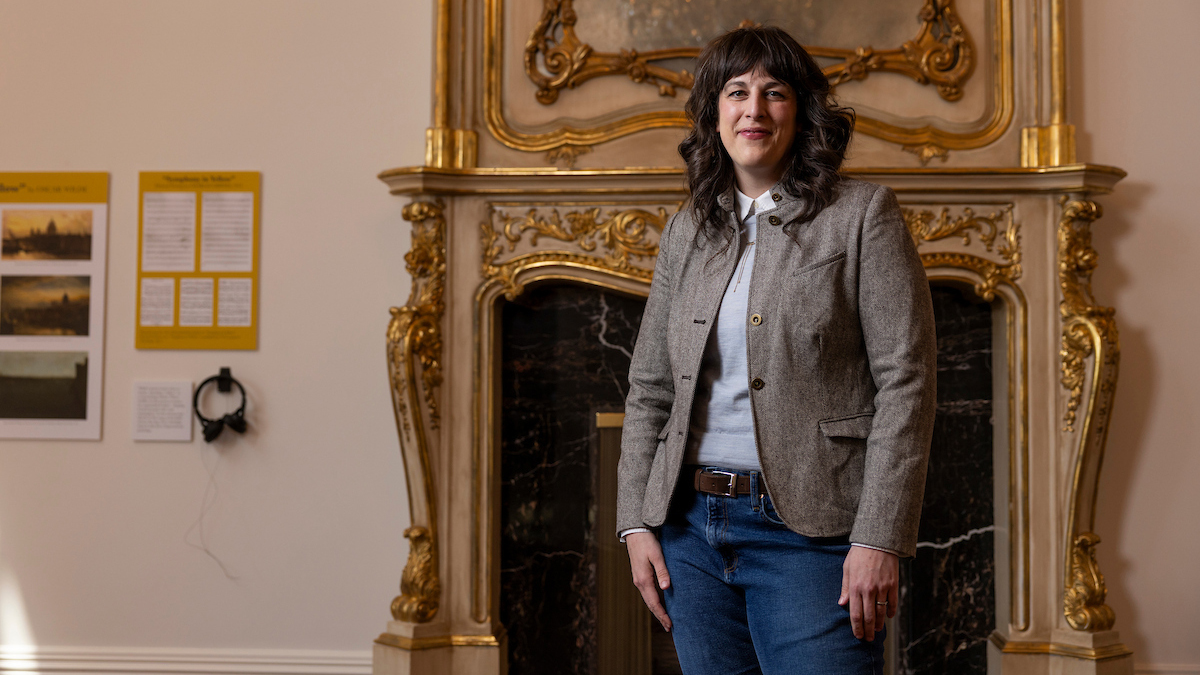
You may not know what it’s like to hear colors or see sounds. But an exhibit curated by Utah Valley University English professor Zan Cammack might help you understand.
Cammack’s exhibit, entitled “Seeing Wilde Songs: Charles T. Griffes’ Synesthetic Musical Settings of Oscar Wilde’s Poetry,” is on display at the UVU Museum of Art at Lakemount through May 30, 2026. Focusing on the work of Irish poet Oscar Wilde and American composer Charles Tomlinson Griffes, the exhibition explores how poetry, music, and visual art intersect.
“Oscar Wilde's poetry uses a lot of colors. Specifically, yellow is a very prominent color for him when he's writing his impressionistic poetry,” Cammack said. “He describes a lot of his songs as impressions, which is an art reference, but he also describes them as things like a symphony.”
Griffes, meanwhile, was known for having a neurological experience called synesthesia, where the brain takes sensory input and processes it through seemingly unrelated senses — like seeing a specific color when hearing a specific sound.
“For example, when Griffes hears the note E flat, he sees yellow,” Cammack said. “Yellow is kind of a big motif in the exhibit, as well as with other elements of his work. So he puts a lot of Oscar Wilde's poems to musical settings. And both artists, I think, are drawing significantly from the impressionistic art movement as well, the idea that we're trying to just capture moments of a feeling or expression and things like that. So the exhibit is intended to really combine those major sensory experiences.”
Visitors to the UVU exhibit can read the poetry, see the art that visually represents what the poem is talking about, and then listen to the music Griffes wrote for the poems, combining multiple mediums to give an idea of the experience of synesthesia.
Cammack said she’s had students tell her, upon hearing about the concept of synesthesia in class, that they experience it too, but didn’t know what it was called.
“If that's not something that you experience, it sounds metaphorical, but for some people it's a very literal neurological situation that's happening,” she said. “It’s very cool to have been able to go and do research in Griffes's archives and his manuscripts to have him actually, in his own words, say, ‘An E-flat is a gold color, or a C major chord is the most bright, incandescent white light.’ And it's not a metaphor, it's a very literal experience for him.”
Cammack said she’s been working on this project for a few years, but this was her first opportunity to turn it into a full museum exhibit, partnering with UVU Museum of Art Director Emily Johnsen.
“As an English professor, I am not used to doing [this kind of work] in a museum context,” Cammack said. “So it was a really interesting and unique challenge.”
Cammack said it was important to her that the exhibit allow for a more personal experience rather than overwhelming visitors with information.
“People don't necessarily always want the info dump when they go to an art museum,” she said. “They want to just be able to feel free to experience it however feels authentic to them. So I was trying to peel back the layers of my really nerdy interest in this and say, you're allowed to come here and feel whatever sensory experiences you're getting with all of these interesting intersections.”
While Oscar Wilde is often thought of as an English writer, he was actually born Irish; his original name was Oscar Fingal O’Fflahertie Wills Wilde. Cammack specializes in Irish studies, and she wanted to combine that focus with her interest in music to curate the exhibit.
“I was raised in a very musical family. I'm not a musician myself, but I'm just knowledgeable enough with music to be kind of somewhat dangerous,” Cammack said. “And so it was kind of that intersection of the words of the poetry but also the beauty of the songs that really draws me in.”
Cammack said it’s important to break down barriers in the arts and the humanities, making them accessible to the public. She co-hosts a podcast titled “The Thing About Austen,” exploring the people, culture, and history behind Jane Austen’s books. The show has more than 100 episodes and more than 1 million downloads.
“There's something really fun about making sure that we don't think of authors like Austen or Oscar Wilde as untouchable,” she said. “We put them on this high shelf or this pedestal. And it's like, no, they're very approachable. I mean, there's a reason that we love them. There's a reason that we come back to them.
“I think people want to be able to feel like they understand these cool artistic things […] without feeling like they're being condescended to, without feeling like you have to have special knowledge to appreciate it.”
“Seeing Wilde Songs” is on display at the UVU Museum of Art at Lakemount through May 30, 2026. For more information, visit the Museum of Art website.

