2026-2027 Honors Admissions Essay Prompt Options: New Applicants
The UVU Honors Program seeks students who are creative, reflective, and capable of
thinking beyond traditional boundaries. We want to know who you are, what motivates
you, and how you think. To help us see beyond your grades and accomplishments, we
ask you to engage in composing an innovative response to one of our prompts. We are
seeking students who display evidence of curiosity, innovative thinking, and potential
for intellectual and personal growth.
Your response will be evaluated on the focus, originality, and creativity of the content,
but spelling, grammar, and punctuation matter, too.
DO:
- Draw on your best qualities as a writer and thinker
- Strive to be an effective storyteller or communicator
- Take some risks and have fun
- Have someone with experience proofread your writing
- Carefully remove typos, clichéd phrasing, and unclear ideas
DON’T:
- Let anyone erase your unique voice
- Share your darkest thoughts, experiences, fears, or desires
- Preach or lecture
- Plagiarize or use generative AI like ChatGPT to prepare your responses Essay responses
are limited to 300-400 words.
Prompts, Choose ONE:
A. Imagine the scenario: You’ve struck a deal with the UVU Honors Director that guarantees your admission
to the program.
- Understand the task: You must use a blank, 8.5” x 11” piece of paper or document to create something
using any medium you choose—drawing, writing, sketching, photographing, collaging,
shading, stenciling, or You are limited to one side of the paper or a single page
of a digital document. Please note that AI-generated art pieces are not acceptable,
although the use of programs like Adobe Creative Cloud is acceptable.
- Consider the catch: For the rest of your life, your creation will be the first thing anyone sees when
they meet you. Whether it’s a job interview, a first date, or your first graduate
class, people will see this page before you even speak and form their first impression
based on it.
- Create your submission: Keep in mind that it will be the defining first impression of you.
- Submit your page as a PDF: After completing your creation, attach it (including the image) as a PDF to your
application.
- Explain your creation: Along with your submission, provide an explanation of what’s on the page and why
you chose to create it. If your piece is largely or exclusively visual, you may include
a separate creator’s statement of no more than 200 words explaining its meaning.
B. The scenario: Author Susan Sontag wrote in 1967’s The Aesthetics of Silence that “[s]ilence remains,
inescapably, a form of speech.” Write about a situation when you remained silent and
explain how silence may speak in ways that you did or did not intend.
- To respond to this prompt, you will submit both a written statement and a supporting
visual that shows you as a participant in the group, class, team, relationship, etc. where
you chose not to speak up.
- Understand the task: Drawing from your formal and informal educational experiences (school, travel, job,
faith community, volunteer service, leadership roles, athletics or arts participation,
etc.), assess the truth (or falsity) of Sontag’s statement using a specific experience that
you have had with remaining silent.
- Create your submission: Compose and revise your 300-400 word response, being certain to discuss how silence
impacted your life.
- Submit your response as a PDF: After completing the response and choosing the image, attach them as a PDF to your
application.
C. Imagine the scenario: You are a professional photographer like Chris Jordan exploring New Orleans in the
aftermath of Hurricane Katrina in Near two thousand people died and tens of thousands
displaced by flooding. You snap this image of the piles of ruined books in a neighborhood.
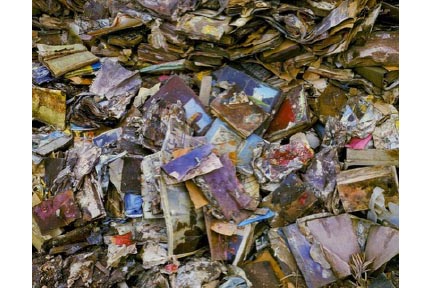
Photo credit: Chris Jordan, In Katrina’s Wake. Princeton Architectural Press, 2006.
- Understand the task: What did you want to say with this image of books outside a flooded home in New Orleans
in 2005? You may take any approach or perspective you like in explaining the photograph. That
is, you could tell an imagined story based on the photo, look at it as a piece of
visual art, or you may explore it as a commentary on the economic, political, cultural,
social, or environmental meanings it might convey.
- Consider the catch: You must stay in the persona of a photographer as you explore the potential meaning(s)
of the image. Artists convey complex observations about the world, so exercise your
analytical capabilities.
- Create your submission: Compose and revise your 300-400 word response.
- Submit your response as a PDF: After completing the response, attach it as a PDF to your application.

